

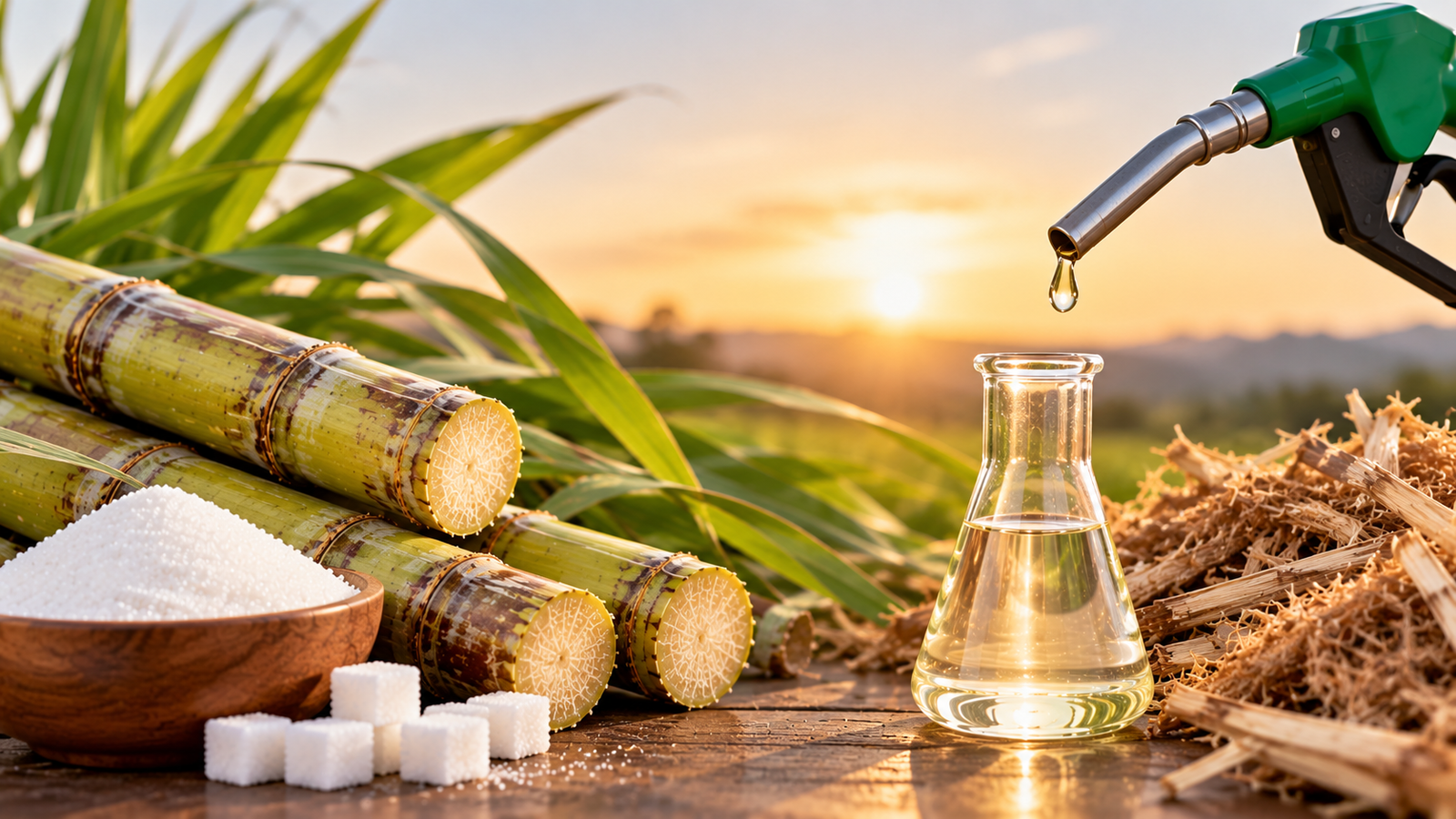
India’s ethanol programme is about to lose one of its oldest feedstocks. According to multiple media reports in October 2026, the Centre is expected to stop sugar mills from making ethanol out of sugarcane juice, sugar syrup and B-heavy molasses for the 2026-27 Ethanol Supply Year (ESY), which starts on 1 November.
The reason is simple: sugar output has fallen short, and the government wants enough sugar on the shelves. But any limit on sugar diversion for ethanol raises a harder question. If cane can’t be counted on, and grain is already pushing up feed and food prices, where will the next litre of ethanol come from?
This article explains what the expected restriction covers, how much ethanol is at stake, and why second-generation (2G) ethanol made from crop residue has moved from a long-term ambition to a practical necessity for keeping India at E20 and beyond.
What the Government Is Expected to Restrict in 2026-27
Reports by the Times of India, ChiniMandi and others say the restriction will cover three cane-based routes to ethanol:
- Sugarcane juice and sugar syrup: fermented directly into ethanol, with no sugar produced
- B-heavy molasses: a by-product taken out of the sugar process early, while it still contains a lot of recoverable sugar
- The sugar that would otherwise be made from both
Mills would still be allowed to use C-heavy molasses, the final by-product left after as much sugar as possible has been extracted. Grain-based ethanol from maize and rice would be expected to make up the rest.
At the time of writing, the restriction was reported as expected rather than notified. Readers should check the final government order for the exact terms.
This has happened before
India has done this once already. On 7 December 2023, the government banned the use of sugarcane juice and syrup for ethanol in ESY 2023-24. About a week later, it revised the order to allow both juice and B-heavy molasses, within an overall cap of 17 lakh tonnes of sugar diverted. The pattern is clear: when the cane crop falls short, ethanol is the first use to be cut.
Why Sugar Diversion for Ethanol Is Being Stopped
The numbers for the 2025-26 sugar season (October–September), as reported by ChiniMandi, show why the government is worried:
| Indicator | Reported figure |
| Initial 2025-26 production estimate | ~343 lakh tonnes |
| Revised estimate (August 2026, including sugar diverted to ethanol) | ~306 lakh tonnes |
| Sugar diverted to ethanol in 2025-26 | ~30 lakh tonnes (close to 10% of output) |
| Net sugar production | ~279 lakh tonnes |
| Domestic consumption | ~280–285 lakh tonnes |
| Opening stock, 1 October 2026 | ~37.5 lakh tonnes (vs ~50 lakh tonnes a year earlier) |
Crop disease, waterlogging and bad weather in Maharashtra and Karnataka cut cane yields. Net production now roughly matches consumption, and opening stocks are about a quarter lower than last year, so the government has little room to spare. Stopping sugar diversion for ethanol is the quickest way to keep more sugar in the domestic market.
Will India’s Ethanol Blending Target Survive?
India reached 20% ethanol blending in petrol in 2025, five years ahead of the 2030 target set under the National Policy on Biofuels. Petroleum Minister Hardeep Singh Puri announced the milestone in July 2025. Holding that level needs more than 1,000 crore litres of ethanol a year.
How much ethanol is at stake
For ESY 2025-26, oil marketing companies (OMCs) allocated about 1,048 crore litres of ethanol in the first tender cycle. The breakdown, as reported by BioEnergy Times in October 2025:
| Feedstock | Share of allocation | Approx. volume |
| Maize | 45.68% | ~478.9 crore litres |
| FCI rice | 22.25% | ~233.3 crore litres |
| Sugarcane juice | 15.82% | ~165.9 crore litres |
| B-heavy molasses | 10.54% | ~110.5 crore litres |
| Damaged food grains | 4.54% | ~47.6 crore litres |
| C-heavy molasses | 1.16% | ~12.2 crore litres |
Cane juice and B-heavy molasses together made up about 26% of that allocation, roughly 276 crore litres. That’s the volume a full restriction would affect.
A note on differing figures: other estimates put cane’s share of ethanol supply anywhere from about 25% to 33%. Reports also say grain now provides “nearly three-fourths” of India’s ethanol. The numbers differ because some count tender allocations and some count actual deliveries, and because they cover different parts of the year. Whichever number you use, about a quarter or more of India’s ethanol has come from cane.
On paper, grain can fill the gap
Capacity isn’t the bottleneck. For ESY 2025-26, manufacturers offered OMCs about 1,776 crore litres against a requirement of around 1,050 crore litres. Many distilleries can run on grain, and the reports suggest more maize and rice ethanol can keep blending at 20%.
The real constraint is feedstock, and that’s where grain has its own problems.
The Grain Problem: Food, Feed and Prices
Moving ethanol away from sugar mostly moves the pressure onto maize and rice.
- Maize use for ethanol has climbed sharply. In a Lok Sabha reply in July 2026, the Ministry of Consumer Affairs, Food and Public Distribution said 131.1 lakh tonnes of maize went to ethanol in ESY 2024-25, up from 75.4 lakh tonnes in 2023-24.
- FCI rice is going to ethanol too. The same reply said 44.2 lakh tonnes of surplus FCI rice was supplied for ethanol up to 30 June in ESY 2025-26. The ministry said this happens only after food security and buffer stock needs are met.
- Feed prices are rising. Business Today reported in September 2026 that wholesale maize was around ₹27 per kg, more than 30% higher than in May–June. Maize makes up about 55% of poultry feed by weight, and wholesale egg prices in Delhi were reported to be sharply higher than a year earlier.
- Supply may tighten. The same report cited the US Department of Agriculture’s expectation that India’s maize production could fall by around 10% in 2026-27.
Our analysis: using more grain to make up for cane works as a short-term fix, but it simply swaps a sugar-versus-fuel trade-off for a feed-versus-fuel one. When a feedstock competes with food or feed, policymakers will cut it during a shortage. Cane has now shown this twice in three years. Grain could be next.
Why 2G Ethanol Is the Need of the Hour
Second-generation (2G) ethanol is made from lignocellulosic biomass: rice straw, wheat straw, bagasse, corn cobs, bamboo and other residues that people don’t eat. Here’s why it matters more after this restriction.
1. It breaks the food-versus-fuel link
Crop residue is left over after the grain or cane has been harvested. Using it for ethanol doesn’t take sugar off the shelf or maize out of a poultry farm. That makes 2G ethanol the one feedstock route that a sugar or grain shortage can’t shut down.
2. It gives ethanol supply some protection from bad monsoons
A drought or flood that hits cane or maize hurts sugar and ethanol at once. Residue supply still varies with the harvest, but it isn’t fought over the same way. A weak cane year leaves food supply and the blending programme in conflict. A residue-based supply avoids most of that.
3. Sugar mills already have a 2G feedstock: bagasse
When juice and B-heavy molasses are restricted, mill distilleries can sit idle. Bagasse, the fibre left after crushing, is already on site. In August 2024 the Union Cabinet amended the Pradhan Mantri JI-VAN Yojana, extended it to 2028-29, and opened it to bolt-on and brownfield projects using agricultural residue and other lignocellulosic feedstocks. Adding 2G units to existing mills could keep that distillery capacity busy without touching sugar.
4. It turns a pollution problem into fuel
Paddy straw is burnt across north India every autumn because farmers have a short window before sowing wheat. IOCL’s Panipat 2G plant was designed to use about 2 lakh tonnes of rice straw a year to produce roughly 3 crore litres of ethanol. That gives farmers a buyer for straw they would otherwise burn.
Where India’s 2G Ethanol Programme Stands in 2026
Progress is real but small:
| Plant | Operator | Feedstock | Status |
| Panipat, Haryana | IOCL | Rice straw | Dedicated to the nation, August 2022 (100 KLPD design) |
| Numaligarh, Assam | NRL | Bamboo | Inaugurated September 2025 (design: ~49,000 tonnes of ethanol a year) |
| Bargarh, Odisha | BPCL | Rice straw | 2G unit commissioned 19 March 2026 (30,000 KL/year design) |
| Bathinda, Punjab | HPCL | Agricultural residue | Reported as under construction in government statements in 2024 |
Our analysis: taken together, the three commissioned plants have a design capacity of roughly 12 crore litres a year (our own conversion of the Numaligarh tonnage). That’s less than 5% of the ~276 crore litres of juice and B-heavy molasses ethanol now at risk. Running at full capacity also takes time. An RTI response reported that the Bargarh complex produced just 76 KL of 2G ethanol in FY 2025-26, because the unit began operating only in the last days of the financial year.
So 2G ethanol can’t fill the 2026-27 gap. That’s the main reason to build it faster now. Each new cane or grain shortage will hit a blending programme that still relies almost entirely on food crops, unless non-food capacity is in place before the next shortage.
What Would Help 2G Ethanol Scale Faster
The suggestions below are our analysis, not existing government policy.
- Long-term offtake certainty: OMC contracts that run longer than one supply year, with separate pricing for 2G ethanol, would make new plants easier to finance.
- Biomass supply chains: baling, collection and storage networks so plants can run all year on residue that is harvested in a few weeks.
- Mill-level integration: pushing sugar mills to add bagasse-based 2G units under the amended JI-VAN scheme.
- By-product value: 2G biorefineries can recover co-products such as silica, gypsum and lignin, which improve plant economics.
- Feedstock-neutral targets: tracking how much ethanol comes from non-food feedstocks, alongside the overall blending percentage.
Conclusion
The expected halt on sugar diversion for ethanol is a sensible response to a short sugar year. Opening stocks are lower, net output roughly matches consumption, and the government doesn’t want sugar prices to rise. India can probably hold E20 in 2026-27 by using more maize and rice.
That fix has a cost, though. Grain-based ethanol is already raising feed costs and adding to demand on FCI rice, and maize output may fall. A blending programme built almost entirely on food crops will keep facing restrictions like this one whenever a harvest falls short.
2G ethanol is the way out of that cycle. India has the residue, the policy framework and the first working plants. What it needs now is speed: more plants, reliable biomass supply chains, and offtake terms that make 2G projects bankable. If India wants to keep blending high and to move towards E25 or E30 later, more of its ethanol needs to come from crop waste.
Frequently Asked Questions
Has India banned sugar diversion for ethanol in 2026-27?
As of early October 2026, multiple media reports said the Centre was expected to bar mills from using sugarcane juice, syrup and B-heavy molasses for ethanol in ESY 2026-27, starting 1 November. Check the official notification for final terms.
Why is the government restricting ethanol from sugarcane?
Sugar output in 2025-26 came in well below early estimates because of weather and crop problems in Maharashtra and Karnataka. Opening stocks have dropped to about 37.5 lakh tonnes, so the government wants to keep more sugar in the domestic market.
Will the restriction affect E20 petrol availability?
Reports suggest the 20% blending level can be kept by using more ethanol from maize, rice and C-heavy molasses, since distillery capacity is well above OMC demand. The pressure moves to grain supplies and prices instead.
What is the difference between B-heavy and C-heavy molasses?
B-heavy molasses is taken out of the sugar process earlier, so it still contains sugar that could have been recovered as sugar. C-heavy molasses is the final residue after maximum sugar extraction. That’s why C-heavy molasses is usually allowed even when diversion is restricted.
What is 2G ethanol and how is it different from 1G ethanol?
1G ethanol is made from food crops such as cane juice, molasses, maize or rice. 2G ethanol is made from non-food lignocellulosic biomass such as rice straw, bagasse or bamboo, so it doesn’t compete with food or feed.
How many 2G ethanol plants are operating in India?
Commercial 2G plants have been commissioned at Panipat (IOCL, 2022), Numaligarh (NRL, bamboo-based, 2025) and Bargarh (BPCL, 2026). HPCL’s Bathinda project was reported as under construction. The Pradhan Mantri JI-VAN Yojana has been extended to 2028-29 to support more projects.