

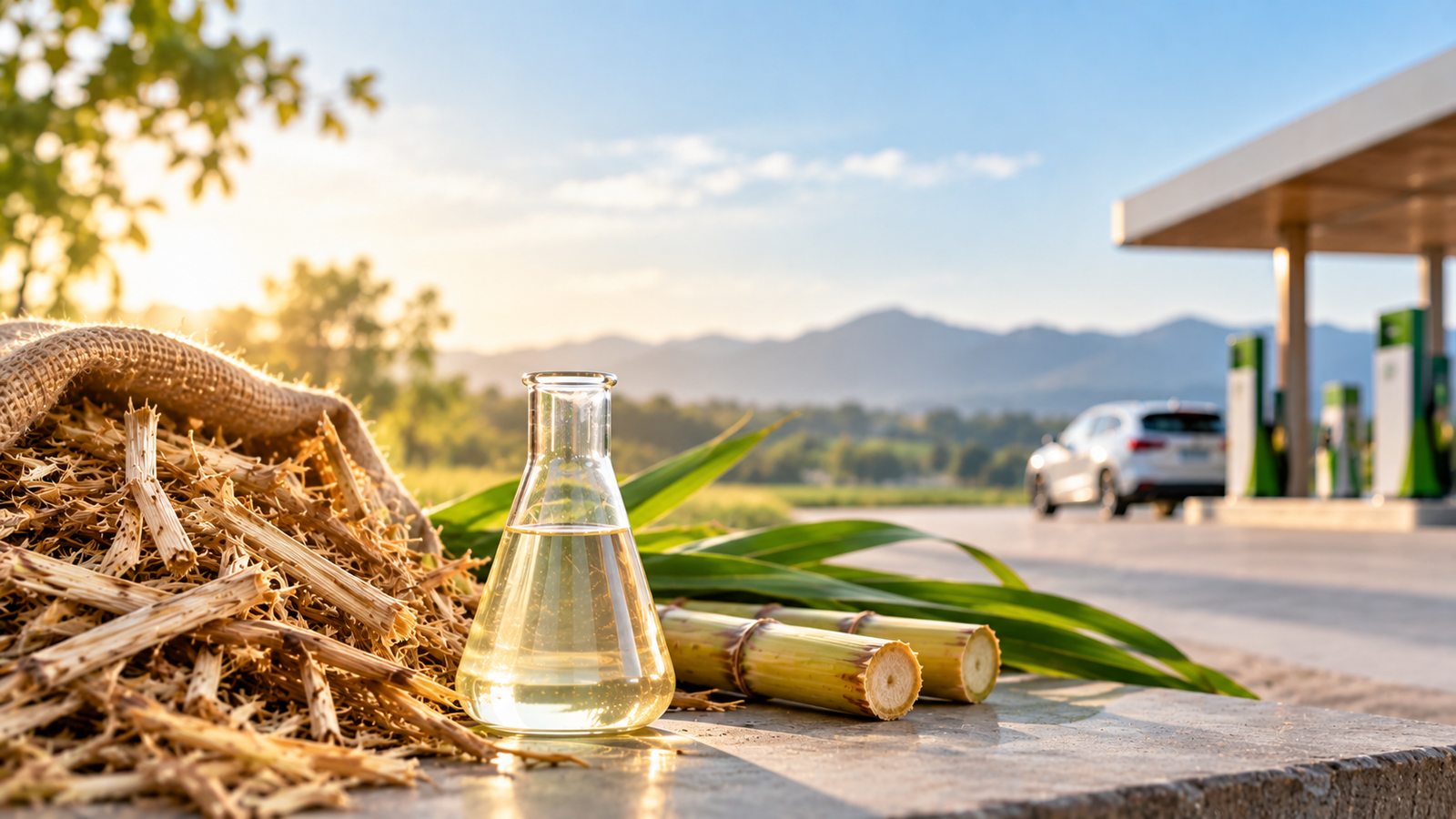
For years, India’s ethanol story has been told in one number: 20. E20 petrol, a blend of 20 percent ethanol, was the milestone the country worked towards. That number is now starting to look small. Union Road Transport and Highways Minister Nitin Gadkari is openly pushing for vehicles that need no petrol at all and run entirely on ethanol.
In late September 2026, Gadkari said he had been invited to the October launch of Toyota’s Innova flex-fuel vehicle, a car capable of running on 100 percent ethanol. He said its running cost would be equivalent to a petrol car using fuel priced at around Rs 25 a litre, and claimed the vehicle would generate 60 percent electricity while running, without elaborating. He made the remarks while responding to questions over the E20 policy, which has faced scrutiny in Parliament and on social media over mileage, engine performance and maintenance. Maruti Suzuki had already launched what it described as India’s first flex-fuel passenger car in June, and such vehicles can run on blends from E20 up to pure ethanol.
The pitch is not only about cars. At an event in Bhopal on 25 September, Gadkari said all automobile companies would prepare flex-fuel vehicles that can use ethanol as the sole fuel, that India spends around Rs 22 lakh crore a year importing petroleum products, and that the farmer is now an “urja data” (energy provider) as well as an “anna data” (food provider).
It is a compelling vision, but the launch announcements rarely answer the obvious question: if India moves towards 100 percent ethanol fuel, how much ethanol does that take, and where does it come from? This article works through the numbers, explains why first-generation (1G) ethanol made from food crops cannot carry an E100 transition, and shows why second-generation (2G) ethanol made from crop residue is the only pathway with the scale to get India there.
From E20 to E100: India’s Next Fuel Ambition
India’s Ethanol Blended Petrol programme took E20 from target to forecourt, and ethanol supply has grown faster than blending demand. The Grain Ethanol Manufacturers Association said in December 2025 that ethanol consumption had plateaued at around 1,200 crore litres even though the industry could supply about 1,500 crore litres. Gadkari himself put India’s annual ethanol procurement at around 1,500 crore litres from nearly 550 producers using sugarcane juice, molasses, rice and maize. Trade coverage this week has already referred to a 27 percent blending target.
That spare capacity is the commercial logic behind flex-fuel vehicles (FFVs), engines that can run on anything from petrol-ethanol blends to pure ethanol. Gadkari argues ethanol is used in 19 countries and says no complaints are coming from vehicles in India. The government has said it has not received widespread or confirmed complaints from manufacturers, automobile associations or consumer groups about E20’s effect on mileage, engine health or maintenance costs, citing laboratory studies and field trials.
| What has and hasn’t been announced. The references describe vehicle launches and ministerial statements: the Toyota Innova flex-fuel launch expected in October, Maruti Suzuki’s June flex-fuel car, and Gadkari’s statement that carmakers will build flex-fuel engines. None of them sets a nationwide E100 blending mandate, a rollout date, or a plan for where E100 will be sold. E100 today is a vehicle story. The fuel-supply story is still open. |
How Much Ethanol Would 100% Blending Actually Require?
The Ministry of Petroleum and Natural Gas estimated that about 1,016 crore litres (10.16 billion litres) of ethanol would be needed for 20 percent blending in 2025-26. That figure implies petrol demand of roughly 50 billion litres a year. From there, the scale of higher blends is simple arithmetic.
- By volume alone: E100 is five times the ethanol content of E20, so it needs about 51 billion litres a year. E85 is 4.25 times E20, or about 43 billion litres.
- Adjusted for energy content: ethanol’s calorific value is 30 to 35 percent lower than petrol’s, according to ARAI and industry officials speaking on E20. Brazil’s experience is that ethanol engines use about 25 percent more ethanol per mile than petrol engines use petrol. On that basis, replacing all petrol at today’s demand would take roughly 64 to 78 billion litres of ethanol.
| Blending level | Ethanol required annually | Where India stands |
| E20 (current) | ~10.2 billion litres for blending | Supply of ~15 billion litres a year is already available |
| E85 | ~43 billion litres (volume basis | No confirmed timeline |
| E100 (floor) | ~51 billion litres (volume basis) | Vehicles launching; supply pathway undecided |
| E100 (energy-adjusted) | ~64-78 billion litres | Ceiling case: every petrol vehicle flex-fuel, today’s demand |
These are our own calculations from the cited inputs, not official projections. They cover petrol demand at today’s level, ignore future growth, and assume every petrol vehicle is flex-fuel, so they are best read as the ceiling of the ambition. Even so, the gap is stark: E100 would need somewhere between 3.4 and 5.2 times the roughly 15 billion litres India procures today, and the current surplus of about 3 billion litres of unused capacity covers only a small slice of it.
Why 1G Ethanol Cannot Carry India to E100
India’s ethanol today comes overwhelmingly from 1G feedstocks: sugarcane juice, molasses, maize and rice. Down To Earth, citing the earlier planning for the 2025 blending target, reported that producing about 1,500 crore litres of ethanol would require diverting around 165 lakh tonnes of grain and 60 lakh tonnes of sugar, and that this route also raises the water footprint significantly.
Scale that up linearly to the E100 range of 51 to 78 billion litres, roughly 3.4 to 5.2 times, and the diversion becomes about 56 to 86 million tonnes of grain and 20 to 31 million tonnes of sugar every year. This is an illustration rather than a forecast, but for context India’s annual sugar production has recently been in the range of roughly 26 to 32 million tonnes. Diverting anything close to that is not a supply plan that food and sugar markets could absorb.
The strain is already visible at E20. Speaking in Bhopal, Gadkari said maize had earlier sold at around Rs 1,200 a quintal against an MSP of Rs 1,800, and that prices in Uttar Pradesh and Bihar rose to around Rs 2,600 a quintal after maize was increasingly used for ethanol. That is good news for farmers in the short run and evidence of how quickly ethanol demand moves food-crop prices. The same speech is revealing on strategy: “Country’s farmers will produce ethanol from maize,” he said. Maize-based ethanol is exactly the 1G route that cannot stretch to E100 volumes.
- Sugarcane is water- and land-intensive, and expanding it several-fold to fuel cars competes with food, sugar and irrigation needs.
- Maize is already pulled between food, feed and fuel, and ethanol demand is visibly lifting its price.
- Rice diversion draws political scrutiny because it competes with grain meant for food security.
1G ethanol got India to E20. It is not built to take India to E100 without reopening the food-versus-fuel debate at several times the scale.
2G Ethanol: The Only Realistic Path to E100 Scale
Second-generation ethanol is made from lignocellulosic biomass such as rice straw, wheat straw, bagasse and other crop residue, not from the harvested food crop. It is the only feedstock pool in India large enough to be discussed in the same breath as E100.
A TIFAC study with the Indian Agricultural Research Institute estimated that eleven selected crops generate about 683 million tonnes of dry biomass a year. About 178 million tonnes of that, 26 percent, is surplus after farmers’ own uses. The theoretical bioethanol potential of that surplus is 51.35 billion litres a year. Down To Earth separately notes that India generates about 500 million tonnes of agricultural waste a year, more than half of which is discarded or burned.
| The headline comparison. The theoretical 2G potential from surplus crop residue (~51 billion litres) is in the same range as the volume-basis E100 requirement (~51 billion litres). On paper, 2G is the only pathway that can approach E100. The next section explains why the practical number is lower. |
2G also solves a second problem. Much of the surplus is paddy straw burned in the fields of Punjab and Haryana each year, a major source of seasonal smog. Praj Industries estimated that the 32 million tonnes of residue burned in Punjab in a single season could have yielded about 6 billion litres of ethanol. Turning residue into fuel tackles ethanol supply and air quality with one feedstock stream, something 1G expansion cannot do.
Policy groundwork exists. The PM JI-VAN Yojana sanctioned Rs 1,969.5 crore of viability-gap support for commercial 2G projects, with twelve commercial and ten demonstration plants proposed. Indian Oil’s Panipat plant, unveiled in August 2022, is India’s first commercial-scale 2G ethanol biorefinery. It processes about 2 lakh tonnes of rice straw a year into roughly 3 crore litres of ethanol. Oil PSU refineries were also planned at Bathinda, Bargarh, Numaligarh and Davangere, according to a 2021 parliamentary reply.
The Reality Check: Technical Potential vs Ground Reality
The 51-billion-litre figure is a theoretical ceiling. It works out to about 288 litres per tonne of surplus residue, well above what India’s first commercial plant delivers. Panipat’s design output of about 3 crore litres from 2 lakh tonnes is around 150 litres per tonne. Praj Industries cites around 250 litres per tonne as typical for the technology. Applying those two yields to the 178 million tonnes of surplus gives roughly 27 to 45 billion litres, before any collection losses. Against an energy-adjusted E100 demand of 64 to 78 billion litres, that is between about a third and two-thirds of the requirement. It is enough to make 2G indispensable, not enough to make it painless.
The capital cost is the other constraint. Panipat cost over Rs 900 crore. Producing 30 billion litres at Panipat’s scale and cost would take about 1,000 such plants, roughly Rs 9 lakh crore. This is an illustrative extrapolation, and larger plants and learning effects should bring the cost per litre down. But it shows why the twelve commercial plants proposed under PM JI-VAN are a starting point, not a supply plan.
| Challenge | Why it limits 2G scale-up |
| Very little commercial output | GEMA’s president said in December 2025 that permission exists to export 2G ethanol but it is not being produced, so 2G output is negligible |
| High capital cost | Panipat cost over Rs 900 crore for about 3 crore litres a year, far more per litre than a conventional distillery. |
| Real yields below theory | Panipat’s ~150 litres per tonne compares with a theoretical ~288 litres per tonne across the surplus. |
| Fragmented biomass supply | Residue is bulky, seasonal and spread across millions of small farms, so year-round collection and storage need organised logistics. |
| Weak near-term incentive | With 1G capacity already ahead of demand, there is little commercial pressure to fund costlier 2G plants without stronger policy support. |
Are India’s Vehicles and Fuel Pumps Ready for E100?
Even with unlimited ethanol, E100 needs the right hardware. Brazil’s experience shows what flex-fuel engineering involves: replacing materials that ethanol corrodes, changing the amount of fuel injected, using sensors that adjust the engine to whatever blend is in the tank, and fitting a small auxiliary petrol tank to help cold starts. India will face the same engineering questions, particularly for cold-weather starting in the north.
On the fuel-retail side, none of the announcements say where E100 will be sold. Vehicles need dependable pumps, and pump operators and ethanol producers need confirmed vehicle demand. That chicken-and-egg problem has to be resolved alongside the supply problem.
Global Lessons: What Brazil Teaches India
Brazil is the reference case, and it offers encouragement and a warning. It ran dedicated ethanol cars in the 1980s, but pure-ethanol demand collapsed when supply was disrupted. Volkswagen’s Gol Total Flex arrived in March 2003 as the first commercial car able to run on any blend of petrol and ethanol, and flex-fuel adoption then moved fast. By 2005 flex cars were about half of new car sales, in August 2006 they were 62 percent, and today they account for over 90 percent of new light vehicles.
The speed came from price, not mandates. Flex cars did not cost more than conventional models, ethanol sold at between a third and half the price of petrol, and drivers chose fuel at the pump, typically switching to ethanol when it costs under about 70 percent of petrol. Brazil also blends around 27 percent ethanol in its standard petrol.
| Factor | Brazil | India (late 2026) |
| Vehicle technology | Flex-fuel since 2003; over 90% of new light vehicles | First flex-fuel launches in 2026 |
| What drove adoption | Price parity, no vehicle price premium, driver choice at the pump | Claimed Rs 25/litre-equivalent running cost; retail plan not announced |
| Feedstock | Sugarcane at large scale | Sugarcane, maize, rice; 2G negligible |
| Standard petrol blend | About E27 | E20 |
The lesson for India is that vehicle technology is not the hard part. Brazil’s vehicles took off in a couple of years once price and fuel availability lined up. India’s challenge is to build the fuel supply, at a competitive price, before the vehicles arrive in volume, and its feedstock base is more food-constrained than Brazil’s.
What India Needs to Do to Make E100 Work
The ambition currently outpaces the supply plan. Closing the gap requires vehicles, feedstock and fuel retail to move together.
- Scale up viability-gap funding and fast-track approvals for 2G plants well beyond the 12 commercial plants under PM JI-VAN.
- Build biomass aggregation networks, with collection centres, storage and long-term supply contracts with farmer groups.
- Cap how much of any higher-blend target can come from food-crop feedstocks, so E85 and E100 do not repeat the maize and sugar price pressure seen at E20.
- Sequence the rollout through intermediate blends and regional E100 pilots as 2G capacity comes online.
- Put E100 dispensing in place alongside confirmed flex-fuel vehicle volumes, so supply and demand scale together.
- Keep funding research that lowers 2G enzyme and process costs, since cost matters as much as feedstock availability.
Conclusion: A Bold Vision That Needs a Waste-First Supply Plan
The logic behind India’s flex-fuel push is real: it extends the energy-security and farmer-income case behind E20 and gives surplus ethanol capacity somewhere to go. The vehicles are arriving, with Toyota’s ethanol-capable Innova due in October and Maruti Suzuki’s flex-fuel car already launched.
But the numbers show that E100 means roughly 51 billion litres of ethanol a year at the very least, and likely 64 to 78 billion once ethanol’s lower energy content is counted. That is several times what India produces today. Feeding that through sugarcane, maize and rice would take tens of millions of tonnes of food crops and repeat, at several times the size, the price pressure already visible in maize. 1G ethanol cannot carry E100. Second-generation ethanol from crop residue is the only feedstock with anything like the required scale, with a theoretical potential of about 51 billion litres and a more realistic 27 to 45 billion at demonstrated yields. Whether India can turn that into delivered fuel depends on plants, biomass logistics and price, all still at an early stage. The cars may arrive in October. The waste-first fuel supply chain to run them at national scale still has to be built.
Frequently Asked Questions
1. Has India officially approved a 100% ethanol (E100) blending target?
No. The references describe flex-fuel launches and ministerial statements, not a nationwide E100 mandate or timeline. Gadkari has said carmakers will build flex-fuel vehicles that can run on ethanol alone.
2. How much ethanol would India need for E100?
At current petrol demand, about 51 billion litres a year by volume, and roughly 64 to 78 billion litres once ethanol’s 30 to 35 percent lower energy content is accounted for. E20 needs about 10.2 billion litres. These are estimates based on the ministry’s E20 figure, not official projections.
3. Does India produce enough ethanol for E100?
No. India procures about 1,500 crore litres (15 billion litres) a year, and consumption has plateaued around 1,200 crore litres. E100 would need roughly 3.4 to 5.2 times current procurement.
4. Why can’t sugarcane, rice and maize be scaled up for E100?
Scaling today’s grain and sugar diversion to E100 volumes would mean roughly 56 to 86 million tonnes of grain and 20 to 31 million tonnes of sugar a year, on top of the water demand. Maize prices have already risen sharply because of ethanol demand.
5. What is 2G ethanol and why is it the solution?
2G ethanol is made from crop residue such as paddy straw, wheat straw and bagasse rather than food crops. TIFAC estimates surplus residue of about 178 million tonnes could theoretically yield 51.35 billion litres a year, the only pool of that size.
6. Can 2G ethanol alone fully cover E100?
Not easily. At Panipat’s demonstrated yield the surplus residue gives about 27 billion litres, and at typical technology yields about 45 billion, against an energy-adjusted need of 64 to 78 billion. 2G must be the backbone, and rollout will likely be staged.
7. Which E100-capable vehicles are being launched?
Maruti Suzuki launched what it called India’s first flex-fuel passenger car in June 2026, and Toyota’s flex-fuel Innova, capable of running on 100 percent ethanol, is expected in October.
8. What would E100 cost to run?
Gadkari said the Innova’s running cost would equal that of a petrol car using fuel at about Rs 25 a litre. That is a ministerial claim, not an independently verified figure.
9. Is India’s 2G ethanol industry ready?
Not yet. Indian Oil’s Panipat plant is the first commercial facility, and GEMA’s president said in December 2025 that 2G ethanol production is negligible.
10. How does India compare with Brazil?
Brazil’s flex-fuel cars reached majority of new sales within about three years of launch, driven by price parity and no vehicle premium. India has the vehicle technology arriving but not yet the fuel supply or retail plan.