

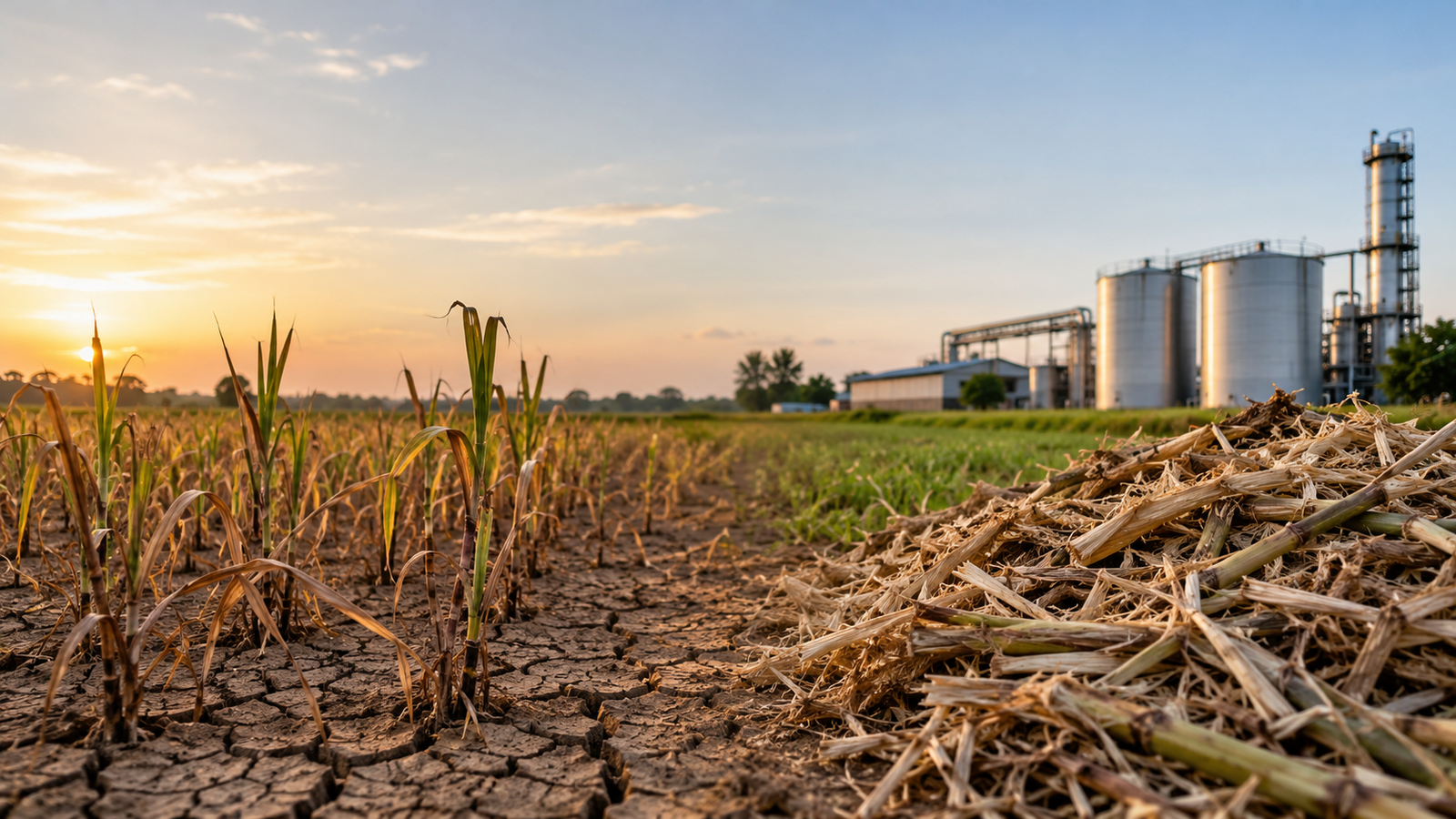
India’s ethanol programme runs on farm produce, so it is only as steady as the harvest. The 2026 monsoon has tested that. The India Meteorological Department (IMD) says rainfall from June to September came in at 87% of the long-period average under the impact of El Nino, the weakest season since 2015.
A few weeks later, the oil marketing companies’ (OMCs) tender for Ethanol Supply Year (ESY) 2026-27 set sugar diversion for ethanol at zero. It seeks no ethanol made from sugarcane juice, sugar, sugar syrup or B-heavy molasses.
El Nino isn’t the only reason for that decision. India’s sugar supply was already tight after a disease-hit 2025-26 crop. But the El Nino impact on ethanol is real, and it shows how exposed the programme is to weather. This article sets out what happened, why grain can’t carry the whole load, and where second-generation (2G) ethanol fits in.
What the 2026 Monsoon Data Shows
IMD’s end-of-season figures, as reported by Business Standard and The New Indian Express:
| Indicator (June–September 2026) | Figure |
| All-India rainfall | 759.4 mm against a normal of 868.6 mm (87.4% of the long-period average) |
| Rank | Fourth-lowest since 2001 and 13th-lowest since 1901; lowest since 2015 |
| South Peninsular India | 542 mm, 76% of normal (fourth-lowest since 1901) |
| East and Northeast India | 1,016.3 mm, 74% of normal (lowest since 1901) |
| Meteorological subdivisions | 17 of 36 deficient, covering 42% of India’s area |
| Monthly pattern | June 65%, July 101%, August 84%, September 92% of normal |
| Southern reservoirs (24 September) | 50% of live storage, against 79% nationally |
IMD’s end-of-season figures, as reported by Business Standard and The New Indian Express:IMD Director General Mrutyunjay Mohapatra said El Nino hit the southern and eastern parts of the country hardest. IMD expects El Nino to peak in November and weaken from March, and has forecast below-normal rainfall for October. The World Meteorological Organization has described El Nino as “firmly established”, and Down To Earth reported its forecasts give a near-100% chance that it lasts through February 2027.
The dry spell spread quickly. According to IIT Gandhinagar’s India Drought Monitor, cited by Down To Earth, about 52.5% of India’s area was under dry or drought conditions by 16 September 2026, up from 38.9% a month earlier.
The regional split matters for ethanol. Maharashtra and Karnataka, two of India’s largest cane-growing states, were among the worst affected, according to Agriculture Minister Shivraj Singh Chouhan.
How Weather Is Hitting Sugarcane
In a normal year, India produces about 320–340 lakh tonnes of sugar against domestic consumption of about 280–290 lakh tonnes, according to the government. That surplus is what made sugar-based ethanol possible. When the crop falls short, the surplus disappears.
India’s sugar problem started before El Nino. In a Press Information Bureau (PIB) release of 21 August 2026, the government said 2025-26 production fell to about 306 lakh tonnes, against an initial estimate of about 343 lakh tonnes. It blamed Red Rot and Top Borer disease and waterlogging from excess rain. Retail sugar rose from ₹48.18 per kg on 20 July 2026 to ₹55.70 per kg on 20 August. The government also pointed to festive demand, tighter global supply and hoarding.
Global prices are rising too. The same release said international sugar prices climbed from $474 per tonne on 30 June 2026 to $552 per tonne on 20 August, an increase of over 16%. It estimated the global sugar deficit for 2026-27 at around 33 lakh tonnes.
El Nino now threatens the next crop as well:
| Indicator | Earlier figure | Latest figure |
| Maharashtra sugar output, 2026-27 (state sugar commissionerate) | 102.5 lakh tonnes (Sept 2026 estimate) | 90.18 lakh tonnes (Oct 2026 estimate) |
| Maharashtra cane production | 1,316 lakh tonnes (2025-26) | ~1,127 lakh tonnes (2026-27 estimate) |
| Maharashtra average cane yield | 95 tonnes/hectare (2025-26) | 74 tonnes/hectare (2026-27 estimate) |
| India sugar output, 2026-27 (USDA forecast, raw value) | 33.6 million tonnes | 29.5 million tonnes |
| India cane output, 2026-27 (USDA forecast) | 455 million tonnes | 434 million tonnes |
These are estimates and may change as crushing gets under way. Taken together, though, they point to a second tight sugar year in a row.
What the government has done on sugar supply
Alongside the ethanol tender, the Centre has taken several steps to keep sugar available, according to the 21 August PIB release:
- A stock limit of 400 tonnes on sugar dealers from 1 August to 30 November 2026
- From 1 September, bulk consumers may not hold more than 15 days’ worth of sugar
- Duty-free import of 10 lakh tonnes of raw sugar
- Mills advised to start crushing from 15 October 2026, which the government expected to raise October output from the usual 3–4 lakh tonnes to more than 10 lakh tonnes
Sugar Diversion for Ethanol Set to Zero for 2026-27
The OMCs’ tender, dated 16 October 2026, covers supplies from 1 November 2026 to 31 October 2027 and seeks about 11 billion litres (1,100 crore litres) of ethanol. According to Reuters and other outlets, the tender document says sugar diversion for ethanol is to be reduced to zero for the year.
| Excluded from the tender | Still eligible |
| Sugarcane juice Sugar and sugar syrup B-heavy molasses | Maize Broken rice and surplus FCI rice C-heavy molasses |
C-heavy molasses stays in because it is the final by-product left after as much sugar as possible has been extracted. The decision applies to this supply year. It isn’t a permanent end to sugar-based ethanol.
India has done something similar before. In December 2023, the government banned cane juice for ethanol and then allowed limited use under a 17 lakh tonne cap on diverted sugar. This year the cut is total.
Distillery capacity isn’t the problem. For ESY 2025-26, manufacturers offered OMCs about 1,776 crore litres of ethanol against a requirement of around 1,050 crore litres. The limit is feedstock, not plants.
Why Grain-Based Ethanol Can’t Be the Only Backup
Grain already supplies most of India’s ethanol. The PIB release of 21 August 2026 said nearly three-fourths now comes from grain, mainly maize, and that the share of sugar diverted to ethanol fell from about 12% in 2022-23 to about 9% in 2025-26. In a Lok Sabha reply in July 2026, the food ministry said 131.1 lakh tonnes of maize went to ethanol in ESY 2024-25, up from 75.4 lakh tonnes in 2023-24.
Grain is under pressure of its own:
- Sowing: overall kharif sowing was only about 1.2% below last year as of 25 September, but paddy, cotton and maize were affected. The Agriculture Minister said paddy area was down by about 16.32 lakh hectares.
- Foodgrain target: the government set its 2026-27 foodgrain target at 373.93 million tonnes, about 2.63 million tonnes below the estimated 2025-26 output, citing El Nino.
- Prices: Business Today reported in September 2026 that wholesale maize was around ₹27 per kg, more than 30% higher than in May–June, as poultry feed costs climbed.
- Tender pricing: the 2026-27 tender also cut the maize ethanol procurement price from ₹71.86 to ₹68.86 per litre, reducing the maize incentive from ₹5.79 to ₹2.79 per litre, according to reports on the tender.
A weak monsoon doesn’t cut every grain crop by the same amount. Results differ by crop, region and irrigation. The wider point is that relying on a narrow set of food crops leaves the programme exposed whenever harvests or prices move the wrong way.
Why Steady Ethanol Supply Matters
The stakes are high. According to the Ministry of Petroleum and Natural Gas (PIB, 23 July 2026), the Ethanol Blended Petrol Programme has so far:
- Saved over ₹1.97 lakh crore in foreign exchange
- Replaced nearly 316 lakh tonnes of crude oil
- Cut around 952 lakh tonnes of CO₂ emissions
- Transferred over ₹1.66 lakh crore to farmers
Every weather shock that cuts feedstock puts some of those gains at risk. That is why the source of the next litre matters as much as the blending target.
How 2G Ethanol Can Help Diversify Supply
2G ethanol is made from lignocellulosic biomass, the parts of plants people don’t eat, such as rice straw, wheat straw, bagasse, corn cobs and bamboo. It isn’t a drought-proof replacement for grain or sugar ethanol. It can make the supply mix more resilient in four ways.
1. It uses non-food plant material
First-generation (1G) ethanol uses sugar or starch. 2G ethanol converts residue left after the food crop has been harvested. That reduces direct competition with food, as long as residue is collected sustainably and isn’t needed for a more important use.
2. It spreads risk across crops, seasons and regions
Residue comes from different crops and harvests: paddy straw after kharif, wheat straw after rabi, bagasse during crushing and bamboo in the Northeast. Drawing on several of these reduces dependence on one crop or one belt. It doesn’t remove weather risk, because drought also reduces residue, and straw is used for fodder and soil cover too. Plants need sound feedstock assessments and supply contracts.
3. It gives farmers a market for residue
Where straw would otherwise be burnt or left unused, selling it to an ethanol plant adds income for farmers and local aggregators. IOCL’s Panipat plant, for example, was designed to use about 2 lakh tonnes of rice straw a year to make roughly 3 crore litres of ethanol. How much farmers gain depends on collection costs, transport distance, storage losses and the price paid. Taking too much residue off fields can also hurt soil health, so removal limits matter.
4. It can build on existing industrial sites
Since August 2024, the amended Pradhan Mantri JI-VAN Yojana has supported 2G projects, including bolt-on and brownfield units, until 2028-29. Sugar mills with distilleries are one possible home, since they now face idle capacity when juice and B-heavy molasses are excluded. But bagasse already fuels boilers and power plants at most mills, so only genuinely surplus biomass should be counted.
What Could Help 2G Ethanol Scale Responsibly
The following are our recommendations, not existing government policy.
- Plan feedstock first: map residue availability, competing uses, collection costs and sustainable removal limits before approving capacity.
- Strengthen collection and storage: support baling, aggregation and covered storage to bridge seasonal gaps and cut losses.
- Offer longer offtake contracts: multi-year purchase agreements would make 2G projects easier to finance than one-year tenders.
- Integrate where it fits: assess whether sugar mills and other sites have suitable utilities and genuinely surplus biomass.
- Report ethanol by feedstock: publish volumes by feedstock so the programme’s resilience can be measured.
- Protect food and soil: make sure biomass use doesn’t undermine fodder supply, soil health or local livelihoods.
What This Means for India’s E20 Programme
India has kept blending rising year after year. According to the Ministry of Petroleum and Natural Gas (PIB, 23 July 2026):
| Ethanol Supply Year | Average blending |
| 2022-23 | ~12% |
| 2023-24 | ~14.6% |
| 2024-25 | ~19.2% |
| 2025-26 (November–June) | 20% |
The same release said no decision has been taken to raise nationwide blending beyond E20, and that any change would follow scientific studies and consultation with industry. E85 has been introduced only for certified flex-fuel vehicles. The Bureau of Indian Standards has notified standards for E22–E30 blends, effective 15 May 2026, but those standards are not a nationwide rollout.
For 2026-27, grain ethanol and C-heavy molasses are expected to keep E20 supplied. 2G ethanol can add another route over time. How large and how soon depends on verified production, feedstock logistics and project economics.
Conclusion
The 2026 monsoon ended well below normal, El Nino hit the south and east hardest, and the 2026-27 ethanol tender has shut out sugar-based feedstocks except C-heavy molasses. El Nino doesn’t explain every crop or price change, since disease and excess rain had already cut the 2025-26 sugar crop. But together these events show how closely ethanol supply is tied to weather and food markets.
2G ethanol offers a way to widen the feedstock base using residue rather than food. It isn’t a single, guaranteed fix: residue supply also depends on the weather, biomass has other uses, and scaling up needs reliable technology, logistics and economics. A more resilient ethanol programme will combine feedstock diversity with transparent data, sustainable biomass practices and a firm eye on food security. Building 2G capacity now is how India prepares for the next El Nino.
Frequently Asked Questions
How does El Nino affect ethanol production in India?
El Nino usually weakens India’s monsoon, which can cut yields of sugarcane, rice and maize, the main ethanol feedstocks. In 2026, IMD said the 13% rainfall shortfall was under the impact of El Nino. The effect varies by region and crop, and other factors such as disease also shape production.
Has India stopped sugar diversion for ethanol in 2026-27?
Yes, for this supply year. The OMC tender dated 16 October 2026 seeks no ethanol from sugarcane juice, sugar, sugar syrup or B-heavy molasses for November 2026 to October 2027. C-heavy molasses, maize and rice remain eligible.
How weak was India’s 2026 monsoon?
IMD recorded 759.4 mm from June to September against a normal of 868.6 mm, or 87.4% of the long-period average. It was the fourth-lowest since 2001 and the weakest since 2015.
Why did sugar prices rise in 2026?
The government cited lower 2025-26 production caused by disease and waterlogging, festive demand, tighter global supply and hoarding. It said ethanol diversion was not the cause, since the share of sugar diverted had fallen to about 9%.
What is C-heavy molasses, and why is it still allowed?
C-heavy molasses is the final by-product of sugar making, left after as much sugar as possible has been extracted. Using it for ethanol doesn’t reduce sugar output, which is why the 2026-27 tender still accepts it.
Will E20 petrol still be available?
Yes. Average blending was 20% in November 2025–June 2026, and the 2026-27 tender seeks about 11 billion litres from grain and C-heavy molasses to maintain supply.
Is 2G ethanol unaffected by drought?
No. Drought can reduce crop residue too. But because residue comes from many crops, seasons and regions, and doesn’t compete directly with food, 2G ethanol can reduce the programme’s concentration risk.
Which 2G ethanol plants are operating in India?
IOCL’s Panipat plant (rice straw, 2022), NRL’s bamboo-based biorefinery at Numaligarh (inaugurated 2025) and BPCL’s Bargarh plant (rice straw, 2026). The Pradhan Mantri JI-VAN Yojana supports further projects until 2028-29.
Is India moving to E25 or E27 nationwide?
Not yet. As of July 2026, the government said no decision had been taken to raise blending beyond E20. Fuel standards for E22–E30 have been notified, but that doesn’t mean a nationwide rollout.