International Ozone Day

What is an Ozone Layer?

The ozone layer works as a protective screen, absorbing UV rays from the sun, commonly represented as O3 and comprises three oxygen atoms. This layer is located between 15 to 30 kilometres above the Earth’s surface in the stratosphere. It produces natural UV light from the sun, reacting with molecular oxygen (O2). However, in a nutshell, we could say that ozone serves as a layer that shields harmful rays and pollutants.

Causes and effects of Ozone layer depletion

Several regularly used compounds have been discovered to be particularly harmful to the ozone layer. Halocarbons are compounds with one or more carbon atoms bonded to halogen atoms (fluorine, chlorine, bromine or iodine). Bromine-containing halocarbons typically have a substantially higher ozone-depleting potential (ODP) than chlorine-containing halocarbons. The artificial substances that have provided the majority of the chlorine and bromine for ozone depletion are methyl bromide, methyl chloroform, carbon tetrachloride, and the halons, chlorofluorocarbons (CFCs), and hydrochlorofluorocarbons families of chemicals (HCFCs).

Depletion of stratospheric ozone occurs over both hemispheres of the Earth. However, this phenomenon is less severe in the northern hemisphere (Arctic) than in the southern hemisphere (Antarctica). This is because meteorological variability is more significant over the Arctic than in the Antarctic year-to-year. Furthermore, temperatures in the stratosphere do not remain low for a long time in the Arctic, as in the case in the Antarctic.

The concentration levels of 220 Dobson Units (DU) or less (in blue in the figure) show severe ozone depletion and develop “ozone hole”. Basically, It is an area or a region of significant ozone layer thinning in high latitudes, primarily in winter, caused by the chemical action of CFCs and other atmospheric contaminants. This is only apparent in the southern hemisphere. Here, the most significant historical extent of the ozone hole – 28.4 million km2– occurred in September 2000. This area is equivalent to almost seven times the territory of the European Union (EU).

Maximum ozone hole extent over the southern hemisphere (1979-2021)

Preservation of the Ozone Layer

Hazardous chemicals emitted through aerosol sprays, refrigerants, solvents, propellants, foam-blowing agents, and other sources cause ozone layer depletion. UV radiations break down chlorofluorocarbon molecules in the stratosphere, releasing chlorine atoms. The influence of radiative forcing on the climate increases as greenhouse gas concentrations rise. The breakdown of stratospheric ozone by substances such as chlorine radicals increases UV radiation at the terrestrial level. These distinct occurrences are part of a more prominent family of global environmental changes. Scientists claim that in the early 1970s, stratospheric ozone levels in the polar regions began to decline. But the ozone’s condition has improved, according to a 2018 “Ozone Depletion Factor” measurement. Also, some of the climate change is now slowed down by continuous efforts.

World Ozone Day

Ozone Day aims to achieve the objectives of the Montreal Protocol and its amendments and promote public awareness about the importance of protecting the Ozone Layer from depletion. The ozone layer protects us from the sun’s ultraviolet radiation (UV rays). The Montreal Protocol forbids the use of substances that weaken the ozone layer with the long-term goal of eliminating them in light of new scientific and technological knowledge. Its structure is based on many categories of ozone-depleting chemicals. Nearly 100 substances across various types must be under control according to the Protocol. The Treaty lays out a timeline for phasing out the production and consumption of each class or annexe of chemicals to eliminate them.

Montreal Protocol (2022)

When the Montreal Protocol was signed in 1987, all 197 members of the United Nations voted in favour of it. The Canadian city of Montreal typically plans several special events, lectures, and seminars on September 16 every year. The United Nations General Assembly (UNGA) established International Day for preserving the Ozone Layer in 1994. The day’s primary goal is to raise awareness about the Ozone Layer’s depletion and to look for ways to protect it. On September 16th, people from all over the world will gather in Montreal to attend the speeches and seminars. Educators frequently set aside this day to teach their pupils about the Ozone layer, and many schools organise special events and activities to increase awareness.

The Montreal Protocol@35: The theme of the 2022 International Day for the Preservation of the Ozone Layer, which will be held on September 16th, is global cooperation to protect life on Earth. The theme recognises the Montreal Protocol’s broader impact on global warming and the need to act in harmony, form partnerships, and develop international collaboration to solve climate challenges and protect life on Earth for future generations.

Why is Ozone Day Important?

The ozone layer preserves life on Earth by absorbing harmful UV radiation, which is essential for life to exist on this planet. The ozone layer protects us from the sun’s ultraviolet radiation (UV rays). UV radiation from the sun causes cataracts, blindness, a weakened immune system, skin ageing, and other health issues. Direct UV radiation exposure in animals and humans promotes skin and eye cancer. UV-B rays also cause crop damage. UV-B exposure has a significant influence on plankton and zooplankton and a decrease in plant productivity which has an impact on soil erosion and the carbon cycle. Reduced plant growth, smaller leaf size, decreased blooming and photosynthesis, and lower crop quality.

How can we prevent ozone layer depletion

Here are some steps which each of us can put forward to protect the ozone layer from depletion :-

  • Consume ozone-depleting gases as little as possible.
  • Avoid burning plastics and rubber materials, which emit toxic fumes into the environment.
  • Reduce the use of smoke-emitting automobiles.
  • Try to replace hazardous cleaning products, cosmetics, hair spray, air fresheners, and other household products with non-toxic alternatives.
  • Encourage gardening and plantation to lower the risk of harmful pollutants in the atmosphere.
  • Maintain air conditioners as their malfunctioning generates CFC production.
  • Raise awareness on World Ozone Day about the significance of keeping our environment safe and healthy to protect the ozone layer.

Global warming

Why the world is now warming faster

Global warming occurs when carbon dioxide (CO2) and other air pollutants gather in the atmosphere trapping sunlight and solar radiation that has bounced off the earth’s surface. Usually, this radiation would escape into space. However, these pollutants linger in the atmosphere for centuries—trapping heat that causes the planet to heat up. Pollutants called greenhouse gases are responsible for trapping the heat from the atmosphere. Thus, the impact that contributes to these gases is the ” Greenhouse Effect”. Carbon dioxide, methane, nitrous oxide, and synthetic fluorinated gases are primary pollutants in the process.

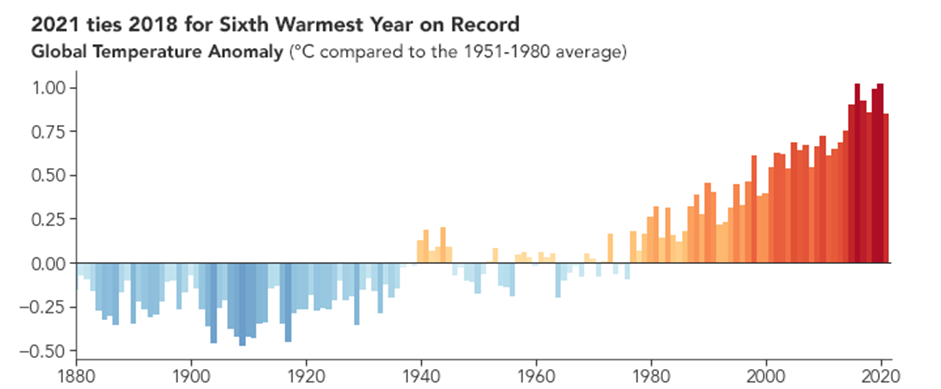
Global annual temperatures have risen by more than 1 degree Celsius (approximately 2 degrees Fahrenheit). It rose by 0.07 degrees Celsius (0.13 degrees Fahrenheit) every 10 ten years between 1880 and 1980. However, the rate of increase has more than doubled since 1981. Over the last 40 years, the global annual temperature has risen by 0.18 degrees Celsius (0.32 degrees Fahrenheit) per decade. India is the third-largest emitter of carbon dioxide after China and the US, and this is because of its rapidly growing population and an economy heavily dependent on coal and other fossil fuels. The nation’s Prime Minister committed that it would reduce the emission intensity of its economy to 45% from 33–35% in the previous years by 2030.

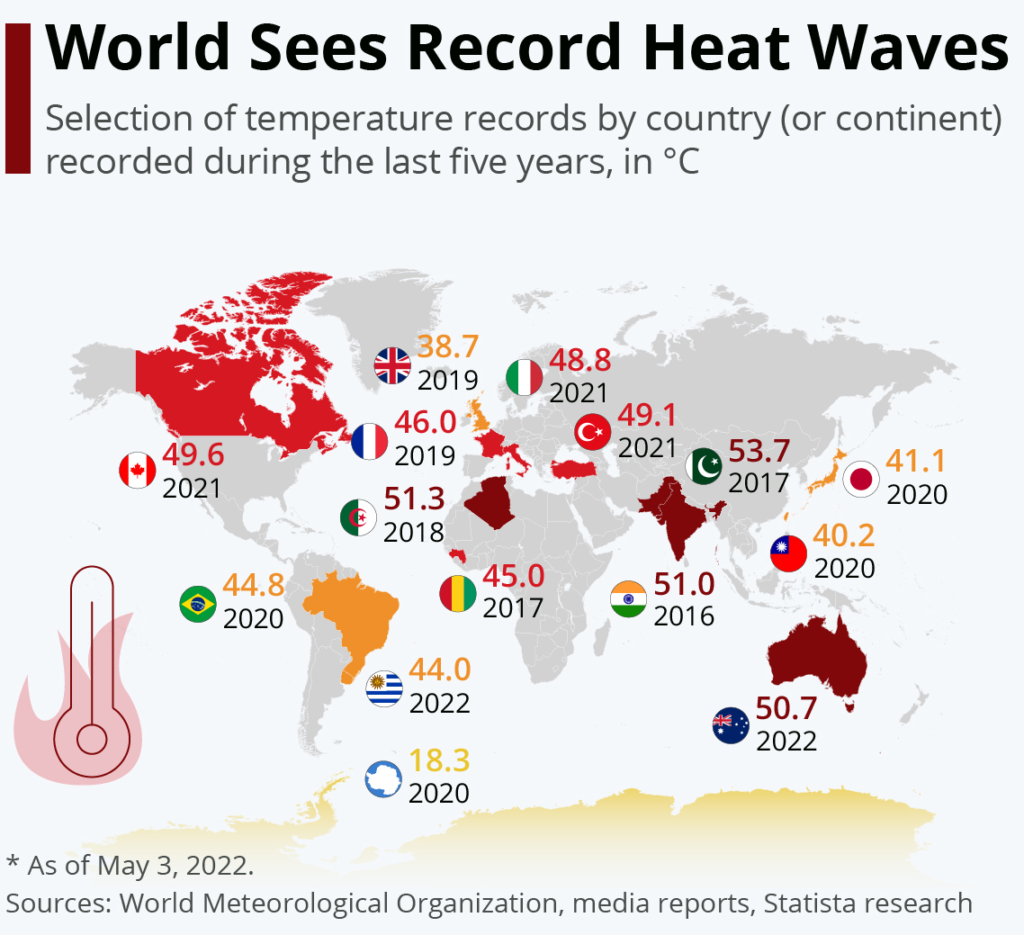
Temperature records by countries (or continent) (2015-2020)

The International governmental Panel on Climate Change (IPCC) states that global economies keeping their target of achieving global net-zero emissions will help the world minimise overall temperature rise to 1.5OC. There are more than 140 countries have given their consent and promised to achieve this. Also to work towards achieving this ambitious target in the coming decades.

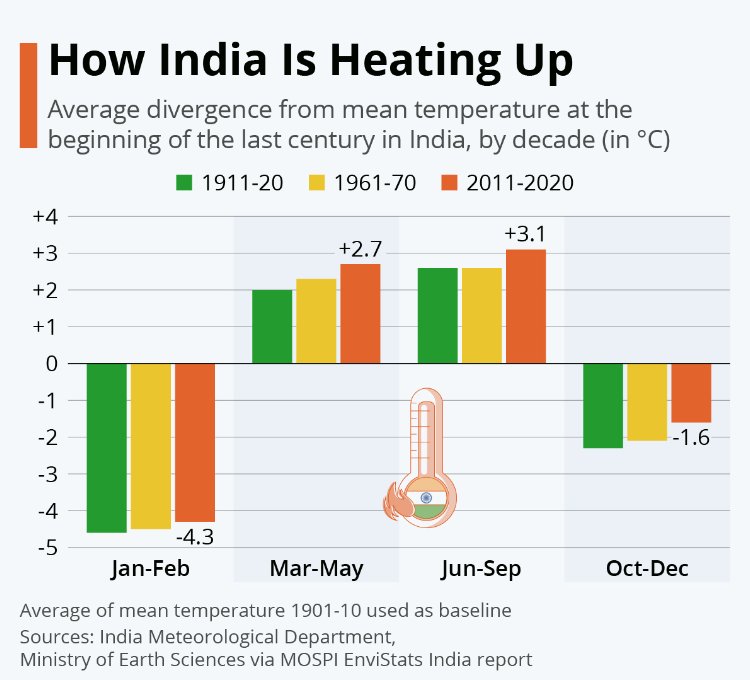
As a tropical developing economy, India faces more significant challenges. Mainly in coping with adverse climate changes in recent years than other countries. The Central Government launched the National Clean Air Programme as a long-term, time-bound and nationwide strategy. This is to tackle the air pollution problem with a target of 20-30% reduction.      

“Statista – How India is heating up (1911-2020)”

The country is planning to achieve net-zero emissions by 2070   

As part of this, India’s journey to Net Zero emissions and new climate change targets appear to be ambitious. And towards achieving this, Prime Minister Narendra Modi announced a five-fold strategy named ‘Panchamitra’. This is done at the 26th Conference of Parties (CoP26), which states that;

  • The country’s non-fossil energy will be increased to 500 gigawatts by 2030: Central Electricity Authority (CEA) has projected the country’s energy mix for 2030. And as per this projection, the country’s installed capacity of non-fossil energy for electricity generation in 2019 was 134GW. 522GW will increase by 2030, which requires a solar and wind energy capacity of 280 GW and 140 GW, respectively, with a total installed capacity of 817 GW with a power generation of 2518 billion units by 2030.
  • 50% of the country’s energy requirement will be met from renewable energy by 2030. As per the estimates with CEA, 9.2% of the county’s electricity requirement are being met from renewables by 2019. In 2021, this has increased to 12%, with an increase in renewable energy capacity by 102 GW. That means that India needs to increase this exponentially to meet 50% electricity generation by 2030. The country’s power requirement is expected to touch 2518 billion by 2030. And to meet this requirement, the capacity has to increase to 700GW from the present 450 GW. And considering hydroelectricity as part of this will require raising the new renewable power to 630GW, which is obviously achievable.
  • The total projected carbon emission by the country will reduce to one billion tonnes by 2030. The current CO2 emission by the government estimates at 2.88 GT. And as per the projections by the Centre for Science and Environment (CSE), the country’s CO2 emission on account of business activities will be 4.48 Gt by 2030. But the government is planning to cut its carbon emission by 10 billion tons, making its emissions in 2030 at 3.48 GT. This shows the country’s ambitious target to cut its emissions by 22% in the coming years.
  • The country will reduce the carbon intensity of its economy by less than 45% by 2030. Thus helping the country to achieve;
  • The target of Net-Zero by 2070: As per the estimates of CSE, between 2005-2016, the country has achieved a 25% reduction in its emission intensity and is on its way to earning more than 40% by 2030. India will improve measures to reduce emissions from various sectors like transportation and other energy-intensive industries like cement, iron, steel, non-metallic and chemicals. All these efforts by the country will help it become a Net Zero by 2070.

COP26: India’s efforts to combat climate change

In November 2021, the COP26 global summit, held in Glasgow, had a significant role in bringing climate change under control. Around 200 countries have been asked to plan efficient ways to cut emissions.

As per the UN Environment Program’s Emission Gap Report estimates, India is only the major economy on track to achieving its target set out in the Paris Climate Agreement. The country plans to reduce its GDP’s emission intensity, i.e. a significant reduction in the volume of carbon emissions emitted for every unit of its GDP by nearly around 35% by 2030. Further, as per the reports by the Environment Ministry, India has achieved its ambitious target of reducing the emission intensity of its GDP by over 21% in 2020. The country is almost nearing its goal of reaching about 40% share of non-fossil fuel-based electricity generation capacity.

Further, the Ministry of Environment, Forests, and Climate Change state that the country is favourable toward the International Panel on Climate Change (IPCC) report. The government has taken several initiatives over the past few years, including setting up the International Solar Alliances and Coalition for Disaster.

Significant impacts of global warming

Climate change can bring multiple changes in different regions, expected to worsen with further warming. These changes include; Change in wetness and dryness, Changes to winds, snow and ice, coastal areas and oceans. For instance,

  • The water cycle is intensified because of severe climate change, resulting in intense rainfall, flooding, and more intense drought in many regions.
  • Climate change will affect rainfall and alter monsoon precipitation in different regions.
  • The continued sea-level rise will result in frequent and severe coastal flooding, especially in low-lying areas.
  • Global warming will also lead to the loss of seasonal snow cover, and melting of glaciers and ice sheets.
  • Changes to the oceans on account of warmings, such as frequent marine heatwaves, ocean acidification and reduced oxygen levels, will affect the ocean ecosystems and the people who rely on them.
  • For cities, warming will increase heat, flooding because of heavy and frequent precipitations, and sea-level rise in coastal areas.

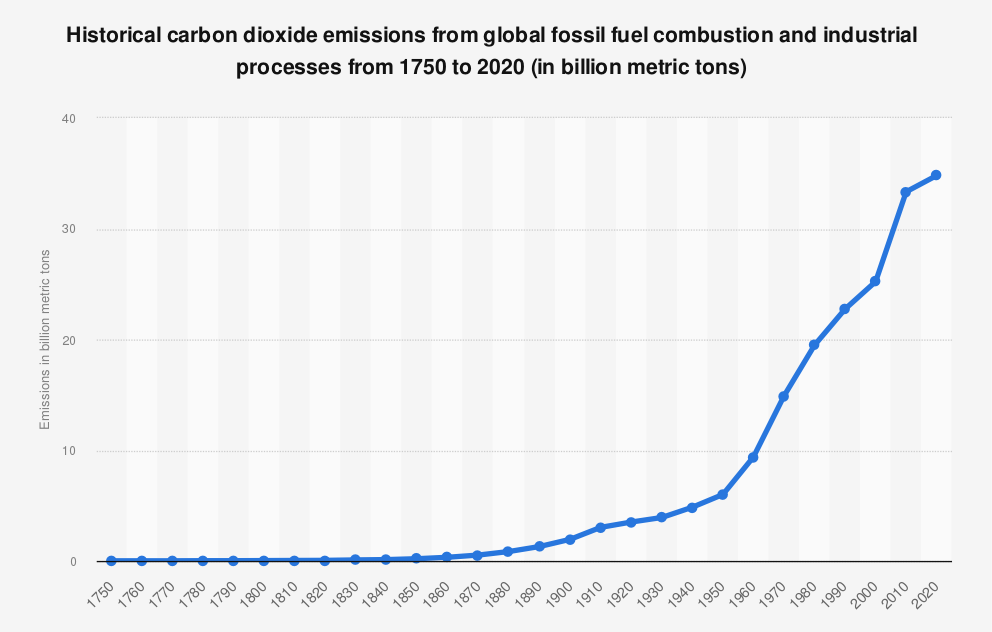
The rise in carbon dioxide emission from fossil fuel combustion (1750-2020)

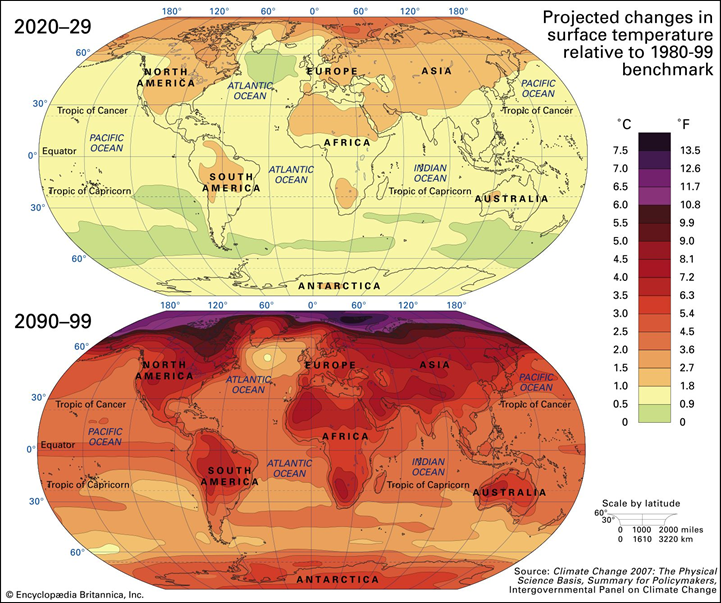
Climate Change (2020-2029 in comparison with 2090-2099)

Global warming and the greenhouse effect

At present human-caused greenhouse gas emissions are much higher than ever. And if the warming trends continue at the current rate, it will take the estimated global heating up to 2.7 degrees Fahrenheit. As a result of which, the earth’s climate system, in many ways, like;

  • More frequent and intense weather events include heat waves, hurricanes, droughts and floods.
  • Rising sea level because of melting glaciers and sea ice and increased ocean temperature.
  • Changes the ecosystems and natural habitat.

And these changes not only create a risk to the plants and wildlife and have a direct impact on the overall population.

Analysis by Nasa Earth Observatory – Global Temperature Anomaly (1880-2020)

What can be done to tackle the greenhouse effect

According to IPCC, countries should focus on decreasing their greenhouse gas pollution by 45% by 2030 to achieve net-zero emissions by 2050. Reducing greenhouse gas will require significant efforts at the international, national and country levels. And as a foremost step towards this,

  • Countries should reduce fossil fuel production, consumption, and pollution using cleaner and renewable energy sources.
  • Significant efforts must be made to protect forests, reduce deforestation to all possible extent, and reduce food waste and emissions.
  • Every individual must be committed to taking carbon-cutting actions in their daily life.

Some possible solutions to combat global warming

  • Save energy at home: Where possible, use compact fluorescent lights (CFL) bulbs than regular light bulbs. CFLs use two-thirds less energy and last longer than standard bulbs.
  • Use less heat and air conditioning: Installing weather strippings or caulking around windows and doors will lower the energy to heat and cool the homes by 25%. Keeping the thermostat just 2 degrees lower in winters and higer in summers will help save about 2000 pounds of carbon dioxide every year.
  • Plant a tree: Planting suitable trees around residential areas and parkways helps to reduce energy usage during hot summers.
  • Buy fuel-efficient cars or hybrid vehicles: Buying a fuel-efficient car will save money and pollute less than engine run vehicles. Further, buying a hybrid vehicle will significantly reduce greenhouse gas emissions.
  • Switch to Biofuel: Adopt new methods to use biofuel, alternative to the current petroleum derivatives. This for a long term creates the major impact and save our planet from future disasters.
  • Walk, bike or take public transport: Rather than using private vehicles to cover shorter distances, using public transportation will significantly reduce the amount o air pollution. Committing to using public transit will lower the emissions to a great extent.
  • Inflate your tires: Keeping your vehicle’s tires adequate inflated will save 250 lbs of CO2.
  • Reduce, reuse and recycle: All possible attempts should be made to reduce waste by choosing reusable products instead of disposables. Further buying products with little packaging will help to minimise waste. Also, recycling half of the household waste saves considerable carbon emissions annually.
Translate »