

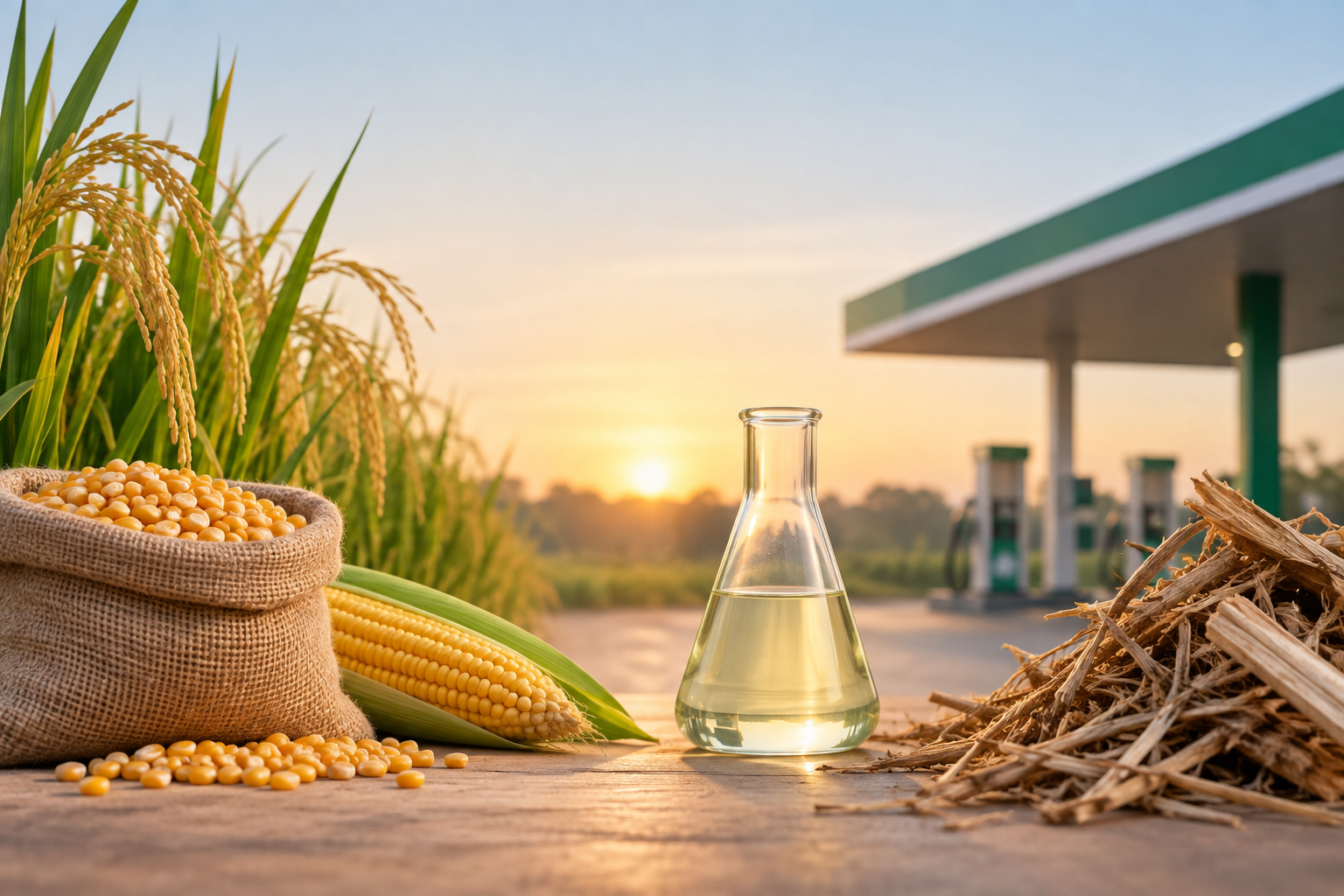
Introduction: A Fuel Success Story With a Feedstock Problem
India’s ethanol blending programme has become one of the more visible achievements of the country’s clean-energy push. What began as a modest, sugarcane-driven initiative has expanded into a nationwide E20 rollout, with fuel standards for even higher blends -E22, E25, E27 and E30 -already notified by the government. Distillery capacity across the country has grown from around 421 crore litres in 2014 to nearly 2,000 crore litres today, roughly double the ethanol that oil marketing companies (OMCs) currently offtake in a year.
But the composition of that ethanol has changed just as dramatically as its volume. In the programme’s early years, almost all of it came from a single, low-value by-product of sugar milling: C-heavy molasses, the residual syrup left over after sugar has been crystallised out of cane juice. Today, the picture looks very different. For the ethanol supply year ending October 2026, grain -chiefly maize and rice sourced from the Food Corporation of India (FCI) -is expected to account for as much as 72.5 per cent of total ethanol supply, against 27.5 per cent from sugarcane-based feedstock.
This shift from a sugar-industry by-product to staple food grains sits at the centre of a genuine and still-unresolved policy debate. It touches food security, given that some of the rice diverted to ethanol comes from stocks meant for welfare schemes. It touches water security, because rice, sugarcane and maize are all water-intensive crops grown heavily in already-stressed regions. It touches vehicle economics, since ethanol’s chemical properties differ meaningfully from petrol’s. And it sits alongside a separate but related story -India’s consistently poor showing on Yale University’s Environmental Performance Index (EPI), which has repeatedly flagged air quality and biodiversity as the country’s weakest links.
This article draws on government data, independent agricultural reporting, and policy documentation to lay out what is actually happening in India’s ethanol economy, where the genuine trade-offs lie, and why second-generation (2G) ethanol -made from crop residues rather than food grain -is increasingly presented as the structural answer to several of these tensions at once.
The Evolution of India’s Ethanol Blended Petrol Programme
India’s Ethanol Blended Petrol (EBP) programme was originally conceived to support the sugar industry. Sugar mills facing stagnant domestic consumption but rising production needed an additional revenue stream to make timely cane payments to farmers, and ethanol supplied that outlet. Until 2017-18, the entire ethanol supply to OMCs was drawn from C-heavy molasses -a thick, dark by-product from which mills cannot economically recover any further sugar after three rounds of boiling and crystallisation.
From the 2018-19 supply year onward, the feedstock base widened. Mills began producing ethanol from intermediate-stage B-heavy molasses and directly from sugarcane juice and syrup, after the government began paying a higher price for ethanol made through these routes than for the conventional C-heavy route. This pricing incentive worked: ethanol supply to OMCs rose from 38 crore litres in 2013-14 to 190 crore litres in 2018-19, and the all-India average blending rate climbed from 1.6 per cent to 4.9 per cent over the same period.
The table below traces how the feedstock mix has changed over the life of the programme, based on official supply-year data reported in the Indian Express.
| Supply Year | C-Heavy Molasses | B-Heavy Molasses | Cane Juice | Maize | Surplus FCI Rice | Damaged Foodgrain | Total (Crore Litres) |
| 2013-14 | 38 | 0 | 0 | 0 | 0 | 0 | 38 |
| 2017-18 | 151 | 0 | 0 | 0 | 0 | 0 | 151 |
| 2018-19 | 146 | 33 | 1 | 0 | 0 | 10 | 190 |
| 2020-21 | 39 | 183 | 39 | 0 | 2 | 39 | 302 |
| 2022-23 | 6 | 235 | 128 | 32 | 74 | 32 | 507 |
| 2023-24 | 58 | 149 | 64 | 286 | 0 | 116 | 673 |
| 2025-26 | 12 | 110 | 166 | 479 | 233 | 48 | 1,048 |
Two things stand out from this trajectory. First, the scale of the programme has grown more than twenty-five-fold in little over a decade -from 38 crore litres in 2013-14 to roughly 1,048 crore litres allocated for the year ending October 2026. Second, and more significant for this discussion, the composition has flipped almost entirely. In 2023-24, total ethanol supply of 673 crore litres achieved an average blending level of 14.6 per cent, with grain-based feedstock alone contributing 402 crore litres, or 59.7 per cent of the total -a level that had never been reached before in the programme’s history. For the year ending October 2026, grain’s share is projected to rise further, to 72.5 per cent of a 1,048.3-crore-litre pool, while sugarcane-based feedstock supplies the remaining 27.5 per cent.
The Changing Feedstock Landscape: From Cane By-Product to Staple Grain
This reversal has an immediate cause: sugar economics. With domestic sugar prices elevated and stocks projected at a multi-year low heading into the 2026-27 supply year, it is unlikely that the government will permit ethanol production from direct cane juice or B-heavy molasses in that year. Mills will instead be pushed to recover the maximum possible sugar from cane juice, limiting ethanol production to the non-crystallisable sucrose left in C-heavy molasses -effectively reverting sugarcane’s role in the programme closer to where it started.
Sugar diversion into ethanol has nonetheless been a real and measurable draw on supply in recent years. According to Indian Express reporting, diversion through the B-heavy and cane-juice routes amounted to 2.2 million tonnes (mt) of cane-equivalent sugar in 2020-21, and 3.6 mt, 4.3 mt, 2.4 mt, 3.5 mt and 3 mt in the five sugar years that followed. The most recent figure of 3 mt represents roughly a tenth of India’s estimated gross sugar output of 30.9 mt in 2025-26 -a meaningful, if not overwhelming, share of national production.
With sugarcane’s contribution constrained, grain has filled the gap -and increasingly, that grain is rice drawn from FCI’s central pool. For the 2025-26 supply year, the government allocated 5.2 mt of surplus FCI rice to ethanol distilleries, a figure that was raised to 7.2 mt in July 2026. At a conversion rate of 450–460 litres of ethanol per tonne of rice, that additional allocation would yield roughly 325–330 crore litres. With sugar diversion curtailed and maize supply facing its own uncertainties (discussed below), Indian Express reporting notes that sustaining even the current E20 blending level -which requires around 1,050 crore litres of ethanol -would likely require earmarking still more FCI rice.
The Price Gap in FCI Rice for Ethanol
The economics of this route raise a separate question of value. FCI rice is sold to ethanol distilleries at Rs 23.2 per kg, with the auction reserve price for rice with 100 per cent broken grains set even lower, at Rs 21 per kg. For comparison, the Department of Consumer Affairs’ latest data puts the all-India modal retail price of normal rice at Rs 40 per kg and broken rice at Rs 30 per kg. Rice, in other words, is reaching distilleries at roughly half the price a consumer would pay for it in the open market -a gap that explains why the diversion of foodgrain into fuel remains a live point of scrutiny, even when it is framed as the use of genuinely surplus stock.
Maize: A Parallel Demand Story
Maize tells a related story from the demand side. Ethanol has become an important additional buyer for a crop that was historically used mainly for poultry feed, livestock feed and industrial starch. Indian Express reporting notes that wholesale maize prices rose from a range of Rs 13.8–17.8 per kg in 2021 to Rs 22.1–24.5 per kg in 2024, a period that coincides with maize’s rapidly growing role in the ethanol supply chain -its contribution rose from essentially zero before 2022-23 to 479 crore litres’ worth of feedstock allocated for 2025-26, on Table 1 above. Looking ahead to 2026-27, the same reporting flags that El Niño conditions, expected to persist through the first half of the year, could constrain maize availability just as sugarcane-based supply is also being curtailed -tightening the feedstock picture from two directions at once.
E20 and the Transition Challenge: What Higher Blends Mean for Vehicles
Alongside the feedstock question, industry commentary has raised a second, more technical concern: how well India’s existing vehicle fleet is suited to higher ethanol blends. It is worth being precise here about what is established fact and what is argument.
Ethanol’s basic chemical properties are well documented. It is hygroscopic -it absorbs atmospheric moisture -and its calorific value of roughly 6.4 kcal/g is markedly lower than petrol’s 10.3 kcal/g, a difference of about 35–38 per cent. A policy critique titled “The Ethanol Trap,” one of the reference documents behind this article, argues that this lower energy density causes E20 to reduce fuel efficiency by an estimated 3–6 per cent compared with pure petrol, and that moisture absorption can, over time, lead to phase separation in fuel tanks, corrosion of metal components, degradation of non-compatible rubber hoses, clogged filters and engine stalling -risks it argues are most relevant for an estimated 80 million legacy two-wheelers and a substantial number of cars built before the BS6 Stage II emission norms took effect in March 2023.
The same document also raises a more specific materials-engineering concern: that chloride contamination associated with the maize wet-milling process used at grain-based distilleries can increase stress-corrosion cracking in carbon steel fuel-system components, citing a 2013 study on chloride effects in simulated fuel-grade ethanol published in Electrochimica Acta. It further notes that, unlike Brazil or the United States, India does not currently offer motorists a choice of unblended or lower-blend fuel at the pump.
These are documented arguments from a critical policy commentary rather than settled, universally-accepted engineering conclusions, and readers should treat them as one side of an active debate rather than proven outcomes for every vehicle. What is not in dispute is the underlying chemistry -ethanol’s hygroscopic nature and lower calorific value relative to petrol -and the fact that India’s blending trajectory (E20 today, with E22 through E30 standards already notified) is moving faster than the natural replacement cycle of the country’s vehicle fleet. That gap between policy pace and fleet turnover is the crux of the transition challenge, whatever view one takes of its precise severity.
Food, Feed, Water and Fuel: The Resource Competition Question
The most consequential debate around India’s ethanol programme is the extent to which it competes with food, animal feed and water resources that have other, more immediate claims on them.
Food Security and the FCI Rice Question
“The Ethanol Trap” argues that diverting maize, damaged foodgrain and FCI rice stocks into ethanol production conflicts with the food security of the roughly 80 crore beneficiaries covered by India’s public distribution system, and that it also reduces feedstock available to the livestock sector, contributing to higher prices for sugar, milk, eggs and meat. This is presented in the document as a policy argument and risk rather than as a verified, quantified outcome, and it should be read as such. What can be stated as fact, based on the Indian Express reporting cited above, is the scale of the rice allocation itself -7.2 mt for 2025-26 -and the price at which that rice reaches distilleries relative to its open-market value.
Water-Intensive Cropping
A related concern raised in the same document is that cultivating rice, sugarcane and maize -all water-intensive crops -in hydrologically stressed regions such as Punjab, Haryana and western Uttar Pradesh is accelerating groundwater depletion. Again, this is presented as an argument in the source material rather than as an independently verified measurement within these documents, but it aligns with the broader, well-established agronomic reality that all three crops carry a high water footprint relative to alternatives such as millets.
A Possible Way Through: Alternative Feedstocks
The Indian Express analysis points to one practical option worth noting: millets such as bajra and jowar contain 58–62 per cent recoverable starch and can yield 380–400 litres of ethanol per tonne -comparable to maize -while requiring less water. Shifting a portion of grain-based ethanol demand toward such crops, the analysis suggests, could let millet farmers benefit from the kind of price realisation that maize growers have seen, without adding further pressure to India’s most water-stressed agricultural belts.The Environmental Dimension: What the EPI Ranking Says -and Doesn’t Say
| Feedstock | Typical Route to Distillery | Price to Distillery | Comparable Market Price | Primary Concern Raised |
| Surplus FCI rice | Open Market Sale Scheme, Central Pool | Rs 23.2/kg (Rs 21/kg reserve for 100% broken) | Rs 40/kg (normal), Rs 30/kg (broken) | Discount to market value; PDS-linked stock |
| Maize | Open market procurement | Market-linked (rose ~60% from 2021 to 2024) | Competes with poultry & livestock feed, starch industry | Rising cost pressure on feed and food-processing sectors |
| Sugarcane (B-heavy/cane juice) | Sugar mill diversion | Government-incentivised pricing vs. C-heavy route | Diverted 2.2–4.3 mt of cane-equivalent sugar annually (2020-21 to 2025-26) | Reduces sugar output available for the market |
Running alongside the feedstock debate is a separate but relevant thread: India’s persistently weak performance on Yale University’s Environmental Performance Index (EPI). In the 2026 assessment, released by the Yale Center for Environmental Law & Policy, India was ranked 176th out of 177 countries -the second-lowest position after Laos -with a score of 22.46 per cent, against a global-topping score of 74.79 per cent for Estonia. Within South Asia, India ranked seventh of eight countries assessed.
India’s EPI trajectory over the past decade has been one of consistent decline: from 141st in 2016 to 177th in 2018, 168th in 2020, and a low of 180th -the worst position among all countries assessed -in 2022, before settling at 176th in both 2024 and 2026. The country has remained within the five worst-performing nations on the index since 2022.
| EPI Assessment Year | India’s Global Rank |
| 2016 | 141st |
| 2018 | 177th |
| 2020 | 168th |
| 2022 | 180th (lowest of all countries) |
| 2024 | 176th |
| 2026 | 176th (second-lowest, after Laos) |
The 2026 assessment considered 47 indicators across 12 issue categories. India’s weakest categories were environmental health and biodiversity, both ranked 174th, and its comparatively stronger category was climate change, at 130th -also its most improved category, gaining 13.98 points over the past decade. Waste management and sanitation were both ranked 141st. Air quality has been a particular pressure point: India’s air-quality score actually slipped by 0.15 points over the decade, despite the country spending Rs 16,423 crore on the National Clean Air Programme since its launch in 2019.
It is important to represent the methodology debate accurately. When India received its lowest-ever EPI ranking in 2022, the Ministry of Environment, Forest and Climate Change (MoEFCC) formally rejected the findings, stating that the analysis contained “many indicators based on unfounded assumptions” and that some indicators were “extrapolated and based on surmises and unscientific methods.” Responding to similar criticism in 2026, Martin Wolf, the EPI’s Principal Investigator at Yale, said the index is designed to measure countries’ current environmental conditions rather than their stated policy intentions, and that India’s low score reflects performance across a range of issues -air quality, water quality, agriculture and fisheries -rather than climate change alone. He also acknowledged that historical, cumulative emissions, a factor the Indian government has previously raised, are not part of the EPI’s methodology.
Independent experts interviewed for the Down To Earth report offered a more measured middle ground. Anjal Prakash of FLAME University, Pune, described India’s low rank as “real but incomplete,” arguing that compressing a large, diverse, low-income country into a single cross-national score can overstate comparisons with wealthier nations that followed different historical development paths -while also noting that India’s poor showing is concentrated in a few high-impact indicators rather than reflecting universal underperformance. Nilanjan Ghosh of the Observer Research Foundation similarly cautioned that the index does not fully capture the developmental realities of a country at India’s scale and stage of economic transformation, while agreeing that the ranking should not be dismissed outright, since it highlights genuine and pressing concerns in air quality, urban environmental management, wastewater treatment and biodiversity conservation.
Why does this matter for a discussion about ethanol feedstock? Because one of the most direct levers connecting agricultural policy to air quality -India’s weakest and most stagnant EPI category -is what happens to crop residue after harvest. Large volumes of paddy straw are burned in fields across northern India each winter, a widely documented contributor to seasonal air pollution across the Indo-Gangetic plain. Any programme that gives farmers and industry a commercial reason to convert that residue into fuel, rather than burn it, addresses a fuel-supply objective and an air-quality objective simultaneously. That is precisely the logic behind second-generation ethanol.
Why Second-Generation (2G) Ethanol Matters
Conventional, or first-generation (1G), ethanol in India is made from the parts of a crop that also have food, feed or industrial value: sugarcane juice and molasses, and the starch in maize and rice grain. Every litre of 1G ethanol therefore carries some degree of competing claim from food, feed or sugar markets -which is exactly the tension explored in the sections above.
Second-generation, or 2G, ethanol is produced from a different category of raw material altogether: lignocellulosic biomass, the fibrous, non-food residue left over once the primary crop has been harvested. This includes paddy and wheat straw, sugarcane bagasse, corn stover, and other agricultural residues that are otherwise treated as waste -and, in large volumes across northern India, simply burned in the field. Because 2G feedstock is residue rather than the harvested grain or cane juice itself, converting it into ethanol does not draw directly on food, feed or sugar supply in the way 1G grain-based ethanol does, and it offers an additional environmental benefit by giving farmers and aggregators a commercial alternative to stubble burning.
| Dimension | First-Generation (1G) Ethanol | Second-Generation (2G) Ethanol |
| Feedstock | Sugarcane juice/molasses, maize grain, rice grain | Paddy/wheat straw, bagasse, crop residues |
| Competes with food/feed supply | Yes -draws on grain and cane also used for food, feed, sugar | No -uses residue left after the food crop is harvested |
| Contribution to India’s ethanol pool | Dominant -over 70% of allocated supply in 2025-26 | Small -limited to a handful of commercial and demonstration projects |
| Government support mechanism | Price incentives for B-heavy molasses/cane juice route | PM JI-VAN Yojana viability-gap funding, 15-year offtake assurance, lower GST |
| Additional environmental benefit | Displaces petrol; emissions benefit of blending | Displaces petrol and reduces crop-residue burning |
PM JI-VAN Yojana: India’s Policy Architecture for 2G Ethanol
India’s principal policy instrument for 2G ethanol is the Pradhan Mantri JI-VAN (Jaiv Indhan-Vatavaran Anukool fasal awashesh Nivaran) Yojana, notified by the government in March 2019. The scheme provides financial support for integrated bio-ethanol projects that use lignocellulosic biomass and other renewable feedstocks to produce second-generation ethanol, with a total financial outlay of Rs 1,969.50 crore for the period 2018-19 to 2023-24.
Under the scheme, commercial 2G ethanol projects are eligible for financial assistance of up to Rs 150 crore per project, while demonstration-scale projects can receive up to Rs 15 crore per project, both aimed at enhancing commercial viability and promoting research and development in 2G production technology.
As of the government’s August 2023 update to Parliament, financial assistance of Rs 880 crore had been approved for six commercial 2G bio-ethanol projects -located in Punjab, Haryana, Odisha, Assam and Karnataka -along with two demonstration projects, one each in Haryana and Andhra Pradesh. Of these, the commercial project at Panipat, Haryana, had already been dedicated to the nation, while commercial projects at Bhatinda (Punjab), Bargarh (Odisha) and Numaligarh (Assam) were reported to be in advanced stages of construction.
Beyond direct financial assistance, the government’s policy toolkit for 2G ethanol includes several complementary measures: an additional excise duty on non-blended fuels to strengthen the economic case for blending; 15-year offtake assurance to private investors through Ethanol Purchase Agreements (EPAs) signed by OMCs; active diversification of eligible feedstock for 2G production; a separate, higher price for 2G ethanol relative to conventional ethanol; and a reduced Goods and Services Tax rate of 5 per cent on ethanol supplied under the EBP programme.
This is a genuinely substantial policy architecture -but it is also worth noting the gap between policy design and commercial reality that some critics have highlighted. “The Ethanol Trap,” a critical policy commentary reviewed for this article, argues that despite the JI-VAN Yojana’s outlay, the availability of raw material, existing custom-hiring infrastructure for straw collection, and demonstrated indigenous technology, no plant was, at the time of its writing, commercially producing 2G ethanol from biomass at scale. It attributes this gap primarily to cost: converting complex lignocellulosic biomass requires an estimated three to four times the capital investment of conventional 1G grain processing, and private operators are reluctant to commit that capital without a correspondingly higher guaranteed tariff structure.
These two pictures are not necessarily contradictory -a project reported to be in “advanced stages of construction” in 2023 is a different thing from a plant reported to be running at full commercial scale several years later, and the sources reviewed here span different points in time. What they jointly indicate is that India has built meaningful policy and financial infrastructure for 2G ethanol, but that translating approved projects into fully commercial, scaled-up production remains an ongoing challenge rather than a solved problem.
What a More Sustainable Ethanol Strategy Could Look Like
Neither of the two reference documents examined in detail here argues for abandoning ethanol blending. Both instead point toward a more deliberately managed transition -one that treats grain and cane as a bridge feedstock rather than a permanent one, and accelerates the shift toward residue-based supply. Drawing together their respective recommendations:
From agricultural and feedstock policy
• Discourage ethanol supply from standalone, grain-based distilleries that are significantly reliant on FCI rice, rather than treating grain diversion as a default buffer.
• Encourage distillers to explore lower-water alternative feedstocks such as bajra and jowar, which offer comparable ethanol yields to maize (380–400 litres per tonne) without the same water intensity.
• Avoid setting and chasing blending targets ahead of schedule; the EBP programme functioned successfully even at 10–15 per cent blending, and India’s own Chief Economic Adviser has publicly floated reconsidering the pace of the transition to higher blends.
From vehicle-compatibility and industry commentary
• Restore an element of consumer choice at the pump -such as continued availability of E0 or E10 fuel for legacy vehicles, or clearly defined retrofitting standards for vehicles that need them.
• Price E20 in a way that reflects its lower energy density relative to pure petrol, so that consumers are not effectively paying full price for reduced mileage.
• Cap the share of food grains and water-intensive crops in the feedstock mix, and shift incentives toward lower-water alternatives grown, where possible, on degraded or underutilised land.
• Strengthen tariff structures for 2G ethanol -a role suggested for NITI Aayog -to make commercial-scale residue-based production more financially viable for private operators, and expedite the commercialisation timeline.
• Consider a modest, dedicated surcharge on conventional petrol and diesel to help fund cleaner ethanol production processes and reduce the incentive to burn agricultural residue.
These are recommendations drawn from the two documents’ own analysis and argument, not verified government commitments, and readers evaluating them should treat them accordingly. Taken together, however, they point in a broadly consistent direction: manage the pace of the blending target adaptively rather than rigidly, and invest more deliberately in the residue-based feedstock that avoids most of the food, feed and water trade-offs associated with grain.
The Road Ahead for India’s Bioethanol Industry
Several structural facts will shape how this plays out over the next few years. Distillery capacity, at nearly 2,000 crore litres, already exceeds current annual offtake of roughly 1,050 crore litres by a wide margin, which means the industry has more processing capacity available than the market currently uses -a factor that will matter if and when blending targets move toward E22 and beyond. At the same time, the feedstock available to fill that capacity is under real pressure from multiple directions simultaneously: constrained sugar diversion heading into 2026-27, El Niño-linked uncertainty over maize output, and a rice-for-ethanol allocation that has already been revised upward once in 2026 and may need to rise further to sustain even the current E20 blending level.
Against that backdrop, the case for accelerating 2G ethanol is less about any single dramatic breakthrough and more about steadily converting policy support -the JI-VAN Yojana’s funding, offtake assurances and pricing incentives -into commercially operating capacity. The documents reviewed for this article do not offer a precise timeline for when that will happen at scale, and this article does not speculate beyond what they report. What is clear is that the direction of travel matters: a bioethanol industry that draws a growing share of its feedstock from crop residue, rather than an increasing share from food grain, is better positioned to expand blending targets without repeatedly running into food-price, water-stress or fuel-economics debates of the kind that have surfaced through 2026.
The Khaitan Bio Energy Perspective
Khaitan Bio Energy operates in the bioethanol and 2G bioethanol space, with a focus on converting agricultural residue into fuel rather than competing for the grain and cane that food, feed and sugar markets also depend on. The trends laid out in this article -a national programme increasingly reliant on FCI rice and maize, a distillery capacity build-out that has outpaced offtake, and a well-funded but still-maturing policy framework for residue-based ethanol under the PM JI-VAN Yojana -describe the operating environment in which residue-to-fuel projects are being developed across the country.
The opportunity this points to is straightforward: agricultural residue that would otherwise be burned in the field represents an underused feedstock source that does not draw on food or feed supply, and its conversion into ethanol addresses two policy priorities -fuel-blending targets and crop-residue burning -with a single input stream. Realising that opportunity at scale depends on the kind of viability-gap funding, assured offtake and technology investment that the JI-VAN Yojana framework was designed to support, and on the broader industry successfully translating approved and under-construction projects into consistent commercial output.
Conclusion: From Grain for Fuel to Waste for Fuel
India’s ethanol blending programme has delivered real, measurable results: a twenty-five-fold increase in supply since 2013-14, a national blending rate that has moved from below 2 per cent to 20 per cent, and a distillery infrastructure base built well ahead of current demand. But the path the programme has taken to get there -an increasing reliance on FCI rice and maize rather than the sugarcane by-products it began with -has opened up a set of trade-offs around food security, water use and fuel economics that deserve continued, evidence-based scrutiny rather than either uncritical celebration or blanket dismissal.
At the same time, India’s persistently weak Environmental Performance Index ranking is a reminder that air quality -closely tied to the seasonal burning of crop residue -remains one of the country’s most stubborn environmental challenges, one that has not meaningfully improved even as spending under the National Clean Air Programme has grown. The two threads meet at a single point: agricultural residue that is currently burned represents both an air-quality problem and an underused fuel resource. Converting more of it into second-generation ethanol, backed by the policy architecture already built under the PM JI-VAN Yojana, offers a route to keep expanding India’s ethanol supply without leaning ever more heavily on the country’s food grain. That shift will take sustained investment and time. But the direction is clear, and it is the direction India’s next phase of ethanol growth should increasingly follow.
Frequently Asked Questions
1. What share of India’s ethanol currently comes from food grain?
For the ethanol supply year ending October 2026, grain -mainly maize and FCI rice -is projected to account for around 72.5 per cent of total allocated ethanol supply (759.8 crore litres of 1,048.3 crore litres), with the remaining 27.5 per cent coming from sugarcane-based sources, according to Indian Express reporting.
2. Is FCI rice diverted to ethanol taken from food-security stocks?
The government’s position, as reported, is that only surplus rice from the Central Pool -after welfare-scheme and buffer-stock obligations are met -is sold to distilleries. For 2025-26, this allocation was set at 5.2 million tonnes and later raised to 7.2 million tonnes in July 2026.
3. Why is FCI rice sold to distilleries cheaper than market rice?
FCI rice reaches ethanol distilleries at around Rs 23.2 per kg (with an auction reserve price as low as Rs 21 per kg for fully broken grain), compared with an all-India modal retail price of roughly Rs 40 per kg for normal rice and Rs 30 per kg for broken rice, per Department of Consumer Affairs data cited in Indian Express reporting.
4. What is the difference between 1G and 2G ethanol?
First-generation (1G) ethanol is made from sugarcane juice, molasses, and grain such as maize and rice -materials that also have food, feed or sugar value. Second-generation (2G) ethanol is made from lignocellulosic biomass such as paddy straw, wheat straw and bagasse -crop residue left over after harvest that does not compete directly with food or feed supply.
5. What is the PM JI-VAN Yojana?
The Pradhan Mantri JI-VAN Yojana, notified in March 2019, is the government’s core scheme supporting 2G ethanol. It provides financial assistance of up to Rs 150 crore per commercial project and Rs 15 crore per demonstration project, with a total outlay of Rs 1,969.50 crore for 2018-19 to 2023-24, alongside measures such as 15-year offtake assurance and a lower GST rate for ethanol.
6. Does E20 fuel affect older vehicles?
Industry commentary, including the policy document “The Ethanol Trap” reviewed for this article, argues that ethanol’s hygroscopic and lower-calorific-value properties can affect fuel efficiency and componentry in legacy vehicles built before BS6 Stage II norms (March 2023). This is presented as an industry argument rather than an independently verified finding in the sources reviewed, and readers should treat it as one perspective in an ongoing debate.
7. How does India’s Environmental Performance Index ranking relate to ethanol policy?
They are separate issues connected mainly through air quality and crop-residue burning. India ranked 176th of 177 countries in the 2026 Yale EPI, with air quality among its weakest categories. Since 2G ethanol uses crop residue that would otherwise often be burned, expanding it can support both fuel-supply and air-quality objectives.
8. Has the Indian government disputed its EPI ranking?
Yes. When India received its lowest-ever EPI ranking (180th) in 2022, the Ministry of Environment, Forest and Climate Change stated it did not accept the analysis, describing several indicators as based on unfounded assumptions. Yale’s EPI Principal Investigator responded that the index measures current environmental conditions rather than policy intentions.
9. Why hasn’t 2G ethanol scaled up faster in India?
According to “The Ethanol Trap,” converting lignocellulosic biomass requires an estimated three to four times the capital investment of conventional 1G grain processing, and private operators have been reluctant to commit that capital without higher guaranteed tariffs -even though funding, infrastructure and technology exist under the JI-VAN Yojana framework.
10. What feedstock alternatives could reduce pressure on food grain?
Indian Express reporting highlights millets such as bajra and jowar, which offer 58–62 per cent recoverable starch and ethanol yields of 380–400 litres per tonne -comparable to maize -while requiring significantly less water, as a lower-impact alternative feedstocks.