

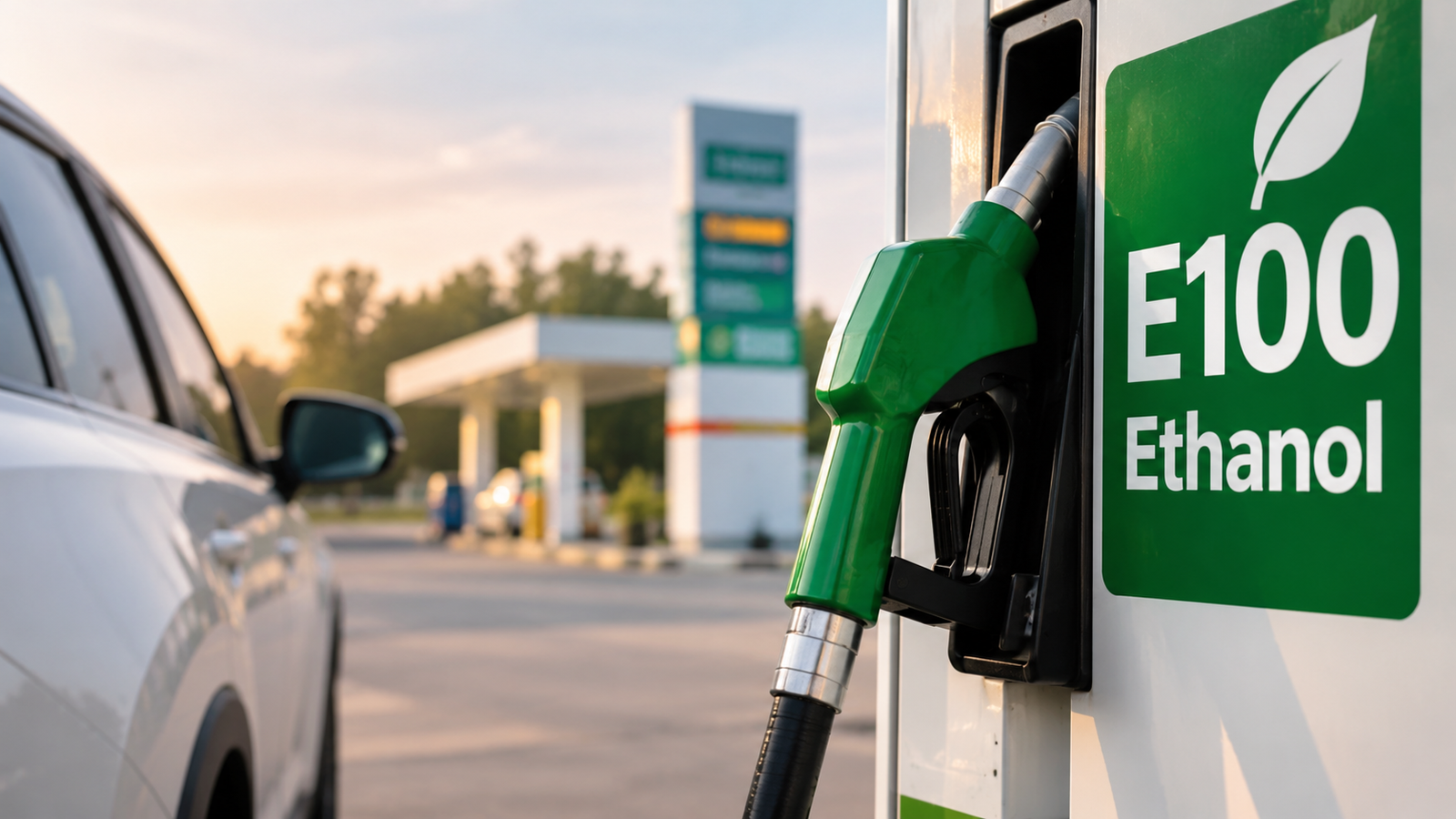
India has taken a formal step towards vehicles that run on almost pure ethanol. On 23 October 2026, the Ministry of Road Transport and Highways (MoRTH) notified an amendment to the Central Motor Vehicles Rules, 1989, adding E100 to the emission and testing provisions alongside E85. The rules were published in the official gazette on 26 October and took effect immediately, according to reports.
For automakers, this means flex-fuel vehicles (FFVs) built and certified for E100 now have a legal route to market. For the ethanol industry, it raises a bigger question: if these vehicles catch on, how much more ethanol will India need, and where will it come from?
This article explains what E100 fuel in India is, what the notification changes, how it fits into the wider regulatory framework, and what it could mean for ethanol production.
What Is E100 Fuel?
E100 is fuel made almost entirely of ethanol. It can only be used in flex-fuel vehicles, whose engines and fuel systems are designed and certified for very high ethanol content. Ordinary petrol vehicles, including those built for E20, can’t use it.
E100 isn’t new at Indian fuel stations. Indian Oil launched its “ETHANOL 100” fuel on 15 March 2024 at 183 retail outlets across Maharashtra, Karnataka, Uttar Pradesh, Delhi and Tamil Nadu. Indian Oil said the fuel has an octane rating of typically 100 -105. What was missing until now was a complete vehicle-side framework for certifying cars and two-wheelers to run on it.
| Fuel | Ethanol content | Who can use it |
| E20 | Up to 20% ethanol, 80% petrol | Standard petrol sold across India; for E20-compatible vehicles |
| E85 | Up to 85% ethanol (reported as 80–85% at launch) | Certified flex-fuel vehicles only |
| E100 | Nearly pure ethanol | Certified flex-fuel vehicles only |
What the October 2026 Notification Changes
The amendment follows a draft MoRTH published in April 2026, which was opened for public comment before being finalised. According to Business Standard and Autocar Professional, the final rules:
- Add E100 to Rule 115. The emission certification tables now cover “E85 or E100”, where they previously referred only to E85.
- Restrict E85 and E100 to certified FFVs. An explanatory note says these fuels may be used only in vehicles specifically designed and certified as flex-fuel vehicles.
- Formalise E10 and E20. Standard petrol in the testing provisions is now described as E10/E20, matching what is sold at pumps.
- Update biodiesel provisions. Testing references have been expanded from B10 to B100.
- Raise a weight threshold. The gross vehicle weight limit in the relevant emission standards has gone up from 3,000 kg to 3,500 kg, so heavier light vehicles can be tested under the light-vehicle procedure.
The ministry was clear about what the rules don’t do. Its statement said E85 and E100 are “intended only for vehicles specifically designed and certified to use it”. It added that owners of existing vehicles don’t have to switch fuels or modify their vehicles, now or in future.
The ministry also said that using ethanol in suitably designed vehicles can cut some exhaust pollutants, such as carbon monoxide and certain hydrocarbons, and lower lifecycle greenhouse gas emissions, depending on the feedstock and how the ethanol is made.
India’s Regulatory Framework for Ethanol Fuels
No single law governs ethanol as a fuel. Several ministries and bodies each handle one part:
| Layer | Responsible body | What it covers |
| Biofuel policy | Ministry of Petroleum and Natural Gas (MoPNG) | National Policy on Biofuels, 2018 (amended 2022), which brought the E20 target forward to ESY 2025-26; the Ethanol Blended Petrol Programme |
| Ethanol procurement | Oil marketing companies (IOCL, BPCL, HPCL) | Annual tenders that set volumes, prices and allowed feedstocks for each ethanol supply year |
| Fuel quality | Bureau of Indian Standards (BIS) | Fuel specifications, such as IS 16634 for E85 and IS 19850:2026 for E22–E30 blends (in force from 15 May 2026) |
| Vehicle emissions and certification | Ministry of Road Transport and Highways (MoRTH) | Central Motor Vehicles Rules, 1989, including Rule 115 on emission standards, now covering E85 and E100 |
| Vehicle safety for ethanol blends | MoRTH / Automotive Industry Standards | AIS-171, covering vehicles that run on blends of 20% ethanol and above, notified in May 2021 |
| Retail supply | MoPNG and OMCs | Rollout of E20, E85 and E100 at fuel stations |
The October notification fills the vehicle-certification gap. Fuel standards and retail E100 already existed. Now automakers have a clear testing and approval path for E100 vehicles.
What the notification doesn’t change
The E100 rules apply only to flex-fuel vehicles. They don’t raise the blending level of regular petrol. In a Lok Sabha reply in July 2026, MoPNG said no decision has been taken to increase ethanol blending in petrol beyond 20%. It said any future change would follow scientific and technical studies and consultation with automakers, OMCs and research institutions. The same reply described E85 as introduced only for certified FFVs, not as an increase in the nationwide blend.
Where Flex-Fuel Vehicles and E85/E100 Supply Stand Today
- E85 at the pump: E85 was launched on 5 June 2026 at 48 public sector fuel stations. The government aims to reach 500 outlets by December 2026 and about 5,000 by December 2027, according to reports of the launch.
- E100 at the pump: Indian Oil has sold ETHANOL 100 at selected outlets since March 2024. The notification doesn’t set a timeline for wider E100 availability.
- Vehicles: Maruti Suzuki launched the Wagon R Flex Fuel, India’s first flex-fuel passenger car, at ₹7.24 lakh (ex-showroom) in June 2026. Reports said it was built for blends up to E100 but initially homologated for up to E85. Toyota, Tata Motors and Hyundai are also developing flex-fuel vehicles for India, according to Business Standard.
The new rules give manufacturers like these a formal way to certify vehicles for E100. How quickly models reach showrooms is up to the companies.
How Much Ethanol Could E100 Require?
The government hasn’t published an estimate of ethanol demand from E100 vehicles. What we can do is put the scale in context using established figures.
Where ethanol supply stands now
- ESY 2025-26: OMCs received about 987 crore litres of ethanol by the end of September 2026, according to data reported by the All India Distillers’ Association. Grain supplied about 71% of that.
- ESY 2026-27: the OMC tender seeks about 1,100 crore litres, with sugar diversion for ethanol set to zero for the year.
- Capacity: total ethanol production capacity is close to 2,000 crore litres, according to Business Today.
An illustrative estimate
The estimate below is our own calculation, based on public data and standard fuel properties. It is not a government projection.
India consumed about 40 million tonnes of petrol in FY 2024-25, according to Petroleum Planning and Analysis Cell data. That is roughly 5,300–5,400 crore litres. Ethanol carries about a third less energy per litre than petrol, so a vehicle on E100 needs roughly 1.5 litres of ethanol to cover the distance one litre of petrol would.
On that basis, every 1% of India’s current petrol volume that moves from petrol to E100 would need roughly 80 crore litres of extra ethanol a year:
| Share of today’s petrol volume replaced by E100 | Approximate extra ethanol needed per year |
| 1% | ~80 crore litres |
| 5% | ~400 crore litres |
| 10% | ~800 crore litres |
Even a 10% shift would mean adding about three-quarters of the ethanol now procured for E20 blending. These figures are rough. Actual demand will depend on how many FFVs are sold, how often owners choose E100 over E20, fuel prices, and growth in overall petrol demand.
The timeline is gradual
Demand from E100 will build slowly. FFVs make up a tiny share of India’s vehicle fleet today, E85 is at only a few dozen outlets, and the notification sets no date for wider E100 retail. Growth will depend on how many models automakers launch, how quickly OMCs expand pumps, and whether pricing makes E100 attractive. The scale of ethanol needed later means planning for supply has to start now.
Why Feedstock Is the Real Constraint
India doesn’t lack distillery capacity. It lacks a dependable supply of raw material. The 2026-27 tender shows the problem: a weak 2026 monsoon and tight sugar supply pushed the government to set sugar diversion for ethanol at zero, leaving grain and C-heavy molasses to carry the load. Grain already provides most of India’s ethanol, and maize prices have risen as ethanol demand has grown.
Meeting E20 alongside rising FFV demand from these same food crops would put more pressure on food and feed markets. That is where second-generation (2G) ethanol comes in.
Where 2G Ethanol Fits In
2G ethanol is made from agricultural residue such as rice straw, wheat straw, bagasse and bamboo, rather than from sugar or grain. It reduces direct competition with food, and it turns residue that is often burnt into a source of income for farmers.
- Plants are running: IOCL’s Panipat plant (rice straw, 2022), NRL’s bamboo-based biorefinery at Numaligarh (inaugurated 2025) and BPCL’s Bargarh plant (rice straw, 2026) have all been commissioned.
- Policy support exists: the Pradhan Mantri JI-VAN Yojana, extended in August 2024 to 2028-29, supports 2G projects, including bolt-on and brownfield units.
- Scale is still small: 2G output today is a small fraction of national supply. Growing it needs reliable biomass collection and storage, proven technology and long-term offtake contracts.
If E100 vehicles take off, 2G ethanol offers a way to supply the extra demand without leaning harder on food crops. Building that capacity takes years, which is why it needs to start alongside the rollout of FFVs, not after it.
Conclusion
The E100 notification completes an important piece of India’s ethanol framework. Fuel standards, retail E85 and E100, and now vehicle certification rules are all in place for flex-fuel vehicles. Regular petrol stays at E20, and existing vehicles don’t need to change anything.
The bigger impact will be on ethanol demand. Our estimate suggests every 1% of petrol volume that moves to E100 could need around 80 crore litres of extra ethanol a year. With grain and sugar already stretched, much of that growth will have to come from non-food sources. Scaling 2G ethanol alongside flex-fuel vehicles is the most practical way to make E100 sustainable.
Frequently Asked Questions
Has India notified E100 fuel?
Yes. MoRTH notified an amendment to the Central Motor Vehicles Rules, 1989, on 23 October 2026, adding E100 alongside E85 in the emission and testing provisions of Rule 115. It was published in the gazette on 26 October and took effect immediately, according to reports.
Can I use E100 in my current petrol car or bike?
No. E85 and E100 can only be used in vehicles designed and certified as flex-fuel vehicles. A vehicle built for E10 or E20 isn’t suitable, and owners of existing vehicles aren’t required to switch fuels or modify their vehicles.
Is E100 available at petrol pumps in India?
Indian Oil has sold ETHANOL 100 at selected outlets since March 2024, starting with 183 outlets in five states. The new notification doesn’t set a timeline for wider E100 availability.
What is the difference between E85 and E100?
E85 contains up to 85% ethanol, with the rest petrol. E100 is nearly pure ethanol. Both are for certified flex-fuel vehicles only. E85 was launched at 48 outlets in June 2026, with targets of 500 outlets by December 2026 and about 5,000 by December 2027.
Does the notification mean India is moving beyond E20 for normal petrol?
No. As of July 2026, the government said no decision had been taken to raise blending in regular petrol beyond 20%. The E100 rules apply only to flex-fuel vehicles.
Which flex-fuel vehicles are available in India?
Maruti Suzuki’s Wagon R Flex Fuel was launched in June 2026 at ₹7.24 lakh (ex-showroom). Toyota, Tata Motors and Hyundai are among the manufacturers developing flex-fuel vehicles for India.
How much ethanol will E100 need?
There’s no official estimate yet. Our rough calculation suggests every 1% of India’s current petrol volume that moves to E100 would need about 80 crore litres of extra ethanol a year, compared with about 1,100 crore litres sought for 2026-27.
Why does 2G ethanol matter for E100?
Extra demand from E100 would add pressure on grain and sugar, which already supply almost all of India’s ethanol. 2G ethanol uses crop residue instead of food crops, so it can help meet growing demand without competing with food.