

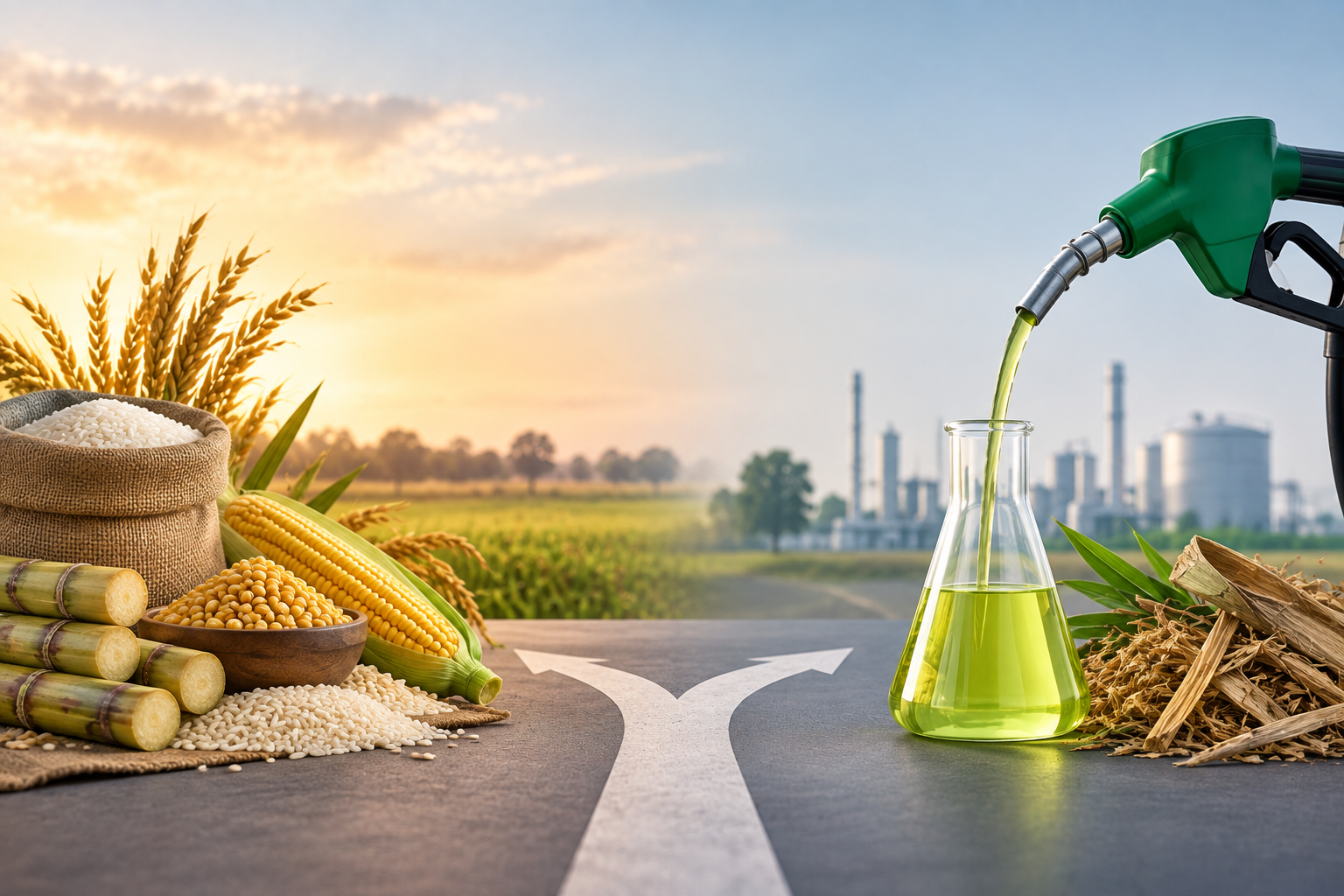
India’s ethanol story has moved faster than almost anyone expected. What was once a modest 5 percent blending target has turned into a nationwide E20 rollout, achieved five years ahead of the original 2030 deadline. Petrol pumps across the country now dispense fuel with one-fifth ethanol content, farmers are earning from a new revenue stream, and the country’s oil import bill has a little more breathing room.
But 2026 has also been the year this success story met an uncomfortable question. Sugar prices have surged. The government has swung from approving sugar exports to banning them, and then to opening a rare duty-free import window. Food-grain stocks meant for welfare schemes are being sold to ethanol distilleries. And economists are now openly asking whether India’s fuel ambitions are beginning to compete with its food security goals.
The central question this raises is simple to ask and hard to answer: can India keep expanding ethanol blending without putting sustained pressure on the crops, land and grain stocks the country depends on for food?
This article looks at what is actually happening to sugar, rice and maize as ethanol demand grows, separates confirmed facts from contested claims, and examines why second-generation (2G) ethanol -made from crop waste rather than food crops -is increasingly being presented as the way out of this bind.
India’s Ethanol Ambitions: How E20 Arrived Early
India’s ethanol blending programme was designed around a straightforward logic: the country imports roughly four-fifths of its crude oil, and every litre of petrol replaced with domestically produced ethanol is a litre of crude that does not need to be shipped in. Blending also gives sugarcane and grain farmers an additional buyer for their produce, alongside the food and sugar markets.
The pace of progress has been striking. India reached its 20 percent ethanol-blending target during the 2025-26 ethanol supply year, five years ahead of the original 2030 schedule. Ethanol supplied to oil marketing companies rose from roughly 1.73 billion litres in 2019-20 to a projected 12 billion litres in 2025-26 -a compound annual growth rate of around 38 percent, according to research cited by an ICRIER working paper reported in the business press. The government has also pointed out that ethanol blending is not an Indian experiment in isolation; countries including the United States, Brazil, Canada, Thailand, Japan and several European nations have used ethanol-blended fuels for decades.
That speed is precisely what has raised questions about supply. Feedstock production has not grown anywhere near as fast as ethanol demand. The same ICRIER analysis notes that while ethanol offtake grew at roughly 38 percent annually, maize production grew about 11.4 percent a year over the same period and sugarcane closer to 5.1 percent. When the fuel side of the equation expands several times faster than the farm side, something eventually has to give -and that something has, at various points in 2026, been sugar availability, grain stock levels and, briefly, maize imports.
When Food Crops Meet Fuel Demand
Ethanol in India is not made from a single feedstock. Distilleries draw on sugarcane juice, B-heavy and C-heavy molasses, surplus rice released by the Food Corporation of India (FCI), maize, and damaged food grains. Each of these has an existing role in the food chain before it is diverted to a fermentation tank.
- Sugarcane and its by-products feed both the sugar industry and, increasingly, ethanol distilleries.
- Rice is a staple food, a Public Distribution System (PDS) commodity, and now also an ethanol feedstock when FCI stocks are deemed surplus.
- Maize is used for poultry and animal feed, human consumption and industrial starch production, in addition to ethanol.
As long as feedstock supply comfortably exceeds these competing demands, the trade-off stays theoretical. The trouble starts in years when a crop underperforms -due to weather, pest pressure or lower acreage -at exactly the point when ethanol offtake keeps climbing on a fixed policy trajectory. That mismatch, rather than ethanol demand in isolation, is what has driven most of 2026’s food-versus-fuel headlines.
India’s Sugar Squeeze: What Actually Happened in 2026
Sugar has been the most visible flashpoint. Early projections for the 2025-26 sugar season were optimistic: the Indian Sugar and Bio-energy Manufacturers Association (ISMA) initially projected gross production increasing sharply on the back of better yields in Maharashtra and Karnataka, and the government approved sugar exports of up to roughly 1.5 to 2 million tonnes in November 2025 based on those expectations.
Through the season, however, the numbers were revised downward. ISMA’s July 2025 forecast of close to 34.9 million tonnes gave way to independent industry estimates closer to 27.9 to 29.3 million tonnes of net production after ethanol diversion, as actual cane yields in Uttar Pradesh and Maharashtra fell short of expectations due to weather-related factors. Roughly 2.4 to 3.4 million tonnes of cane-equivalent sugar was diverted to ethanol during the season, according to different industry estimates.
| The government’s own SOP for the sugar sector follows a “switch on/switch off” principle: sugarcane juice can be diverted to ethanol only in years of surplus sugar production, and this diversion was reportedly disallowed for part of the 2024-25 ethanol year when supplies were tighter, according to industry submissions cited in trade reporting. |
As the production picture weakened, retail sugar prices moved sharply. Reporting based on the ICRIER paper puts the rise at roughly 44 percent -from about ₹45 per kilogram in July 2026 to around ₹65 per kilogram by 29th August 2026 -while other reports describe a roughly 40 percent increase over a similar window. The government responded on two fronts. In May 2026, it moved sugar exports from the “restricted” to the “prohibited” category until 30th September 2026, reversing its earlier export approvals. Then, on 20th August 2026, it took the more unusual step of permitting duty-free imports of up to 1 million tonnes of raw sugar under a Tariff Rate Quota until 31st October 2026 -reportedly the first such window in nearly a decade for the world’s largest sugar-consuming country. Stockholding limits on dealers, effective from 1st August to 30th November 2026, were also introduced to curb hoarding and speculative accumulation.
It would be an overstatement to say ethanol diversion alone caused this price spike. The ICRIER researchers themselves point to a combination of low opening stocks, weaker-than-expected production and continued ethanol diversion arriving together, rather than any single factor. Weather-driven yield shortfalls in India’s two largest cane-growing states were a major contributor. What the episode does show is that India’s ethanol targets currently function as a relatively fixed commitment, while sugar output varies year to year -and when both come under pressure at once, consumers feel it directly in retail prices.
Agricultural Land: Growing Food or Growing Fuel?
A slower-moving concern sits behind the sugar headlines: could rising ethanol demand gradually pull land and farmer choices away from food crops? For sugarcane, the picture so far looks more like intensification than large-scale land conversion -ISMA data shows cane acreage rising only marginally between the 2024-25 and 2025-26 seasons, with most of the additional cane-equivalent supply coming from better yields and recovery rates rather than new area.
Maize tells a more layered story. National industry and policy commentary notes that ethanol-linked maize cultivation has expanded substantially, partly on Zaid (summer) season land that would otherwise often lie fallow, helping national maize output rise from around 31.6 million tonnes in 2020-21 to roughly 42.3 million tonnes in 2024-25. At the same time, growing ethanol and animal-feed demand has been cited as a factor behind India’s emergence as a net maize importer in recent years -a reminder that even residue-friendly framing (“grown on land that would lie fallow”) does not fully eliminate competing demand pressure once a crop is drawn into multiple markets at once.
The long-term risk analysts flag is less about a dramatic land grab and more about incentives: if ethanol procurement prices make a crop more attractive relative to food-grain cultivation, farmers will rationally respond over time by adjusting what they grow, which could gradually tighten food-grain supply if not monitored and balanced with agricultural planning.
The Debate Over Subsidised Rice for Fuel
Perhaps the sharpest political and ethical debate concerns the use of FCI rice -some of it originally procured for welfare and food-security schemes -as an ethanol feedstock. The government’s position is that only surplus rice from the Central Pool, left over after meeting obligations under the National Food Security Act, other welfare schemes and prescribed buffer-stock norms, is sold to distilleries under the Open Market Sale Scheme. Officials have told Parliament that roughly 44.2 lakh tonnes of surplus rice had been supplied for ethanol till 30th June in ESY 2025-26, and that this diversion has had no impact on food inflation or food security.
Critics, including opposition lawmakers, have questioned this framing on cost grounds rather than pure availability grounds. FCI rice is sold to ethanol distilleries at an issue price of ₹2,320 per quintal (rising to ₹2,390 per quintal from later in the cycle), against FCI’s own estimated economic cost of roughly ₹4,100 to ₹4,170 per quintal for the same grain. That gap implies a substantial implicit public subsidy is embedded in every tonne of food-security rice routed to fuel production -a concern raised prominently by state and opposition politicians in public remarks and reported by regional media.
| Two claims can both be broadly true at once: FCI’s rice stocks have, at various points, run well above mandated buffer norms (one analyst report put stocks at roughly four times the buffer norm in 2025), and diverting rice at a steep discount to its economic cost still represents a real fiscal and opportunity cost that deserves scrutiny. |
The more balanced reading of the evidence available is this: outright grain scarcity does not appear to be the immediate risk in a year of comfortable FCI stocks, but the pricing structure of the rice-for-ethanol scheme -and the precedent it sets for years when stocks are tighter -is a legitimate and ongoing policy debate rather than a settled question either way.
Why Ethanol Still Matters for India
None of this amounts to a case against ethanol blending itself. The programme addresses real and pressing national priorities, and dismissing it outright would ignore its documented benefits.
- Energy security: every litre of ethanol blended is a litre of petrol that does not have to be refined from imported crude, in a country that imports the large majority of its crude oil needs.
- Farmer income and cash flow: ethanol revenue gives sugar mills a steadier income stream that is less exposed to global sugar price swings, which industry commentary credits with helping mills clear cane-arrears backlogs to farmers more quickly.
- Emissions: ethanol combustion is associated with lower greenhouse-gas and certain tailpipe emissions compared with pure petrol, supporting India’s broader climate commitments.
- Rural economic activity: distillery investment, feedstock aggregation and allied logistics create economic activity beyond the farm gate.
The government has also pushed back on some of the more alarmist claims circulating about E20 -including on vehicle safety -pointing to Automotive Research Association of India (ARAI) trials covering tens of thousands of kilometres in cars and two-wheelers that found no significant adverse impact on vehicle performance from the blend. The honest conclusion is that ethanol blending is neither an unqualified success story nor a policy mistake; it is a genuine trade-off that needs active, adaptive management rather than a fixed target pursued regardless of yearly farm conditions.
The Better Path: What Second-Generation (2G) Ethanol Changes
This is where second-generation, or 2G, ethanol enters the conversation as a genuine structural solution rather than a talking point. Conventional (first-generation, or 1G) ethanol in India is produced from sugarcane juice, molasses, rice, maize and other food or feed crops -resources with an existing claim on the food chain. 2G ethanol, by contrast, is produced from lignocellulosic biomass: the non-food, fibrous parts of plants that are otherwise treated as waste.
- Rice straw and wheat straw left over after harvest
- Sugarcane bagasse (the fibrous residue after juice extraction)
- Corn stover and other crop residues
- Other agricultural and forestry waste
Because these materials are residues rather than the primary harvested crop, converting them to ethanol does not compete directly with food, feed or sugar markets in the way that diverting rice, maize or cane juice does. Rice straw in particular carries an additional environmental upside: large volumes of it are currently burned in fields across northern India after harvest, a major contributor to seasonal air pollution in the Indo-Gangetic plain. Diverting even a portion of this residue into ethanol production addresses two problems -fuel supply and crop-residue burning -with one feedstock stream.
India’s policy architecture for 2G ethanol already exists. The Pradhan Mantri JI-VAN Yojana (Jaiv Indhan-Vatavaran Anukool fasal awashesh Nivaran Yojana), launched in 2019, provides viability-gap funding to commercial and demonstration-scale 2G bio-ethanol projects, with a scheme outlay of roughly ₹1,969.5 crore and its timeline since extended to 2028-29. India’s first commercial 2G ethanol plant, set up by Indian Oil Corporation at Panipat in Haryana, was inaugurated in August 2022 and produces ethanol from paddy straw, directly targeting the stubble-burning problem in Punjab and Haryana. Additional public-sector projects by BPCL, HPCL and Numaligarh Refinery have been progressing at Bargarh (Odisha), Bathinda (Punjab) and in Assam.
Why 2G Ethanol Hasn’t Scaled Up Yet
If 2G ethanol solves the food-versus-fuel problem so cleanly on paper, the natural question is why it still supplies only a small fraction of India’s ethanol pool. The honest answer is that the technology remains genuinely difficult and expensive to run at scale.
| Challenge | Why It Matters |
| Higher capital and conversion costs | Both the plant cost and the per-litre conversion cost of 2G ethanol are significantly higher than conventional molasses- or grain-based (1G) production. |
| Complex biomass pre-treatment | Lignocellulosic material must go through processes such as acid hydrolysis or steam explosion before fermentation, requiring specialised equipment and enzymes that add cost. |
| Biomass collection and logistics | Crop residue is bulky, seasonal and scattered across millions of small farms, making year-round, cost-effective collection and transport to a central plant difficult. |
| Limited operating commercial capacity | Only a handful of commercial-scale 2G plants are operational or nearing completion in India so far, well short of the number needed to meaningfully shift the feedstock mix. |
| Competing incentives | India has already built substantially more conventional (1G) ethanol distillation capacity than E20 currently requires, which reduces the immediate commercial urgency to invest in costlier 2G capacity |
None of these challenges are unique to India -2G biofuel technology has been commercially difficult to scale in most parts of the world for similar reasons. But they do explain why 2G ethanol remains a small supplement to, rather than a replacement for, conventional feedstocks in the near term.
The Way Forward: A Smarter, Adaptive Ethanol Strategy
The 2026 sugar episode has produced a useful, if uncomfortable, lesson: a fixed blending target pursued without regard to yearly agricultural conditions can create avoidable stress on food prices. Researchers behind the ICRIER analysis, rather than calling for India to abandon E20, have argued for retaining the target but making the feedstock policy more adaptive -reducing sugar diversion in tight years, restricting FCI rice use to genuine surplus stock, and treating temporary imports as a legitimate stabilising tool rather than a policy failure.
- Build in explicit, pre-announced flexibility to scale back sugarcane and rice diversion in years of weak harvests, rather than adjusting reactively after prices spike.
- Accelerate 2G ethanol investment through continued viability-gap funding, faster clearances, and support for biomass aggregation infrastructure connecting small farms to processing plants.
- Prioritise rice straw and other residue-based feedstocks in regions already struggling with crop-residue burning, aligning fuel policy with air-quality goals.
- Maintain transparent, regularly updated public reporting on feedstock allocation, buffer-stock levels and diversion volumes, so that policy debates are grounded in current data rather than outdated assumptions.
- Continue supporting maize diversification carefully, monitoring its knock-on effects on poultry feed costs and India’s net trade position in the crop.
Executed this way, ethanol blending and food security are not necessarily locked in a zero-sum contest. The tension shows up specifically when a fixed fuel target meets a variable harvest, and when food-grade feedstocks are used as the default buffer rather than the last resort.
Conclusion: From Food Crops for Fuel to Waste for Fuel
India’s ethanol programme has delivered on its core promise faster than almost anyone predicted, and it continues to serve real national interests in energy security, farmer income and emissions reduction. But 2026 has also shown that treating ethanol targets as untouchable, regardless of how a given crop year performs, carries a real cost -one that shows up first in the price of sugar on a kitchen shelf.
The more durable answer is not to slow down India’s clean-fuel ambitions, but to change what fuels them. A steady shift in emphasis -from food and feed crops toward agricultural residues that would otherwise be burned or wasted -offers a way to keep expanding ethanol supply without repeatedly testing the limits of food security. That shift will not happen overnight, given the cost and infrastructure hurdles 2G ethanol still faces. But the direction is clear enough: India’s next phase of ethanol growth should increasingly come from what farms leave behind, not from what they are meant to feed the country with.
Frequently Asked Questions
1. Did ethanol blending alone cause India’s 2026 sugar price rise?
No single factor was solely responsible. Analysts point to a combination of weaker-than-expected cane yields in Uttar Pradesh and Maharashtra, low opening stocks, and continued ethanol diversion arriving in the same season. Ethanol diversion added to the pressure but was not the sole cause.
2. Is India currently short of rice or facing a grain crisis because of ethanol?
Available data suggests FCI’s rice stocks have generally remained well above mandated buffer norms, and only surplus stock is officially meant to be diverted to ethanol. The more contested issue is the steep discount at which this rice is sold to distilleries relative to its economic cost, not outright grain scarcity.
3. Is India importing sugar because of ethanol diversion?
In August 2026, India allowed duty-free imports of up to 1 million tonnes of raw sugar until 31 October 2026 to ease tight domestic supply and rising prices. This followed an export ban imposed in May 2026 after production estimates were revised down due to weather-related yield shortfalls, with ethanol diversion as one contributing factor among several.
4. What is 2G ethanol, in simple terms?
Second-generation ethanol is made from agricultural residues and waste -such as rice straw, wheat straw and sugarcane bagasse -rather than from food or feed crops. Because these are by-products rather than the harvested crop itself, 2G ethanol avoids much of the direct competition with food supply that conventional ethanol production can create.
5. Why hasn’t India scaled up 2G ethanol faster?
2G ethanol production involves higher capital costs, complex biomass pre-treatment technology, and difficult logistics for collecting scattered crop residue from millions of small farms. India has also already built more conventional ethanol capacity than current blending targets require, reducing the immediate commercial pressure to invest in costlier 2G plants.
6. Does using food grains for ethanol threaten India’s food security?
The government maintains that only surplus stock, released after meeting welfare-scheme and buffer-stock obligations, is used, and that this has not affected food security to date. Critics argue the underlying subsidy structure and the precedent for tighter years deserve closer scrutiny, even if current stock levels are comfortable.
7. Should India slow down its E20 rollout?
Most research on the subject, including the ICRIER analysis referenced above, recommends retaining the E20 target but making feedstock allocation more adaptive to yearly farm conditions, rather than abandoning the blending programme altogether.
8. What are the real benefits of ethanol blending for India?
Reduced dependence on imported crude oil, additional and steadier income for sugarcane and grain farmers, lower emissions compared with pure petrol, and support for India’s broader energy-security and climate goals.