

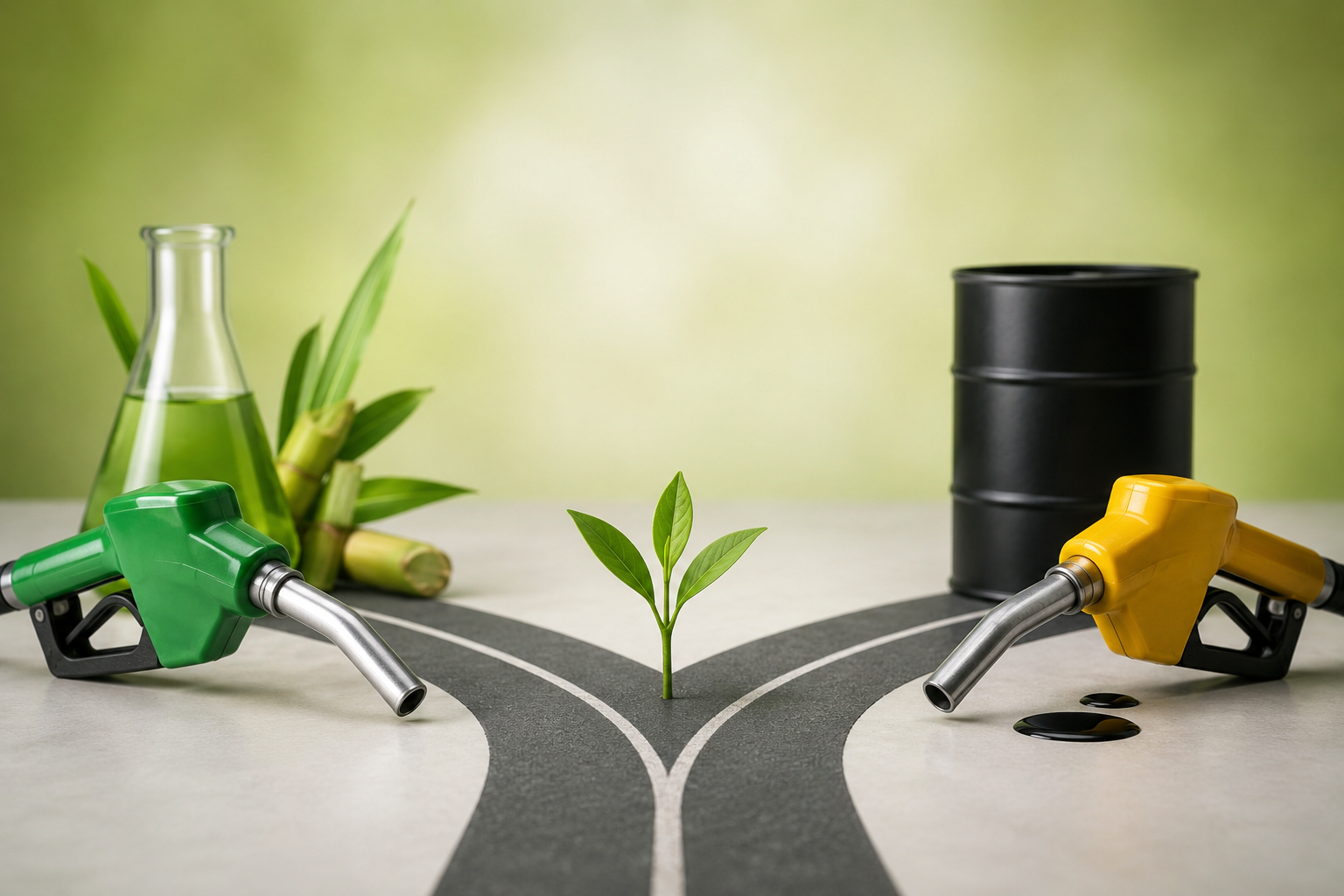
India’s ethanol-blending programme has reached an important stage. E20 petrol is becoming increasingly common, helping the country reduce its dependence on imported fossil fuels while creating new opportunities for farmers and the biofuel industry.
But India’s vehicle fleet is not uniform.
Newer vehicles are designed with modern electronic fuel-management systems and are better equipped to handle higher ethanol blends. At the same time, millions of older vehicles, particularly pre-BS4 two-wheelers using carburettors, were designed around lower ethanol blends and can face compatibility challenges with E20.
This raises an important policy question:
| Should India apply one ethanol blend to every vehicle, regardless of when it was manufactured and what fuel system it uses? |
A more practical approach would be to introduce a phased transition: E10 for older, non-compatible vehicles and E20 for newer, compatible vehicles, while gradually phasing older vehicles out of the fleet.
This would not mean abandoning India’s ethanol programme. It would mean managing the transition more intelligently.
Why India Needs a Phased Ethanol Rollout
The objective of ethanol blending is not simply to increase the percentage of ethanol in petrol. The larger goals include reducing crude-oil imports, improving energy security, supporting agricultural incomes and reducing the environmental impact associated with conventional fuels.
However, the transition has to account for the vehicles already on Indian roads. Older vehicles were built using fuel-system technologies that differ significantly from those found in modern cars and motorcycles. Many older two-wheelers, particularly pre-BS4 models, use carburettors rather than electronically controlled fuel injection.
This distinction matters. A vehicle designed for E10 cannot automatically be assumed to respond to E20 in exactly the same way as a modern vehicle designed around electronic fuel management. That is why a vehicle-linked approach makes sense:
- E10 for older vehicles that are not designed for higher ethanol blends
- E20 for newer, compatible vehicles
- A gradual phase-out of older vehicles
- Greater use of 2G ethanol to reduce food-versus-fuel pressure
The aim should be a transition rather than a sudden switch.
The E10 Option for Older Vehicles
One of the key arguments emerging from the current ethanol debate is that E10 could continue to be made available for older vehicles while E20 remains the standard for newer vehicles. This is particularly relevant to older carburetted two-wheelers.
This view has gained wider traction recently. India’s Chief Economic Advisor has called for E10 petrol to remain available for older vehicles, a caution echoed in commentary that has argued for bringing back E10 for older vehicles while working out the food-versus-fuel trade-off.
The concern is not simply that ethanol is inherently unsuitable for vehicles. The bigger issue is whether a particular vehicle’s fuel system, materials and calibration were designed to operate with a higher ethanol concentration.
For an older vehicle, continuing to provide an E10 option could offer a practical bridge while the vehicle remains on the road. Over time, however, this should not become a permanent exemption.
| The Key Principle The purpose of E10 availability should be to manage the transition while the older fleet gradually declines, not to maintain an indefinitely separate fuel system. |
The E20 Problem Is More Specific Than It Appears
The debate around E20 is sometimes presented as though all older vehicles will automatically experience the same problems. The reality is more specific. Two areas deserve particular attention:
- Carburettor-based fuel systems
- Older fuel-system materials such as rubber seals, gaskets and fuel lines
1. Carburettors and E20
A carburettor is primarily a mechanical fuel-metering device. Unlike a modern electronically controlled system, it does not continuously monitor engine conditions and calculate the appropriate amount of fuel based on sensor data.
Ethanol has a different chemical and energy profile from petrol and also carries additional oxygen. When the fuel composition changes, an older carburettor may not be able to compensate automatically. As a result, a vehicle that was calibrated for a lower ethanol blend may operate differently when exposed to E20.
The important point is that this is largely a technology and compatibility issue, rather than evidence that E20 is unsuitable for every petrol vehicle. Industry commentary has narrowed this concern down specifically to carburetted, mainly pre-BS4, two-wheelers, rather than the wider petrol fleet. This is a fast-evolving area, and a closer, data-backed look at
exactly which vehicle segments are affected is a subject Khaitan Bio Energy plans to explore further in an upcoming blog.
2. Older Rubber Components
Older vehicles may also contain fuel-system components made from materials that were not designed for prolonged exposure to higher ethanol concentrations. Fuel lines, seals and gaskets can be affected over time depending on the materials used and the vehicle’s design.
Some of these components can be replaced with ethanol-compatible alternatives. However, carrying out such modifications across millions of older vehicles would take considerable time and investment. That makes a lower ethanol blend such as E10 a practical transition option for vehicles that have not yet been upgraded or retired.
Why Modern Vehicles Are Different: ECU and MPFI
The fuel systems used in modern vehicles are fundamentally different from older carburetted systems. Most newer petrol vehicles use an Engine Control Unit (ECU) together with an electronic fuel-injection system such as Multi-Point Fuel Injection (MPFI).
The ECU is essentially the digital brain of the engine. It continuously receives information from sensors, processes that information using programmed maps and algorithms, and sends commands to different engine components, allowing the engine to adjust its operation in real time.
How an ECU Works
The ECU’s operation can be understood in three basic stages.
1. Data Gathering
The ECU receives continuous information from sensors monitoring factors such as airflow, engine speed, engine temperature, coolant temperature, throttle position, and other engine operating conditions.
2. Calculation
The ECU processes this information using programmed maps and algorithms. It calculates how much fuel the engine needs and when the ignition spark should occur under the current operating conditions.
3. Actuation
The ECU then sends electrical commands to components such as fuel injectors, ignition coils, idle-control components, and other emissions-related systems. This process happens continuously while the engine is operating.
| The Core Difference A carburettor relies largely on fixed mechanical characteristics. An ECU can measure, calculate and adjust. |
What Does the ECU Control?
Fuel Injection
The ECU controls the duration for which a fuel injector remains open, commonly referred to as injector pulse width. This allows the system to maintain the appropriate air-fuel mixture under different engine loads and speeds.
Ignition Timing
The ECU also determines when the spark should occur. Correct ignition timing helps the engine produce power efficiently while reducing the risk of unwanted combustion or engine knocking.
Emissions and Diagnostics
Modern ECUs also monitor emissions-related components and engine sensors. When something operates outside the expected range, the system can record a diagnostic trouble code (DTC), which can help technicians identify the problem. This diagnostic capability is another major advantage over older mechanical fuel systems.
What Is MPFI?
MPFI stands for Multi-Point Fuel Injection. An MPFI engine uses a separate fuel injector for each cylinder. Instead of relying on a carburettor to create and distribute a fuel-air mixture mechanically, the system uses electronically controlled injectors to deliver a precise quantity of fuel into the intake port associated with each cylinder. The ECU determines how much fuel is required and controls the injectors accordingly.
How MPFI Works
| Sensors → ECU → Fuel Injectors → Engine |
- Sensors: monitor conditions such as engine speed, airflow and temperature.
- ECU: processes the sensor information and calculates the required fuel quantity.
- Injectors: each delivers the calculated amount of fuel into its respective intake port.
Because this process is electronically controlled, the system can adjust fuel delivery as engine conditions change.
Types of MPFI Systems
Sequential Injection
Each injector operates individually and is timed according to the engine’s intake cycle. This provides highly precise fuel delivery.
Batch Injection
The injectors operate in groups rather than completely independently. Several cylinders receive fuel during the same injection event.
Simultaneous Injection
All injectors operate at the same time. This is a simpler approach, although it provides less individual timing control than sequential injection.
Advantages and Disadvantages of MPFI
Compared with traditional carburettor systems, MPFI offers several advantages: better fuel control, improved fuel economy, faster throttle response, smoother engine operation, more consistent idling, lower emissions, and better adaptation to changing operating conditions.
It also has trade-offs: higher repair costs, more complex wiring, greater dependence on electronic components, and sensors that can be more expensive to replace than a carburettor’s mechanical parts.
Despite these drawbacks, the electronic control provided by MPFI and the ECU is precisely what makes modern vehicles better equipped to manage changes in fuel composition.
Carburettor vs ECU + MPFI
| Feature | Feature | ECU + MPFI |
| Fuel metering | Mechanical | Electronic |
| Sensor-based adjustment | Limited or none | Continuous |
| Fuel delivery | Shared mechanical mixture | Individually controlled injectors |
| Response to changing conditions | Limited | Real-time adjustment |
| Fuel efficiency | Generally lower | Generally better |
| Diagnostics | Very limited | Electronic diagnostic capability |
| E20 compatibility | Depends heavily on vehicle design | Modern systems are generally better equipped |
| The E20 compatibility debate should focus on the specific vehicle technology, rather than treating every petrol vehicle as identical. |
The Food-versus-Fuel Question
The ethanol debate does not end with vehicle compatibility. There is another important issue: where the ethanol comes from.
India’s ethanol production can involve feedstocks such as sugarcane, maize, rice and other agricultural products. These resources have competing uses. Maize, for example, is important not only as an ethanol feedstock but also as animal feed. Agricultural land and water are also finite resources.
As ethanol blending targets increase, India therefore needs to consider the potential trade-off between food, feed, water and fuel. This is why the next stage of India’s ethanol programme should not focus exclusively on increasing the blending percentage. It should also focus on developing better feedstocks.
Why 2G Ethanol Matters
This is where second-generation, or 2G, ethanol becomes particularly important. Unlike conventional ethanol that can rely heavily on food and feed crops, 2G ethanol can be produced from lignocellulosic agricultural residues, including rice straw, agricultural waste, bagasse and other crop residues.
These materials are not primarily grown for food. Instead, they are residues generated during agricultural production. Using them for ethanol creates an opportunity to increase fuel production without placing the same direct pressure on food crops.
Rice Straw: From Agricultural Waste to Fuel
Rice straw is a particularly important example. Large quantities of rice residue are generated every year. Where farmers do not have economically viable alternatives, some of this residue can be burned in fields, contributing to air pollution.
Converting rice straw into 2G ethanol can address two problems simultaneously:
| Agricultural Residue → 2G Ethanol → Renewable Fuel |
At the same time, it can reduce dependence on food and feed crops as ethanol feedstocks. This makes 2G ethanol an important part of the long-term solution to the food-versus-fuel challenge.
Phasing Out Older Vehicles
Providing E10 for older vehicles can solve the immediate compatibility problem. But it cannot be the entire solution.
If India wants to move toward a predominantly E20-compatible fleet, the number of vehicles requiring E10 must gradually decline. That means the fuel transition needs to be connected with India’s vehicle replacement and scrappage policies. Older vehicles should not remain on the road indefinitely simply because E10 remains available. Instead, India could combine:
- Fitness testing
- Emission standards
- Scrappage incentives
- Replacement incentives
- Affordable access to newer vehicles
- A defined transition period for E10
The objective should be to make the transition predictable for vehicle owners.
E10 Should Be a Bridge, Not a Permanent Exception
A well-designed E10 programme for older vehicles should have a clear purpose. It should act as a bridge between two vehicle generations. As older carburetted vehicles leave the road through normal replacement and scrappage, the need for E10 should decline. At the same time, newer ECU- and fuel-injection-equipped vehicles can increasingly operate on E20. This creates a natural transition:
| Older Fleet → E10 → Replacement / Retirement → Newer Fleet → E20 |
That is a more practical approach than forcing every vehicle onto the same fuel blend overnight.
What a Phased E10-to-E20 Rollout Could Look Like
A practical transition could include the following steps:
| Step | What It Involves |
| 1 | E10 for older, non-compatible vehicles: continue making E10 available for vehicles not designed for higher ethanol blends, particularly vulnerable carburetted two-wheelers. |
| 2 | E20 for newer vehicles: keep E20 as the standard fuel for newer vehicles designed and certified for the blend. |
| 3 | Gradually reduce the E10 fleet: the E10 allocation should shrink as older vehicles leave the road, not remain fixed. |
| 4 | Strengthen scrappage and fitness policies: apply progressively stronger fitness and emissions requirements to older, less-compliant vehicles, paired with attractive replacement incentives. |
| 5 | Support retrofits where practical: offer affordable, ethanol-compatible fuel-system upgrades for roadworthy older vehicles as an alternative transition path. |
| 6 | Accelerate 2G ethanol: expand agricultural-residue-based ethanol capacity so future blending targets don’t add pressure to food, feed and water resources. |
A Better Way to Think About India’s Ethanol Transition
The debate should not be framed as E10 vs E20. It should be framed as: how do we move an entire vehicle fleet from one fuel technology to another without leaving millions of existing vehicle owners behind? That requires two transitions happening together.
Transition One: The Vehicle Fleet
Older carburetted vehicles gradually move toward:
| E10 → Retrofit or Replacement → E20-Compatible Vehicle |
Transition Two: The Ethanol Feedstock Base
India gradually moves from greater dependence on conventional agricultural feedstocks toward:
| Food / Feed Crops → Greater Use of Agricultural Residues → Stronger 2G Ethanol Capacity |
These two transitions complement each other. A cleaner and more compatible vehicle fleet addresses the demand side. A larger 2G ethanol industry addresses the supply-side food-versus-fuel challenge.
Where Khaitan Bio Energy Fits In
For India’s ethanol programme to continue expanding sustainably, the country will need ethanol production pathways that do not place unnecessary pressure on food and feed resources. This is where Khaitan Bio Energy’s focus on second-generation bioethanol from agricultural residues becomes relevant.
Khaitan Bio Energy’s technology is designed to convert lignocellulosic agricultural residue, including rice straw, into 2G bioethanol. The opportunity is significant: agricultural waste that might otherwise be burned or underutilised can become a source of renewable fuel.
The company’s technology has been certified at Technology Readiness Level 8 (TRL-8) by the Department of Biotechnology, Government of India, evaluated by the Centre for High Technology under the Ministry of Petroleum and Natural Gas, and selected for commercial deployment under the PM JI-VAN Yojana.
As India’s ethanol programme moves into its next phase, increasing ethanol supply alone will not be enough. The country also needs to ask what feedstocks should supply that ethanol. If the answer increasingly includes agricultural residues, India can expand its ethanol capacity while addressing waste management, rural value creation and the food-versus-fuel challenge at the same time.
To learn more about Khaitan Bio Energy’s 2G bioethanol technology, visit khaitanbioenergy.com.
Conclusion: Phasing Ethanol Is About Managing the Transition
India does not have to choose between its ethanol ambitions and the millions of older vehicles already on its roads. A phased approach can address both.
| E10 can provide a transition fuel for older, non-compatible vehicles. E20 can remain the standard for newer, compatible vehicles. Older vehicles can gradually be retired or upgraded. And 2G ethanol can expand the country’s fuel supply without putting the same pressure on food and feed crops. |
The important distinction is that the problem is not simply “E20 versus old vehicles.” It is a question of vehicle technology, fuel compatibility, fleet turnover and feedstock sustainability. Carburettor-based vehicles and modern ECU-MPFI vehicles do not manage fuel in the same way. Treating them as though they do risks creating unnecessary disruption.
A smarter ethanol strategy would therefore phase the transition according to the technology already on India’s roads. At the same time, India should accelerate 2G ethanol so that increasing blending does not simply mean diverting more food and feed resources toward fuel.
The long-term objective remains clear: a modern, E20-compatible vehicle fleet supported by a sustainable ethanol industry that increasingly turns agricultural waste into fuel. That is not a retreat from ethanol blending. It is a more practical way to make the transition work.
References
This article draws on the following recent reporting and commentary on India’s ethanol-blending policy:
- CEA Calls For E10 Petrol For Older Vehicles – NewsBytes
- Bring Back E10 For Older Vehicles: Work Out The Food-Versus-Fuel Trade-Off – The Indian Express
- CEA Urges Caution On Higher Ethanol Blending, Backs E10 Option For Older Two-Wheelers – Chini Mandi
Frequently Asked Questions
1. Why should E10 be available for older vehicles?
Older vehicles, particularly pre-BS4 carburetted two-wheelers, may not have been designed or calibrated for higher ethanol blends. Maintaining an E10 option during the transition can provide a compatible fuel while these vehicles are gradually replaced, retired or upgraded.
2. Why do carburettor vehicles have more difficulty with E20?
Carburettors use mechanical fuel metering and cannot continuously adjust fuel delivery based on sensor data. A modern ECU-controlled system can make real-time adjustments based on engine conditions, whereas a traditional carburettor has much less ability to compensate for changes in fuel composition.
3. What is an ECU?
An Engine Control Unit is the electronic computer that manages important engine functions. It receives information from sensors, calculates the required fuel and ignition settings, and sends commands to components such as fuel injectors and ignition coils.
4. What is MPFI?
MPFI stands for Multi-Point Fuel Injection. It uses separate injectors for individual engine cylinders and electronically controls the amount of fuel delivered to each intake port.
5. Is E20 a problem for all petrol vehicles?
No. Compatibility depends on the vehicle’s design, fuel system, materials and manufacturer specifications. Modern vehicles designed for E20 are fundamentally different from older carburetted vehicles that were built around lower ethanol blends.
6. What is the food-versus-fuel issue?
Some ethanol feedstocks, including maize, sugarcane and grains, also have important food or animal-feed uses. Increasing ethanol production from these crops can therefore create competing demands for agricultural resources.
7. How can 2G ethanol help?
2G ethanol uses lignocellulosic agricultural residues such as rice straw and bagasse. This can increase ethanol production while reducing direct dependence on food and feed crops.
8. Why should older vehicles eventually be phased out?
If E10 remains available indefinitely for every older vehicle, the transition to an E20-compatible fleet could remain incomplete. A combination of vehicle fitness testing, scrappage incentives, replacement programmes and a defined E10 transition period can gradually reduce the number of vehicles requiring lower-blend fuel.
9. Does supporting E10 mean India should abandon E20?
No. A phased E10-E20 approach is not a rejection of ethanol blending. It is a way of managing the transition between older vehicles that may require a lower blend and newer vehicles designed for higher ethanol blends.
10. What is the long-term goal?
The long-term goal should be a vehicle fleet that is compatible with higher ethanol blends, supported by an ethanol industry increasingly based on sustainable feedstocks such as agricultural residues.