

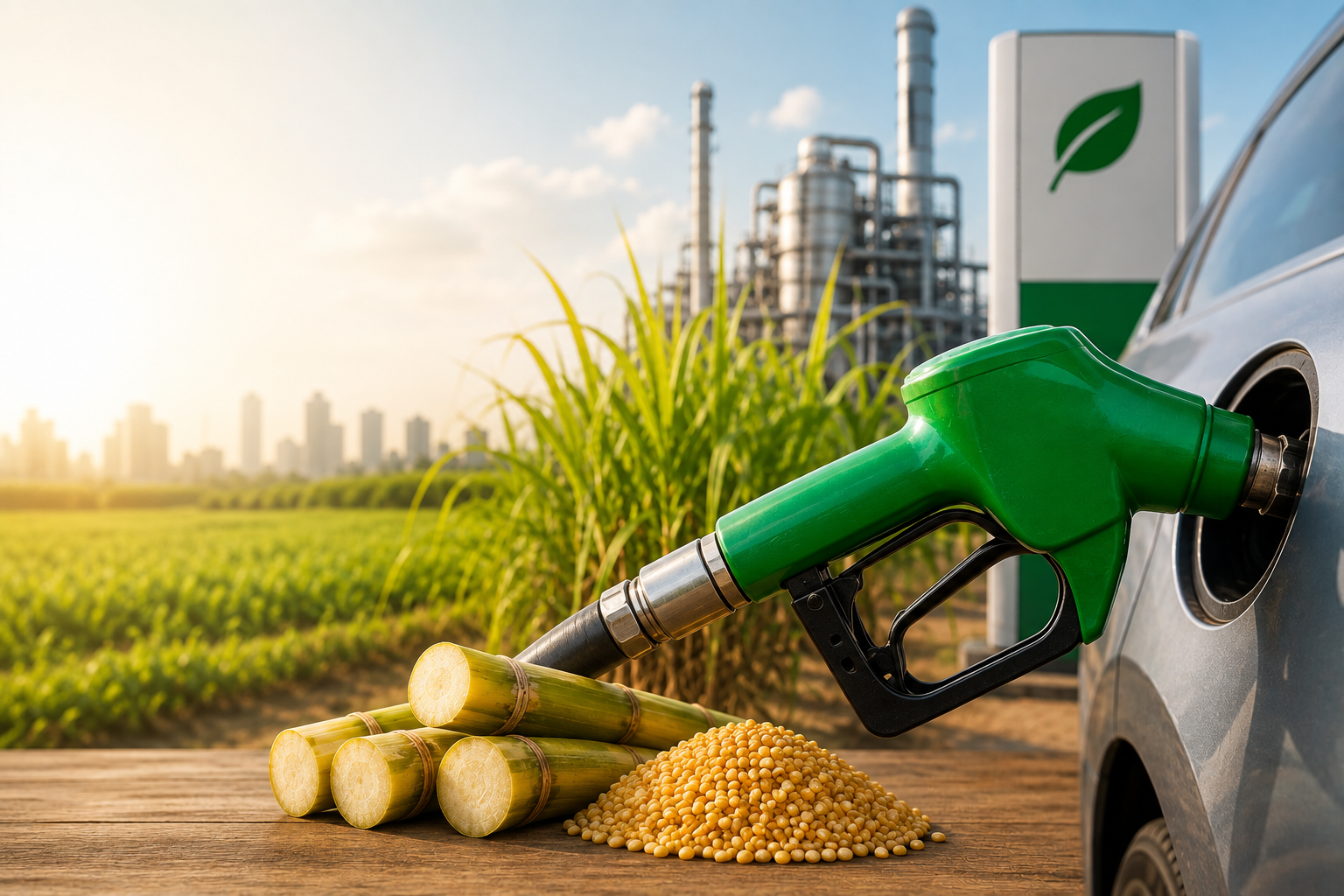
When petrol prices hold steady despite chaos in the global crude market, most drivers assume the government is simply eating the cost somewhere else. It is a reasonable assumption and, for the most part, an incorrect one.
One of the biggest reasons India’s pump prices have not tracked the sharpest swings in international crude is quietly flowing into every litre of petrol sold across the country: ethanol. Roughly a fifth of what goes into a car’s fuel tank today is not petroleum at all. It is ethanol, produced domestically, priced through a stable, pre-agreed mechanism, and largely insulated from the price spikes that rattle oil markets whenever geopolitics turns volatile.
That raises an obvious question. How much has this actually saved Indian consumers and is it enough to explain why petrol prices have stayed relatively steady through a decade of crude oil turbulence?
The numbers, drawn from government data and independent reporting, suggest the answer is: a great deal. This piece walks through the mechanics of how ethanol blending shields consumers, what it has meant for India’s economy and environment, and why the next phase of the programme will depend on a very different kind of ethanol.
India’s Ethanol Journey
India’s tryst with ethanol blending did not begin as an energy security strategy. It began, in the mid-2000s, as a modest pilot to give sugarcane farmers an additional market for surplus molasses. For years, blending levels barely moved. As late as 2013-14, ethanol made up just 1.53% of the petrol sold in India.
What changed was policy intent. Under the Ethanol Blended Petrol (EBP) Programme, the government set a series of increasingly ambitious blending targets, backed by pricing support for producers, expanded feedstock permissions, and infrastructure investment across the country’s oil marketing companies (OMCs). The original goal of 20% blending, or E20, by 2030 was pulled forward twice, first to 2025 and then effectively delivered even earlier. Blending rose from around 1.5% in 2014 to 20% in 2025, roughly a thirteen-fold increase in eleven years, with the government describing the achievement as five years ahead of the original target.
The supply side scaled just as fast. Ethanol production climbed from 38 crore litres in 2014 to 661.1 crore litres by June 2025, with installed distillation capacity reported at over 1,600 crore litres by September 2024, more than double what existed four years earlier. Feedstock sources diversified too, from sugarcane molasses to surplus grain, maize and damaged foodgrain, reducing the programme’s dependence on any single crop cycle.
| Milestone | Blending Level | Approx. Year |
| Programme origin | Under 2% | 2013-14 |
| First major scale-up | ~10% (E10) | 2022 |
| Interim target | ~15% | 2023-24 |
| National target achieved | 20% (E20) | 2025-26 |
By any measure, this is one of the fastest fuel-transition programmes India has executed. But the more consequential story is not how quickly blending scaled, it is what that scale-up has meant at the petrol pump.
How Ethanol Keeps Petrol Prices Lower
To understand why ethanol blending matters to a consumer filling up a two-wheeler or a hatchback, it helps to separate two different fuel markets that most people treat as one.
Petrol sold in India is a blend: roughly 80% refined petroleum and, from 2025-26, around 20% domestically produced ethanol. The petroleum component is priced off international crude benchmarks, it rises and falls with OPEC decisions, shipping disruptions, and geopolitical shocks in oil-producing regions. The ethanol component, by contrast, is procured by OMCs from Indian distilleries at pre-agreed, government-notified prices that are fixed for an entire ethanol supply year and do not move with the crude cycle.
This structural difference gives ethanol its price-stabilising power. When crude spikes, only four-fifths of the fuel in the tank gets more expensive; the remaining fifth stays anchored to a domestic price locked in months earlier. Without that fifth, the full weight of a crude spike would fall on the refined-petroleum component alone, requiring proportionally more imported crude at whatever price the global market was demanding that week.
This mechanism was tested directly during a recent spike in global crude prices. When the Indian crude basket surged to around $135 a barrel, the Ministry of Petroleum and Natural Gas said petrol without any ethanol blending was projected to cost roughly ₹125 per litre in Delhi. Instead, consumers paid ₹94.77 per litre, because 20% of every litre was domestically produced ethanol procured at stable, pre-agreed prices insulated from the global crude spike, a gap the ministry described as “nearly ₹30 per litre in savings at the pump during the peak of the crisis,” and framed not as ethanol being the cheapest fuel available, but as protection from extreme volatility while keeping more of the fuel bill inside the domestic economy.
That distinction matters. Ethanol blending is not a subsidy that makes petrol artificially cheap in normal times. It is closer to a buffer, a mechanism that narrows the gap between what consumers pay and what a crude-only fuel basket would have cost during a shock. The larger the shock, the more visible the buffer becomes.
| Scenario (Illustrative, Delhi) | Approx. Petrol Price |
| Crude at $135/barrel, no ethanol blending | ~₹125/litre |
| Crude at $135/barrel, with 20% ethanol blend (E20) | ₹94.77/litre |
| Approximate consumer saving during the spike | ~₹30/litre |
There are three structural reasons this works at scale. First, lower import dependence: every litre of domestically produced ethanol is a litre of petroleum product India does not need to import, which directly reduces the volume exposed to global price swings. Second, reduced foreign exchange outflow: crude oil is bought in dollars, so substituting ethanol for imported petroleum components keeps rupee spending inside the domestic economy rather than sending it abroad. Third, price predictability: because ethanol pricing is administratively set rather than market-linked, it gives OMCs and, by extension, the government, a stable input cost to plan around even when crude markets are anything but stable.
None of this means petrol prices in India are immune to global crude cycles, they are not. But the ethanol component has become a meaningful shock absorber, one that becomes more powerful as the blending ratio rises.
Ethanol Is Saving India Billions
The consumer-facing price story is really a smaller piece of a much larger macroeconomic one. Since crude oil is India’s single largest import bill item, even a modest reduction in import volumes compounds into significant national savings over a decade.
Government disclosures on this have been consistent in direction, even as the exact figure keeps climbing alongside blending levels. By mid-2026, with a full ethanol supply year of E20 behind it, the Ministry of Petroleum and Natural Gas put cumulative savings at over ₹1.97 lakh crore in foreign exchange and 316 lakh tonnes of crude oil substituted since 2014-15 -up from an eleven-year estimate of more than ₹1.44 lakh crore and around 245 lakh metric tonnes of crude substitution through 2024-25.
| Reporting Period | Cumulative Forex Savings | Crude Oil Substituted |
| FY 2014-15 to 2024-25 | ₹1.44 lakh crore | 245 lakh MT |
| FY 2014-15 to mid-2026 | ₹1.97 lakh crore | 316 lakh MT |
Beyond the headline number, the savings carry a second-order benefit: energy security. A country that imports a smaller share of its transport fuel is less exposed when a producing region goes through a crisis, when shipping lanes are disrupted, or when a cartel tightens supply. Ethanol blending does not eliminate that exposure, India still imports the large majority of the crude it refines, but it narrows it, litre by litre, year by year. There is a currency-stability dimension too: crude purchases are settled in dollars, and a lower import bill eases pressure on the rupee during periods when oil-importing economies typically see their currencies weaken. Keeping close to ₹2 lakh crore of fuel spending inside the domestic economy, flowing to Indian distilleries and farmers rather than overseas producers, is a structurally different kind of energy expenditure than the one India ran for decades before the EBP Programme scaled up.
Cleaner Air Alongside Lower Fuel Costs
The economic case for ethanol blending would be compelling on its own. What makes it unusual as a policy intervention is that the environmental case runs in the same direction rather than working against it.
Ethanol burns more completely than pure petrol, which is why blended fuel produces measurably lower tailpipe emissions of several key pollutants. Government-cited estimates from the ARAI-SIAM-IOCL joint study on E20 fuel found that ethanol-blended petrol reduces carbon emissions by around 30% compared with unblended petrol, alongside improvements in acceleration and combustion quality. Cumulative CO2 reductions across the programme’s life are estimated at nearly 736 lakh tonnes through 2024-25, equivalent to planting about 30 crore trees, with more recent industry tracking placing the figure at over 950 lakh tonnes since 2014-15. Ethanol’s higher oxygen content also lowers emissions of carbon monoxide and unburnt hydrocarbons -both significant contributors to urban air pollution -while its higher octane rating, around 108.5 versus 84.4 for pure petrol, supports cleaner combustion in modern engines.
There is a second, less obvious environmental channel that matters a great deal for regions like north India: what ethanol blending does to agricultural residue. When rice or wheat straw becomes a feedstock for ethanol production rather than a waste product to be disposed of, farmers have a financial incentive to sell it rather than burn it in the field. Open burning of crop residue is a major contributor to the seasonal air-quality crisis that grips the Indo-Gangetic plain every autumn and winter, and expanding a functioning market for that residue is one of the few interventions that addresses the practice at its economic root rather than through enforcement alone.
Taken together, this is why ethanol blending resists the usual trade-off framing of “either cheaper or cleaner.” The blending mechanism produces both effects through the same underlying substitution, domestically produced ethanol in place of a portion of imported, higher-carbon petroleum.
Benefits for Farmers
The rural economy is the third leg of the ethanol story, and it is worth stating that ethanol blending has created a large, recurring buyer for agricultural output that previously had limited commercial use.
Sugarcane growers were the programme’s original beneficiaries, since surplus molasses and, later, sugarcane juice became eligible feedstocks. As blending targets rose, eligibility widened to include maize, damaged foodgrain, and surplus rice, diversifying the farmer base and reducing dependence on any single crop cycle. Payments to distilleries and, through them, to farmers have scaled alongside blending volumes, cumulative disbursements are cited at ₹1.66 lakh crore since 2014-15 in recent government statements.
This deserves balanced framing. Ethanol demand has drawn scrutiny, including parliamentary questions over whether foodgrain meant for public distribution is being diverted to distilleries. The government’s stated position is that only surplus grain certified by the Department of Food & Public Distribution, after every food security obligation has been met, is approved for ethanol production. The underlying economic logic still holds: a diversified feedstock base gives farmers an additional, relatively stable revenue stream -provided the surplus-first principle is genuinely enforced as volumes rise.
The Road Ahead
India’s blending trajectory does not stop at E20. Pilot programmes and policy discussions around E22, E25 and even E30 are already under way, and each incremental step amplifies the effects described above, more foreign exchange saved, more emissions avoided, more rupees routed to domestic producers instead of overseas crude exporters.
But higher blending ratios expose a structural limit that conventional, crop-based ethanol cannot solve indefinitely: feedstock. Sugarcane, maize and surplus grain are finite resources, and pushing blending percentages higher while relying solely on food-based feedstocks risks tightening the link between fuel demand and agricultural commodity markets, the so-called food-versus-fuel tension that policymakers have been careful to avoid so far.
This is precisely why second-generation, or 2G, ethanol has moved from a research curiosity to a policy priority. Unlike conventional ethanol, 2G ethanol is produced from lignocellulosic agricultural residues, rice straw, wheat straw, corn cobs, bagasse and similar biomass with no food value that is otherwise often burned in the open. India’s non-food agricultural residue base runs into hundreds of millions of tonnes annually, most of it currently underutilised. Converting even a fraction of that into fuel-grade ethanol would let blending targets keep climbing without pressuring food-grain or sugar markets.
The hurdles are real. Breaking down cellulosic biomass into fermentable sugars is harder chemistry than fermenting sugarcane juice or grain starch, and 2G plants globally have struggled to move from pilot scale to commercially viable operation. That is the gap schemes like PM JI-VAN Yojana aim to close, through viability-gap funding for advanced biofuel projects that can demonstrate reliable, scalable 2G production. Conventional ethanol got India to 20 per cent blending; sustaining anything beyond that, without straining food security, will depend on how quickly 2G capacity can be commercialised.
Khaitan Bio Energy and India’s 2G Ethanol Future
This is the segment of the ethanol economy where Khaitan Bio Energy operates. The company holds a patented process for converting rice straw, one of India’s most abundant and least commercially utilised agricultural residues, into second-generation ethanol, alongside recoverable co-products including silica and gypsum, with the plant’s own lignin used to generate process steam in a closed-loop, near-zero-liquid-discharge setup.
The technology’s development path runs through India’s public biotechnology research infrastructure rather than around it. Khaitan Bio Energy’s pilot facility, titled the “Cellulosic Ethanol Pilot Plant for Rice Straw Management,” was developed with support from the Biotechnology Industry Research Assistance Council (BIRAC) and was successfully validated in 2021, having advanced to Technology Readiness Level 8, the stage at which a technology has been proven in an operational environment and is ready for commercial deployment rather than further pilot testing.
Rice straw is a particularly well-suited feedstock for this model. It is produced in enormous volumes across India’s paddy-growing states, has essentially no food value, and is disposed of overwhelmingly through open-field burning, the same practice responsible for a large share of the seasonal air pollution crisis in north India. A commercially viable rice-straw-to-ethanol pathway addresses two problems with one input stream: it gives farmers a market for residue they currently burn, and it supplies fuel-grade ethanol without competing against food or feed crops. The circular design, ethanol as the primary output, with silica and gypsum recovered as saleable co-products, is also what gives the model a route to commercial-scale economics rather than remaining a subsidised demonstration project, which is the barrier that has stalled 2G ethanol efforts in many other markets.
As India’s blending ambitions extend toward E22 and beyond, this is the layer of the programme, non-food biomass, proven at pilot scale, ready for commercial replication, that will determine whether those targets are met sustainably or run into the same feedstock ceiling that constrains conventional ethanol.
Conclusion
It is tempting to file ethanol blending under environmental policy and leave it there. The evidence suggests that framing understates what the programme has actually done. Ethanol blending is, first and foremost, an economic policy, one that has kept Indian consumers meaningfully more insulated from global crude price shocks than they would otherwise have been, while saving the country close to ₹2 lakh crore in foreign exchange, strengthening energy security, and routing well over ₹1 lakh crore rupees directly into farmers’ incomes. That it also cuts emissions and reduces crop-residue burning makes it one of the rarer policy interventions where the economic and environmental incentives point the same way rather than pulling against each other.
As blending levels rise toward E22, E25 and beyond, these benefits will scale with them, but only if the feedstock base scales too. Conventional, crop-based ethanol built the first 20% points of India’s blending programme. Sustaining the next stretch, without reopening the food-versus-fuel debate, will depend on how fast second-generation ethanol, made from rice straw, wheat straw and other agricultural residues, moves from validated pilot technology to commercial-scale production across the country.
Frequently Asked Questions
1. Does ethanol blending actually reduce petrol prices in India?
Ethanol blending does not make petrol cheaper in absolute terms every single day, but it significantly limits how much petrol prices rise when global crude oil prices spike. Since roughly 20 per cent of every litre of petrol sold in India is now domestically produced ethanol, priced through a stable, pre-agreed mechanism rather than tracking international crude, that portion of the fuel does not get more expensive when crude prices surge. The government has cited a real-world example where petrol in Delhi would have cost around ₹125 per litre during a crude price spike to $135 a barrel, but consumers actually paid ₹94.77 per litre because of the ethanol blend. The saving is most visible during periods of high crude volatility, which is exactly when consumers need price protection the most.
2. How much money has India saved through ethanol blending?
Cumulative savings have grown steadily as blending percentages have risen. Government and industry figures place total foreign exchange savings from the Ethanol Blended Petrol Programme at over ₹1.97 lakh crore since the 2014-15 ethanol supply year, alongside the substitution of more than 316 lakh metric tonnes of imported crude oil. These figures reflect money that would otherwise have been spent importing crude oil in dollars, and instead stayed within the domestic economy, flowing to Indian distilleries and, through them, to farmers. As blending volumes continue rising toward E22 and beyond, these cumulative savings are expected to keep climbing.
3. Does ethanol blending reduce pollution and vehicle emissions?
Yes. Ethanol burns more completely than pure petrol due to its higher oxygen content, which lowers emissions of carbon monoxide, unburnt hydrocarbons and carbon dioxide. Government-cited studies estimate that E20 fuel cuts carbon emissions by around 30 per cent compared with unblended petrol. Separately, cumulative CO2 emission reductions attributed to the ethanol blending programme are estimated in the range of 736 to over 950 lakh tonnes since 2014-15, depending on the reporting period used. Ethanol blending also reduces crop-residue burning by giving farmers a commercial buyer for agricultural waste, which indirectly improves seasonal air quality in regions affected by stubble burning.
4. Is ethanol-blended petrol safe for vehicle engines?
Modern vehicles designed or calibrated for E20 fuel run on it without issues, and manufacturers report no verified evidence of widespread engine damage across the crores of vehicles currently using E20 or higher blends. A joint study by the Automotive Research Association of India, the Society of Indian Automobile Manufacturers and Indian Oil Corporation found that E20 fuel can cause a marginal 2 to 6 per cent reduction in mileage depending on vehicle type and age, while also improving acceleration and combustion quality. Older vehicles, particularly those manufactured before BS-VI norms, especially pre-2016 models, may need certain rubber components and gaskets replaced due to ethanol compatibility, but this does not represent broad engine failure risk.
5. Why is ethanol blending important for India’s economy?
India imports the large majority of the crude oil it refines, making the country highly exposed to global oil price volatility and geopolitical disruptions in producing regions. Ethanol blending reduces this exposure by substituting a growing share of imported petroleum with domestically produced fuel, which lowers the import bill, eases pressure on foreign exchange reserves, and reduces dependence on volatile international markets. Beyond energy security, the programme has also functioned as a rural income scheme, channeling well over a lakh crore rupees to farmers by creating consistent demand for sugarcane, maize, surplus rice and other approved feedstocks.
6. How exactly does ethanol reduce India’s crude oil import requirement?
Every litre of ethanol blended into petrol is a litre that does not need to be sourced from imported crude oil or refined petroleum products. Since India’s petrol pool is now roughly 80 per cent refined petroleum and 20 per cent domestically produced ethanol, the overall volume of crude oil the country needs to import to meet transport fuel demand falls proportionally as the blending ratio rises. Government estimates put cumulative crude oil substitution at over 316 lakh metric tonnes since the programme’s inception, a figure that continues to grow as blending percentages and vehicle numbers both increase.
7. What is the future of ethanol blending in India?
Having reached the 20 per cent (E20) blending target five years ahead of the original 2030 deadline, India’s policy discussion has already shifted toward higher blends such as E22, E25 and E30. Each incremental increase amplifies the programme’s existing benefits -greater foreign exchange savings, lower emissions and increased farmer income -but also increases the strain on conventional, crop-based ethanol feedstocks. The programme’s future sustainability is widely expected to depend on diversifying feedstock sources further, including a faster scale-up of second-generation ethanol production from agricultural residues.
8. Why is second-generation (2G) ethanol important for India’s future fuel strategy?
Conventional ethanol is produced primarily from sugarcane, maize and surplus grain -feedstocks that are ultimately finite and tied to food and agricultural commodity markets. Pushing blending percentages higher using only these sources risks creating food-versus-fuel tensions as demand grows. Second-generation ethanol solves this by using non-food agricultural residues, such as rice straw and wheat straw, which are produced in enormous volumes across India and are otherwise frequently burned in open fields, contributing to seasonal air pollution. Scaling 2G ethanol production, supported by schemes like PM JI-VAN Yojana, would allow India to keep raising blending targets without adding pressure to food security, while simultaneously offering farmers a productive use for residue they currently have no reason to preserve.