

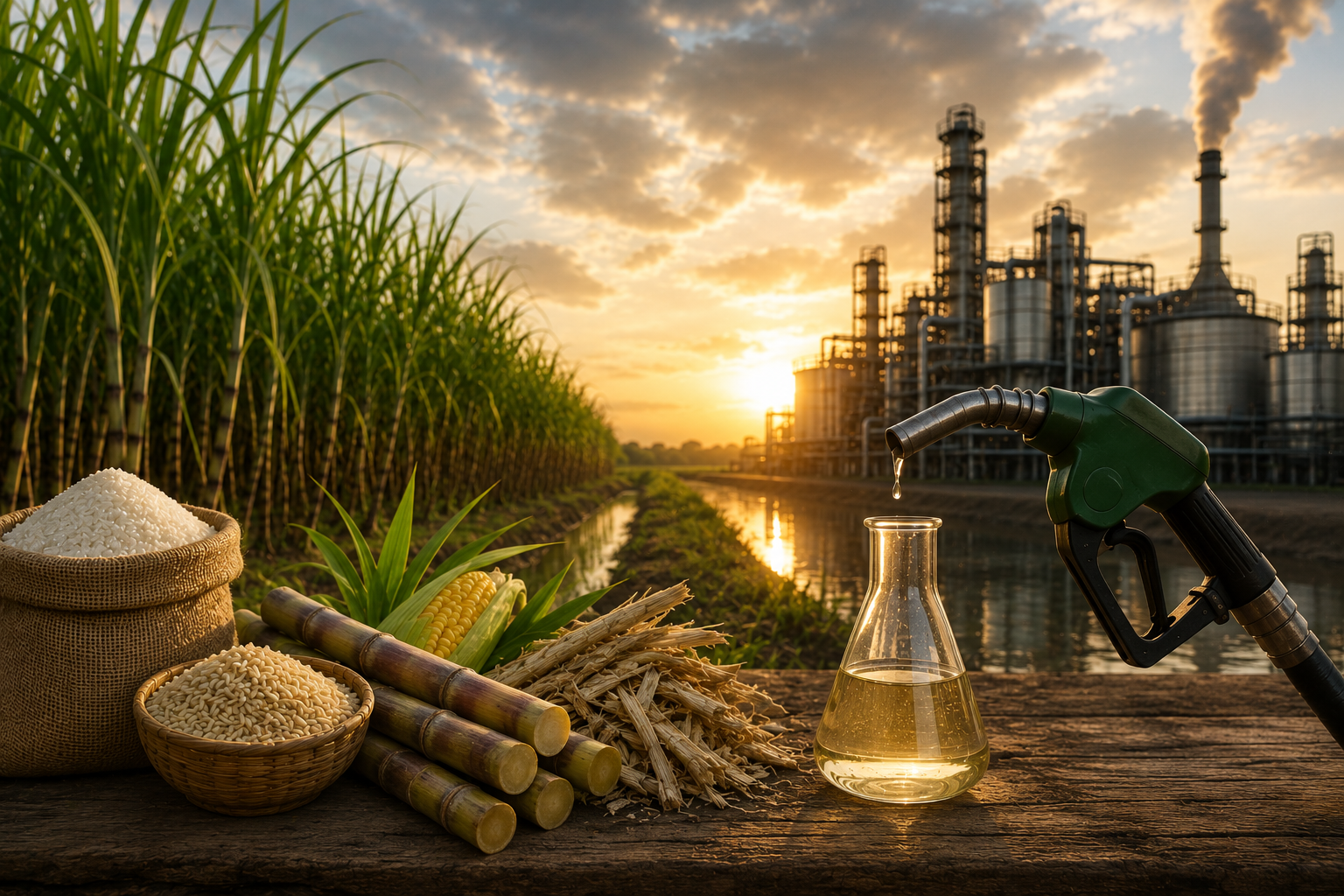
India isn’t going to be selling much sugar to the world for a while. Reuters reported in late June 2026 that trade and industry executives now expect the country’s exportable surplus to stay thin for at least three more seasons. Two things are colliding to cause that: a weak, El Niño-tinged monsoon, and a sugarcane crop that’s increasingly getting pulled toward ethanol distilleries instead of sugar mills.
That single data point sits at the centre of a much bigger story. India’s ethanol blending programme has come a long way since it started as a modest 5 percent mandate back in 2003 – it crossed the E20 target in 2026, and E85 and E100 flex-fuel rollouts are now underway. Ethanol procurement by oil marketing companies has climbed from just 38 crore litres in 2013-14 to 904 crore litres in 2024-25, according to ThePrint’s reporting on All-India Distillers Association (AIDA) data.
Here’s the catch, though. The crops doing the heavy lifting for that growth – sugarcane, rice, and increasingly maize – are the same crops that feed India and draw water from some of the country’s most stressed aquifers. The Central Ground Water Board’s 2025 assessment had already classified several Indian regions as over-exploited, critical, or semi-critical for groundwater.
This isn’t a simple story of a reckless biofuel programme versus an innocent food economy – it’s more complicated than that. Ethanol blending has cut crude oil imports, raised farmer incomes, and genuinely helps cut emissions from road transport. But the feedstock choices behind it – cane, rice, and increasingly grain – carry real, measurable costs in export markets, food-subsidy budgets, and groundwater tables. Understanding both sides is really the only way to see why second-generation (2G) ethanol, made from agricultural residues rather than food crops, isn’t just a talking point anymore. It’s becoming a structural necessity.
This piece walks through the sugar squeeze, the rice and grain diversion debate, the hidden water arithmetic behind every litre of ethanol, and where residue-based 2G technology – including the pathway Khaitan Bio Energy is building – fits into the answer.
The Sugar Squeeze
Until recently, India was the world’s second-largest sugar exporter, shipping an average of 6.8 million metric tonnes a year over the five seasons through 2022-23 – close to 10 percent of global trade, according to Reuters. This season, exports totalled only around 800,000 tonnes before the Government of India suspended shipments until September 30, 2026.
Two forces are squeezing the surplus at the same time. The first is weather: this year’s monsoon is forecast to be the weakest in over a decade under El Niño conditions, with June rainfall running more than 40 percent below normal in several regions, according to Reuters. In Maharashtra’s Sangli district, cane farmer Sambhaji Patil told Reuters he’d shelved his plans to plant long-duration cane varieties and switched to soybeans instead – and he isn’t alone; nursery operators are reporting weaker demand for cane seedlings across the board. A separate analysis found rainfall in Maharashtra running at roughly half of normal levels two weeks into the monsoon, even as neighbouring northern Karnataka and parts of Uttar Pradesh saw better conditions.
The second force is ethanol demand itself. An analysis noted that sugarcane-based ethanol output has been stuck at 3-4 billion litres a year for five years now, well below the 9 billion litres of installed capacity. Why? Because government-set ethanol prices for cane juice and B-heavy molasses haven’t moved in nearly four years, even as sugar prices climbed – which leaves mills with little financial incentive to divert more cane to fuel. If that price gap closes, analysts expect a bigger share of cane to flow toward distilleries instead of sugar pans, squeezing sugar supply even further.
You can see the combined effect in the numbers. Industry estimates now put this season’s sugar production at 27.9 million tonnes – below annual domestic consumption of about 28.5 million tonnes, and well under earlier expectations of 30.95 million tonnes, per Reuters. Carry-in stocks for the next season, starting October 1, could fall to roughly 3.5 million tonnes – which traders describe as the lowest level in more than three decades.
Worst-case outlook, with appropriate caution: Some trade sources interviewed by Reuters suggested a severe El Niño combined with rising ethanol demand could push India toward sugar imports – something it last did in 2016-17 and 2017-18 after a similar drought, and at a scale (2009-10) that previously helped triple global sugar prices. Worth stressing: this is a tail scenario flagged by some traders, not a consensus forecast, and the government has so far chosen to review export approvals season by season rather than impose a formal multi-year ban.
Meanwhile, demand on the structural side isn’t slowing down. Industry estimates cited by both Reuters and ChiniMandi suggest India’s ethanol demand could more than double from today’s 12-13 billion litres to around 30 billion litres by 2039-40 as blending levels rise and flex-fuel vehicle adoption picks up – a trajectory that will keep pulling on cane supply no matter how the next few monsoons play out.
The Rice Diversion Problem
Sugarcane isn’t the only feedstock under pressure to pull double duty. ThePrint’s reporting on India’s evolving ethanol feedstock mix shows that grain-based ethanol – maize and rice combined – now accounts for roughly 65 percent of national ethanol production, with sugarcane supplying the rest. Of the 1,059 crore litres of ethanol contracted for supply in Ethanol Supply Year 2025-26, about 515 crore litres had already been delivered in the first six months, with maize alone contributing 182 crore litres.
Maize’s role has expanded dramatically – from just 6.2 percent of ethanol production in ESY 2022-23 to nearly half of production by ESY 2024-25, per AIDA data reported by ThePrint. Rice, though, remains a significant and contested part of the basket. India is currently sitting on Food Corporation of India (FCI) rice stocks estimated at around three times the prescribed buffer norm, and AIDA argues that diverting a portion of that surplus – including broken and damaged grain – to ethanol is a productive use of stock that would otherwise go to waste.
Not everyone buys that logic. ICRIER agricultural economist Ashok Gulati told ThePrint that FCI procures and stores rice at a cost of roughly Rs 42 per kilogram – a cost built on subsidised power and fertiliser – and then turns around and sells that same rice to ethanol distilleries at Rs 22-23 per kilogram. He called it “the most irrational policy that the government has,” arguing that hidden electricity and fertiliser subsidies mask ethanol’s true production cost, and that rice shouldn’t be anchoring a national fuel programme in the first place.
As ethanol feedstock crops earn better guaranteed returns, farmers may increasingly favour maize, rice, and sugarcane over pulses and oilseeds – reshaping cropping patterns in ways that could deepen India’s existing protein and edible-oil import dependence.
At its core, the debate over which crop should anchor India’s ethanol programme is as much about subsidy logic and water economics as it is about fuel policy. AIDA’s pricing data, via ThePrint, shows maize-based ethanol currently fetching Rs 71.86 per litre from oil marketing companies, against Rs 65.61 for sugarcane-based ethanol and Rs 60.32 for rice-based ethanol – a pricing structure that itself signals where policy is trying to steer the industry, even as rice diversion continues on the ground.
The Hidden Water Cost
Strip away the trade and subsidy debate, and a more basic constraint remains: water. ChiniMandi’s reporting on India’s ethanol-water nexus cites the NITI Aayog and Ministry of Petroleum and Natural Gas’s Roadmap for Ethanol Blending in India, which estimates that producing one kilogram of sugar from sugarcane requires between 1,600 and 2,100 litres of water – working out to roughly 3,000 litres of water for every litre of sugarcane-based ethanol.
Rice is worse. Producing one kilogram of rice typically consumes around 4,000 litres of water, and with roughly 2.5 to 3 kilograms of rice needed per litre of ethanol, the total water footprint can exceed 10,000 litres per litre of fuel, per the same NITI Aayog-cited estimates reported by ChiniMandi.
Figures vary by methodology: ICAR’s Indian Institute of Sugarcane Research (IISR), cited separately by ThePrint, arrives at a different ranking using monthly water use per hectare – estimating sugarcane at 1,313 cubic metres per hectare per month versus 1,691 for maize and 2,548 for rice, which would actually make sugarcane the most water-efficient of the three on a per-hectare basis. Rice in Punjab can need up to 22 irrigations per crop cycle and sugarcane in Maharashtra as many as 25 to 30, against just three to four for maize – placing rice and sugarcane together as the heaviest water users. The two data sets are measuring different things (water per kilogram of output versus water per hectare of land), which is part of why the debate over the “right” ethanol feedstock doesn’t have one settled answer.
What isn’t in dispute is where this water is coming from. ChiniMandi’s reporting flags that much of India’s first-generation ethanol growth has happened in states already under groundwater pressure, with Maharashtra singled out specifically. The Central Ground Water Board’s 2025 assessment, cited in the same report, put India’s annual groundwater recharge at 448.52 billion cubic metres against extractable resources of 407.75 billion cubic metres – a narrow margin, with several regions already categorised as over-exploited, critical, or semi-critical.
The states most exposed sit right at the intersection of heavy ethanol feedstock cultivation and water stress: Maharashtra and Karnataka for sugarcane, Punjab and Haryana for paddy rice, and Uttar Pradesh as both a major cane state and a region with its own groundwater concerns. ChiniMandi’s reporting notes that subsidised electricity and assured procurement systems can reinforce farmers’ incentives to keep growing water-intensive crops in exactly the places where water is most constrained – a feedback loop that growing ethanol demand risks making it worse rather than better.
Headwinds – Honestly Assessed
None of this is an argument for abandoning ethanol blending, and it would be misleading to frame it that way. The programme has delivered real, measurable benefits. ThePrint reports that it has generated more than Rs 1.29 lakh crore in revenue for sugar mills and attracted over Rs 42,000 crore in investment, while blending levels rose from 1.14 percent in 2014-15 to 20 percent in the current Ethanol Supply Year. Every percentage point of blending is a percentage point of crude oil India doesn’t have to import – and that matters a lot for a country that imports the large majority of its crude.
Maize-based ethanol in particular has given farmers in non-cane, non-paddy regions a guaranteed buyer where none existed before. Maize growers previously had “no other market,” and that ethanol demand has created real income for them. Flex-fuel vehicles, the E85 launch, and the elimination of production tax on higher ethanol blends all point to a programme that’s scaling deliberately, not by accident.
So the honest problem isn’t that the ethanol programme exists – it’s the current feedstock mix. Building a fuel strategy substantially on irrigated food crops, in a country where several major producing states are already groundwater-stressed and where sugar and rice carry real food-security weight, has a structural ceiling. Maize helps because it’s comparatively less thirsty, but India’s maize yields, at roughly 3.5 tonnes per hectare against the US’s 11 tonnes, mean more land and more water are needed per litre of ethanol than the headline crop-water numbers might suggest. The programme can keep growing on first-generation feedstocks for a while longer. What it can’t do is keep growing on them indefinitely without repeatedly running into the same sugar-export, food-subsidy, and groundwater constraints that are already playing out in real time.
Why 2G Ethanol Is the Structural Answer
Second-generation (2G) ethanol breaks the link between fuel output and food, land, or irrigated water demand by using agricultural residues – rice straw, wheat straw, bagasse, corn cobs – as feedstock instead of grain or cane juice. These residues are already a by-product of food production, so converting them to ethanol doesn’t require an extra hectare of irrigated land, an extra kilogram of rice, or an extra cubic metre of groundwater drawn specifically for fuel.
The residue pathway also carries a second, immediate benefit that none of the sugar or rice debates capture: stubble management. Rice straw burning across north Indian states is a recurring contributor to seasonal air pollution, and routing that straw into a 2G distillery instead of a field fire turns a waste-disposal problem into a feedstock supply chain. Bagasse – already a byproduct at every sugar mill – offers a parallel residue stream without competing with cane juice earmarked for sugar or 1G ethanol.
Because 2G ethanol draws on residues that are already being generated, it doesn’t introduce the same year-to-year supply volatility that a monsoon-dependent crop like sugarcane or paddy does. In other words, it’s a way to keep growing ethanol output toward E20, E85, and eventual E100 targets without repeating the same food-versus-fuel, water-versus-food trade-offs documented above for every additional billion litres of capacity.
Where Khaitan Bio Energy Fits In
Khaitan Bio Energy is building toward exactly this residue-based pathway. Our technology platform for converting agricultural residues – including rice straw and bagasse – into second-generation ethanol has achieved Technology Readiness Level 8 (TRL-8).
The pilot work behind this technology has been supported by BIRAC (Biotechnology Industry Research Assistance Council), which reflects its alignment with national priorities around biomass-to-biofuel conversion. It also sits squarely within the policy logic of the PM JI-VAN Yojana – the central government scheme designed to incentivise commercial 2G ethanol production from non-food biomass and residues, specifically to reduce dependence on food-crop feedstocks.
A distinguishing feature of Khaitan Bio Energy’s approach is lignin valorisation – converting the lignin-rich residue left over after fermentable sugars are extracted from straw or bagasse into usable co-products, including silica and gypsum. That turns what would otherwise be processed waste into an additional revenue stream, improving the overall economics of residue-based ethanol relative to food-crop pathways that carry no equivalent co-product credit. You can find more detail on the technology and pilot programme at khaitanbioenergy.com.
The Road Ahead
Pulling the threads above together, here’s where India’s ethanol story looks set to go from here:
| Data point | What it tells us |
| Sugar exports | Likely constrained for at least three seasons, per Reuters trade-source interviews, with carry-in stocks potentially falling to their lowest level in more than three decades by October 2026. |
| Ethanol demand | On track to more than double, from 12-13 billion litres today to an estimated 30 billion litres by 2039-40, according to industry estimates cited by Reuters and ChiniMandi. |
| Water footprint | A litre of sugarcane-based ethanol can carry a water footprint of roughly 3,000 litres, and a litre of rice-based ethanol can exceed 10,000 litres, per NITI Aayog estimates reported by ChiniMandi – though alternative studies from ICAR-IISR and ICRIER rank crops differently depending on methodology. |
| Feedstock mix | Roughly 65 percent of India’s ethanol already comes from grain rather than cane, per AIDA data reported by ThePrint, with the subsidy economics of rice-based ethanol specifically disputed by agricultural economists. |
None of these trends reverses on its own. What changes the trajectory is feedstock diversification – moving away from irrigated food crops and toward residues that don’t compete for land, water, or the public food-distribution system. Food security, water security, and India’s ethanol roadmap aren’t really three separate policy tracks. They’re three readings of the same underlying resource, and the residue pathway is the one that lets all three move forward together instead of at each other’s expense.
Frequently Asked Questions
Why is India struggling to export sugar in 2026?
A weak, El Niño-influenced monsoon is cutting into sugarcane planting and yields right as ethanol blending pulls more cane toward distilleries. Reuters reports that industry sources expect little exportable surplus for at least three seasons, with this season’s output forecast at 27.9 million tonnes against domestic consumption of about 28.5 million tonnes.
How much of India’s ethanol now comes from rice and grain rather than sugarcane?
According to All-India Distillers Association data reported by ThePrint, grain-based feedstocks (mainly maize and rice) account for roughly 65 percent of India’s ethanol production, with sugarcane supplying the remainder. Maize’s share alone rose from 6.2 percent of production in ESY 2022-23 to nearly 50 percent by ESY 2024-25.
How water-intensive is ethanol production compared across crops?
Estimates vary depending on methodology. NITI Aayog figures cited by ChiniMandi put sugarcane-based ethanol at roughly 3,000 litres of water per litre of fuel and rice-based ethanol above 10,000 litres per litre. ICAR-IISR’s per-hectare monthly water-use estimates, reported by ThePrint, rank sugarcane as most efficient (1,313 cubic metres/hectare/month) ahead of maize (1,691) and rice (2,548), while ICRIER’s Ashok Gulati cites irrigation-cycle counts showing rice and sugarcane as the heaviest users and maize as comparatively light.
Which Indian states are most exposed to ethanol-linked groundwater stress?
Maharashtra and Karnataka for sugarcane cultivation, Punjab and Haryana for paddy rice, and Uttar Pradesh as a major cane-growing state are the regions most often flagged in industry reporting. The Central Ground Water Board’s 2025 assessment found several regions nationally already classified as over-exploited, critical, or semi-critical, per ChiniMandi.
Is diverting rice to ethanol a good use of India’s surplus food stock?
It’s genuinely contested. AIDA argues that diverting surplus and broken FCI rice – stocks run roughly three times the prescribed buffer norm – to ethanol avoids waste. ICRIER’s Ashok Gulati disputes this on cost grounds, noting FCI procures rice at about Rs 42/kg, built on subsidised inputs, then sells it to distilleries at Rs 22-23/kg – calling the economics irrational once hidden subsidies are accounted for.
What is 2G ethanol and how is it different from sugarcane- or rice-based ethanol?
Second-generation (2G) ethanol is produced from agricultural residues – rice straw, wheat straw, bagasse, corn cobs – rather than food crops grown specifically as fermentable feedstock. Because these residues are already a by-product of existing food production, 2G ethanol doesn’t require additional irrigated land, additional crop volume, or additional groundwater draw the way first-generation (1G) cane- or rice-based ethanol does, while also helping reduce residue burning.
What role does Khaitan Bio Energy play in India’s 2G ethanol transition?