

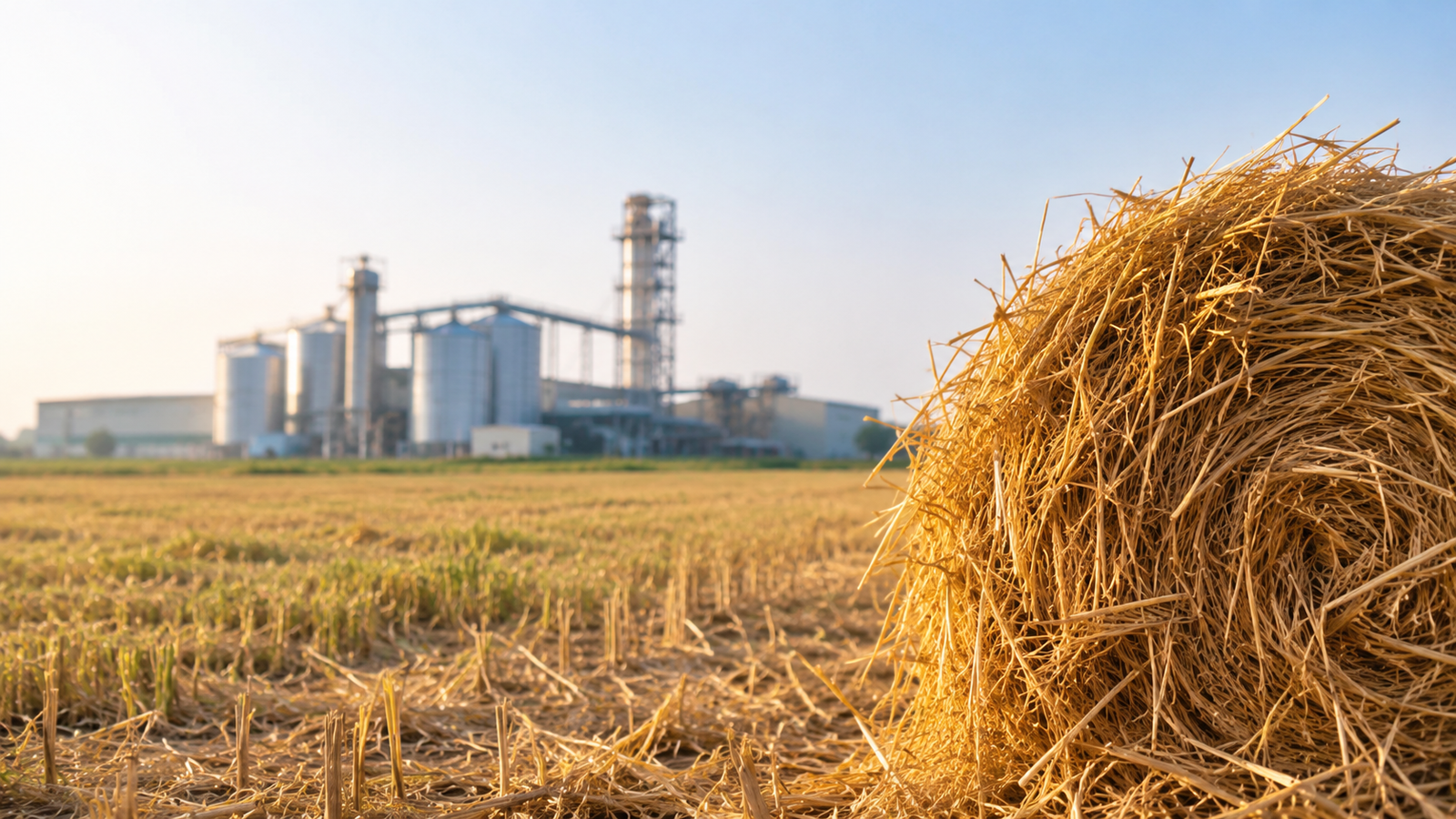
India’s ethanol programme is one of its clearest energy-security successes. Blending reached 20% (E20) five years ahead of the 2030 target, cutting the crude import bill. In October 2026, the government notified rules that let flex-fuel vehicles be certified to run on E85 and E100.
The question now is where the ethanol for anything beyond E20 will come from. Within a single month, sugar was shut out of the 2026-27 ethanol tender, maize ethanol prices were cut, distillers asked for higher prices, and analysts warned that blending could slip below 20% this year. Meanwhile, north India’s skies filled with smoke from burning paddy straw, which is the very residue that could be turned into fuel.
This article draws these threads together: the pressure on food crops, the water cost of first-generation (1G) ethanol, the true scale of stubble burning, and why second-generation (2G) ethanol is the answer to all three.
Enabling E100 Raises the Stakes
The October 2026 amendment to the Central Motor Vehicles Rules allows flex-fuel vehicles to be certified for E85 and E100. As former NITI Aayog CEO Amitabh Kant noted in the Hindustan Times on 30 October 2026, the notification “enables these fuels rather than mandating them”.
Any real uptake, though, would push demand up sharply. An E100 vehicle runs almost entirely on ethanol, and because ethanol carries less energy than petrol, it needs more fuel per kilometre than an E20 vehicle. If that demand is met from sugarcane, rice and maize, it competes directly with the land, water and grain India needs for food and animal feed.
The Margin Is Already Thin: The 2026-27 Ethanol Tender
Events since October show how little room there is.
Sugar is out, maize is cheaper
The oil marketing companies’ (OMCs) tender for Ethanol Supply Year (ESY) 2026-27 seeks about 1,100 crore litres (11 billion litres). It set sugar diversion for ethanol at zero, excluding ethanol from sugarcane juice, sugar syrup and B-heavy molasses, after weak rains raised concerns about sugar output.
The same tender cut the procurement price for maize-based ethanol by ₹3 a litre, from ₹71.86 to ₹68.86, a fall of about 4.2%. At roughly 400 litres of ethanol per tonne of maize, that is about ₹1,200 less revenue per tonne of maize processed, or ₹1.20 per kg. Weaker distillery margins could limit how much distillers can afford to pay for maize.
Offers show heavy reliance on grain
Distillers offered far more ethanol than the OMCs needed. According to a provisional compilation of first-round (C1) offers shared by industry analyst Kapil Nema, bids totalled about 1,934.5 crore litres, roughly 1.76 times the requirement:
| Feedstock | Offers (crore litres) | Share of offers |
| Maize | 1,140.4 | 59% |
| Surplus FCI rice | 457.8 | 24% |
| Damaged food grains | 239.6 | 12% |
| C-heavy molasses | 96.7 | 5% |
In the fourth quarter, when no FCI rice is offered, maize offers total about 385.8 crore litres, nearly 85% of that quarter’s offers. Karnataka (262.5 crore litres) and Uttar Pradesh (257.8 crore litres) lead the state-wise offers, followed by Madhya Pradesh (205.7 crore litres). The top five states account for about half of all offers.
The OMCs allocate volumes in ascending order of price: C-heavy molasses first, then FCI rice, then damaged food grains, and maize last. That means the stiffest competition will be among maize-based bids.
It also means rice uptake will shape maize demand. The more FCI rice distilleries actually lift and convert, the less maize they need. How much rice is really used, not just allocated, will decide how much maize the programme requires this year.
These are offers, not allocations. Final contracted volumes depend on capacity limits and feedstock rules and could be much lower. But the picture is clear: almost all of India’s ethanol for 2026-27 will come from food grain.
Distillers want higher prices
The All India Distillers’ Association (AIDA) has asked for the maize ethanol price to be raised to ₹75 per litre, against the current ₹68.86. It also sought a revision of the FCI rice ethanol price, now fixed at ₹60.32 per litre. AIDA said maize prices have risen from about ₹17–18 per kg last year to around ₹27 per kg, while the incentive has been cut. For rice-based ethanol, it pointed to rising raw material, energy, processing and logistics costs.
AIDA argues that commercially viable prices are needed to keep distilleries running, attract fresh investment and give farmers a reliable market for their produce.
Blending may slip below 20%
ChiniMandi, citing The Economic Times and Reuters on 4 November 2026, reported that blending could fall below the 20% target in 2026-27. G.K. Sood, chairman of KN Agri Resources and a food policy expert, said it could drop to around 15%, adding that food availability will take precedence
over fuel in a drought year. Four ethanol producers expect blending of 15–17%, depending largely on maize prices. The same report said:
- The monsoon was nearly 13% below normal amid a severe El Niño.
- Maize and sugar prices have risen by around 40% to record levels, and rice by about 20%.
- Retail food inflation rose to 7.74% in September 2026 from 5.97% in August.
- Industry estimates suggest maize output could fall by as much as 15% from the record 55 million tonnes.
- Higher winter maize sowing may not happen, because drought-hit farmers in several states lack the water to grow it, according to traders.
- Distillers are increasingly using damaged food grains, raising concerns about animal feed supplies, according to the Grain Ethanol Manufacturers Association.
Ethanol makers have borrowed heavily to build capacity of around 20 billion litres a year, expecting demand to keep rising. If blending falls, much of that could sit idle.
The stakes are high. According to government data cited in the same report, the programme has saved nearly ₹2 trillion in oil import costs since 2014, with annual savings of about ₹43,000 crore at the 20% blending level. E20 has also faced pushback from some motorists and automakers over fuel efficiency and possible engine wear. After these concerns, the government clarified that it has no plans to raise the blending ratio beyond 20%.
The programme’s rapid growth over the past six years was helped by a run of good monsoons. 2026 has shown how quickly that support can disappear.
Maize: Pulling Farmland Away From Pulses and Oilseeds
Maize was already India’s largest ethanol feedstock in 2024-25, supplying nearly half of all ethanol. With cane juice and B-heavy molasses excluded this year, distilleries will need even more of it.
The Economic Survey 2025-26 flagged the consequences early. It found that between FY22 and FY25, maize production grew at about 8.77% a year, while pulses output and acreage declined and oilseed area grew only modestly. It said ethanol price signals and assured offtake were favouring maize, which risks deepening India’s dependence on edible oil imports. The Survey described this as “an emerging tension between Aatmanirbharta in energy and Aatmanirbharta in food”.
Rice: Cheap Grain for Fuel, Paid for by the Food System
Rice tells a similar story. According to Amitabh Kant’s article and a Rajya Sabha reply, the Food Corporation of India (FCI) supplied about 6.35 million tonnes of rice to distilleries between June 2025 and June 2026, at nearly 40% below its acquisition cost. In effect, the food system has been subsidising ethanol.
A further 7.2 million tonnes (72 lakh tonnes) of FCI rice has been allocated for 2026-27. At roughly 450 litres of ethanol per tonne, that could produce about 324 crore litres, nearly 30% of this year’s tender requirement. Allocation doesn’t always mean use, though, and actual lifting by distilleries has often fallen short of allocations in past years. The subsidy amounts to nearly ₹45/- per litre of ethanol from FCI rice or ₹14-₹15,000 crores annually in absolute terms.
Central rice stocks in July 2026 were nearly three times the buffer norm, so this is surplus grain for now. But as Kant points out, that surplus depends on good monsoons and open-ended procurement, and 2026 has shown how quickly a monsoon can fail.
Water: The Hidden Cost of 1G Ethanol
Distilleries themselves use relatively little water. The real water footprint of 1G ethanol lies in growing the crops. The industry argues, with some merit, that some estimates overstate this by counting rainfall. Even so, much of India’s cane and distillery capacity sits in states where groundwater is already under severe stress.
Brazil is often held up as the model. Its standard petrol carries 30% ethanol, but most Brazilian sugarcane is rainfed, and much of its corn ethanol comes from a second crop sown after the soybean harvest. India’s cane, by contrast, has historically been more than 90% irrigated, and its grain ethanol draws on crops that would otherwise feed people and livestock.
Air: The Residue Problem Is Bigger Than Official Numbers Show
While the debate over food crops continues, the feedstock 2G ethanol needs most is going up in smoke every autumn.
Delhi’s air in November 2026
On 6 November 2026, Delhi’s average Air Quality Index (AQI) reached 382, in the “very poor” category, and the Commission for Air Quality Management (CAQM) imposed Stage III restrictions under the Graded Response Action Plan (GRAP) across the National Capital Region.
How much does stubble burning contribute?
A 2026 CAQM expert assessment of winter PM2.5 sources in Delhi-NCR, as reported, attributed:
| Source (winter average) | Share of PM2.5 |
| Secondary particulates | 27% |
| Transport | 23% |
| Biomass burning | 20% |
| Dust | 15% |
| Industries, including thermal power plants | 9% |
That 20% is a seasonal average, and it hides sharp spikes. The Council on Energy, Environment and Water (CEEW) has estimated that crop-residue burning can contribute as much as 40% of Delhi’s daily PM2.5 on peak burning days in late October and early November. Traffic, dust and industry don’t change much from one week to the next. Large-scale crop burning is the main emission source that jumps suddenly in exactly the weeks when Delhi’s air turns hazardous. Colder, calmer weather in those weeks makes it worse by trapping pollutants close to the ground.
Secondary particulates also form partly from gases released by burning, so some of stubble’s effect may appear under that category rather than as direct biomass smoke.
Not firecrackers: farm fires behind the post-Diwali spike
Diwali fell on 8 November this year, and firecrackers are often blamed for the post-Diwali smog. Dr Hiren Jethva, an aerosol remote-sensing scientist associated with NASA’s Goddard Space Flight Center and Morgan State University, disagrees. He said fireworks do add to pollution, but their effect is short-lived, typically under 48 hours, while farm fires remain the dominant factor, with Punjab leading by a wide margin.
The same day, 8 November, Punjab recorded 1,152 farm fires, its highest single-day count of the season.
Official fire counts are missing most of the fires
According to CAQM figures up to 8 November 2026, Punjab recorded 4,459 farm fires this season. Tarn Taran (654), Ferozepur (592), Sangrur (488), Bathinda (406) and Patiala (288) led the count.
Dr Jethva says the true number is far higher. Speaking to NDTV and on social media, he estimated around 34,000 fires across Punjab and Haryana between 1 October and 9 November 2026, which he called “a conservative estimate”. That is more than seven times the official Punjab tally, although the two figures don’t cover exactly the same area and dates. Earlier, he estimated about 27,000 fires in Punjab alone from 1 October to 5 November.
The reason is timing:
- Satellites pass at fixed times. Official counts rely mainly on the MODIS and VIIRS instruments on polar-orbiting satellites, which have traditionally passed over Punjab around 10:30 am and 1:30 pm.
- Burning has moved later in the day. A study by ISRO’s Space Applications Centre, published in Current Science in November 2025 using geostationary satellite data, found that peak burning in Punjab and Haryana shifted from about 1:30 pm in 2020 to around 5 pm in 2024. Jethva told NDTV the shift began in 2022, moving first to 2 pm, then 3 pm, and now 4–5 pm, a pattern he said can be “clearly” seen in geostationary data. Unlike polar-orbiting satellites, geostationary satellites watch the same region continuously through the day.
- Late fires burn out before the next pass. Jethva noted that fires typically last a few hours, so those lit in the late afternoon are often gone by the next morning’s satellite pass.
- An older satellite now sees more. NASA’s Aqua satellite has drifted to a later pass of around 4 pm, allowing its MODIS instrument to detect more late fires: 4,196 detections, compared with 4,089 from the VIIRS instrument on NOAA-20 around 1:30 pm. Jethva’s 34,000 figure adjusts these detections to the higher-resolution VIIRS baseline.
Other research supports the gap. A CEEW study released in October 2026 found two to five times more burnt fields in five Punjab villages using higher-resolution commercial imagery than with Sentinel-2 imagery alone. In a CEEW survey of 1,588 farmers in Haryana, 77% of those who reported burning in their villages said it happened between 4 pm and 10 pm.
This matters beyond the numbers. Jethva argues that air-quality models fed with undercounted fire data will underestimate how much crop smoke contributes to Delhi’s pollution, and that agencies relying only on the traditional NASA and NOAA fire counts are no longer seeing the full picture. CEEW has urged CAQM to add burnt-area estimates to its active-fire counts. Enforcement continues: CAQM data showed 884 FIRs, 1,017 “red entries” in land records, and environmental compensation of ₹62.55 lakh in Punjab up to 8 November. But penalties haven’t stopped the burning, because farmers still lack a paying use for the straw.
2G Ethanol Connects All Three Problems
Food, water and air look like separate problems. 2G ethanol links them:
- Food: 2G ethanol uses crop residue, bamboo and other non-food biomass, so it doesn’t take grain away from people or livestock.
- Water: residue is a by-product of crops already grown for food, so it adds no extra irrigation demand.
- Air: paying farmers for paddy straw gives them a reason not to burn it.
India already has commercial 2G plants at Panipat (rice straw), Bargarh (rice straw) and Numaligarh (bamboo), but none of them are running or producing 2G ethanol in any significant quantities. Seven years after the Pradhan Mantri JI-VAN Yojana was launched, only a handful of plants have been commissioned and even the flagship Panipat plant isn’t running at design capacity. The opportunity is clear, but the delivery has been slow. The key impediment is the non-declaration of a remunerative price for 2G ethanol produced from paddy straw, to channelise private sector investment into 2G ethanol plants. The policy mandates that the entire 2G ethanol produced from a plant setup under the PM JI-VAN Yojana has to mandatorily undertake a long-term 100% buyback contract with the Oil marketing companies and with no rates defined till date, the scheme is a non-starter.
A Roadmap for Ethanol Beyond E20
Amitabh Kant’s article sets out a clear agenda. These are his recommendations, and they reflect much of the wider policy debate:
- Cap 1G ethanol at E20. Stop expanding ethanol from sugarcane, maize and rice beyond what E20 requires. Phase out rice-based ethanol first, and link maize and cane allocations to feed availability and genuine sugar surpluses.
- Meet demand beyond E20 with 2G. Use non-food biomass such as crop residue and bamboo.
- Run 2G as a national technology mission. Use savings from phasing out subsidised rice to fund indigenous conversion technology and a paid biomass collection network.
- Give investors certainty. Guaranteed offtake at a premium price would let 2G plants be built at scale. Research institutes should also develop high-yielding, low-water energy crops for degraded land.
- Price water into procurement. Don’t allow new cane and grain distilleries in over-exploited groundwater blocks, reward lower-water feedstocks, and make drip irrigation a condition for cane supplied to distilleries.
- Make the food-fuel trade-off transparent. Budget and report any support to ethanol that flows through the food system.
- Send ethanol where it adds most value. Kant argues that electrification is the more efficient long-term path for cars and two-wheelers, and that building a parallel E100 retail network risks slowing that shift. In his view, ethanol’s stronger case lies in hybrids and, in time, as a feedstock for sustainable aviation fuel.
Not everyone will agree with every point, especially on E100 and electric vehicles. But the core principle, that growth beyond E20 must come from non-food feedstock, is hard to argue with after the events of 2026.
Conclusion
India’s ethanol programme has delivered E20 ahead of time. Going further on food crops alone now looks risky. The 2026-27 tender has excluded sugar, maize is expensive and distillers are under pressure, FCI rice is sold at a loss to the food system, and cane is heavily irrigated in water-stressed states. Blending itself may slip below 20% this year.
At the same time, millions of tonnes of paddy straw are burnt every autumn, likely far more than official fire counts show, adding to some of the worst air in the world. Turning that residue into fuel would ease pressure on food, water and air at once.
Ethanol has a legitimate place in India’s energy mix, but its growth has to respect the limits of the country’s land and water. 2G ethanol is how India can keep expanding ethanol without crossing those limits.
The capital cost for establishing a 2G ethanol plant is nearly 4 to 5 times that of a 1G plant and the consequent impact on the price of ethanol produced is an acknowledged fact even by the government. The crux is which ministry of the government is willing to bear the burden of the subvention to enable the 2G ethanol production from paddy straw.
Frequently Asked Questions
Why is ethanol beyond E20 a concern for food security?
Almost all of India’s ethanol comes from sugarcane, maize and rice. Going beyond E20, especially with E100 flex-fuel vehicles, would need much more of these crops, which compete with food, animal feed and water. The Economic Survey 2025-26 called this a tension between self-reliance in energy and self-reliance in food.
What changed in the 2026-27 ethanol tender?
The OMC tender seeks about 1,100 crore litres, excludes ethanol from sugarcane juice, sugar syrup and B-heavy molasses, and cuts the maize ethanol price from ₹71.86 to ₹68.86 per litre. First-round offers totalled about 1,934.5 crore litres, with maize making up around 59%.
Could ethanol blending fall below 20% in 2026-27?
Some industry participants and analysts expect blending to fall to around 15–17% this year, depending largely on maize prices, according to reports citing The Economic Times and Reuters. The official target remains 20%.
How much FCI rice goes to ethanol?
FCI supplied about 6.35 million tonnes of rice to distilleries between June 2025 and June 2026, at nearly 40% below its acquisition cost. Another 7.2 million tonnes has been allocated for 2026-27 costing a subsidy burden of ₹14,000 crores annually borne under the food subsidy bill.
How much does stubble burning contribute to Delhi’s pollution?
A 2026 CAQM assessment attributed about 20% of Delhi-NCR’s winter PM2.5 to biomass burning on average. On peak burning days, CEEW estimates crop-residue burning can account for up to 40% of Delhi’s daily PM2.5.
Are farm fire numbers being undercounted?
Evidence suggests so. CAQM recorded 4,459 fires in Punjab up to 8 November 2026. NASA-affiliated scientist Dr Hiren Jethva estimated around 34,000 fires in Punjab and Haryana from 1 October to 9 November, because much burning now happens in the late afternoon, after the main satellite passes.
Are Diwali firecrackers behind the post-Diwali smog?
Firecrackers add to pollution, but Dr Jethva says their effect is short-lived, usually under 48 hours. He says farm fires remain the dominant factor. On Diwali, 8 November 2026, Punjab recorded 1,152 farm fires, its highest single-day count of the season.
How can 2G ethanol help?
2G ethanol is made from non-food biomass such as paddy straw and bamboo. It doesn’t compete with food, adds no extra irrigation demand, and gives farmers a paying alternative to burning straw.
What is holding 2G ethanol back?
Only a handful of plants have been commissioned under the PM JI-VAN Yojana, non-declaration of an off take price for 2G ethanol despite mandating 100% supply to Oil Marketing companies under the policy. It is pertinent to mention here that sometime in the early 1980’s, the wheat straw residue was burnt in the fields in Punjab and Haryana and Non-wood based paper mills were encouraged and established. This led to an eco-system for near complete collection and storage of wheat straw and its commercial utilization and that is why one doesn’t hear of wheat stubble or straw burning post harvest. Experts have called for a national technology mission, a paid biomass collection system for paddy straw and guaranteed offtake at a premium price for 2G ethanol produced from the same.