

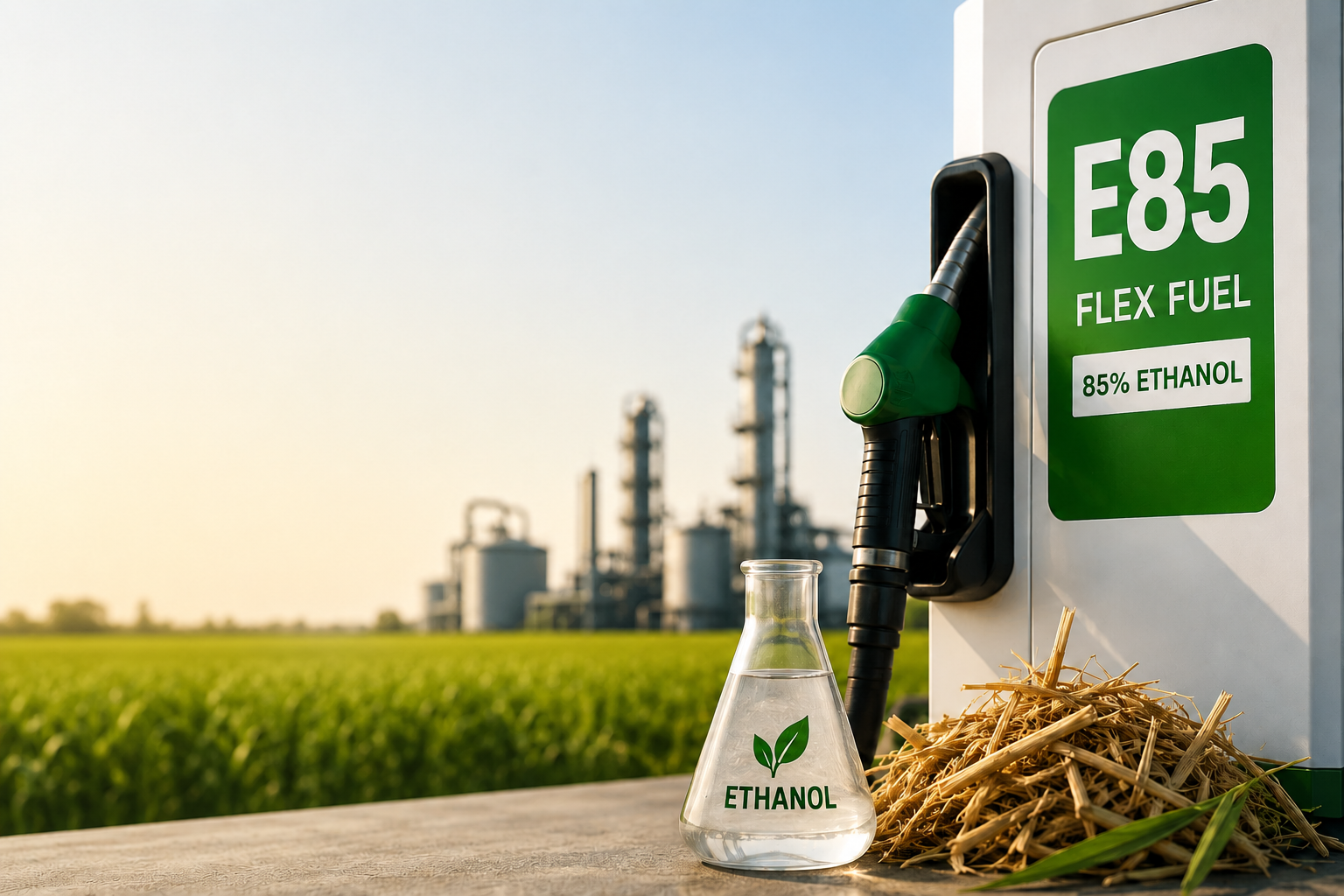
On June 5, 2026 – World Environment Day – Union Petroleum and Natural Gas Minister Hardeep Singh Puri formally launched E85 fuel at an Indian Oil retail outlet in New Delhi. The rollout began at 48 public sector fuel stations nationwide, priced at roughly ₹20 per litre below conventional petrol.
The expansion plan is aggressive:
- 500 outlets by December 2026
- 5,000 outlets by December 2027
- Estimated lift to overall ethanol blending levels of ~26% by 2030–31 as E85 infrastructure scales
E85 contains 80–85% ethanol and 14–19% petrol, usable only in flex-fuel vehicles capable of running anywhere between E20 and E100. With the launch, India is no longer talking about flex-fuels as a future scenario. It is building a retail network for them, today.
And that changes the supply-side math for ethanol in a way the country has not yet fully reckoned with.
The simple version of the story: India already built the ethanol capacity needed to hit E20. The capacity needed to genuinely deliver E85 at scale is several times larger – and cannot be built sustainably on a first-generation (1G) ethanol foundation alone.
Second-generation (2G) ethanol – made from agricultural residues like rice straw – is no longer optional. It is the only feedstock pathway with the headroom to make E85 work.
What Was Launched, And Why It Matters
Three things about the June 5 launch are worth holding on to as the context for everything that follows.
1. The price signal is deliberate, and significant
E85 is being sold at approximately ₹20 per litre below conventional petrol. That gap is not accidental. It is the government’s way of front-loading consumer demand for flex-fuel vehicles before the FFV market exists at scale. The fuel is cheaper than petrol, denominated in rupees, and produced domestically. Energy security and consumer affordability arrive in the same package.
2. The infrastructure plan is national, not symbolic
Forty-eight stations on Day One. Five hundred by year-end. Five thousand by end-2027. This is not a pilot scheme dressed up for World Environment Day. It is the start of a structural retail rollout that, by late 2027, will put E85 within reach of a meaningful share of urban India’s vehicle population.
3. The Brazil benchmark is now openly on the table
The Petroleum Minister explicitly drew the parallel to Brazil, where more than 80% of light vehicles run on flex-fuel technology. India is signalling that flex-fuels are not a niche compliance product – they are intended to become the default architecture of the country’s petrol-vehicle market over the coming decade.
Ministry estimates released alongside the launch quantify what that ambition looks like in numbers:
- If half of all new two-wheelers and passenger vehicles sold in India shift to flex-fuel technology, annual ethanol demand could rise by more than 312 crore litres (~3.12 billion L).
- That transition would generate roughly ₹12,403 crore in additional farmer income.
- It would save about ₹15,151 crore in foreign exchange annually.
- It would cut transport-sector CO₂ emissions by approximately 66.4 lakh metric tonnes per year.
- Lifecycle GHG emissions for an FFV running on E85 are estimated to be about 61% lower than a comparable conventional petrol vehicle.
These are not modest numbers. They are an explicit declaration that India is committing to flex-fuel scale. Which makes the next question the only one that matters: where will the ethanol come from?
The Demand Curve Just Got a Lot Steeper
Independent analysis is now putting hard numbers on the supply-side implications of E85.
A recent report by InCred Research projects that E85 adoption – layered on top of the existing E20 framework – will create a step-change in India’s ethanol demand profile by FY 2040:
| Year | Ethanol demand: E20-only (base case) | Ethanol demand: with E85 + FFV uptake | Incremental demand |
| FY 2026 (current) | ~13.0 billion litres | ~13.0 billion litres | – |
| FY 2030 | 15.80 billion litres | 16.04 billion litres | +0.24 bn L |
| FY 2036 (FFVs at 50% of new petrol-vehicle sales) | Higher base growth | Sharp upward divergence begins | Growing gap |
| FY 2040 | 25.74 billion litres | 29.63 billion litres | +3.89 bn L (~21% uplift) |
The headline finding: by FY 2040, E85-driven flex-fuel adoption could add 3.89 billion litres of incremental annual ethanol demand – a 21% uplift above the E20-only base case. Total demand under that scenario would rise from approximately 13 billion litres in FY 2026 to 29.63 billion litres by FY 2040.
This is more than a doubling of current demand in 14 years.
And critically, the curve is back-loaded. In the early years (through FY 2030), demand grows only modestly because FFV penetration is still under 5%. But as flex-fuel vehicles scale from ~1% of new petrol vehicles in FY 2027 to 50% by FY 2036, the incremental demand begins compounding sharply. The biggest supply-side pressure is in the second half of the decade. Which means the capacity to meet it has to be built now, not then.
It also means that a 21% demand uplift is the conservative estimate. If flex-fuel penetration moves faster – as it well might if consumer economics keep working in E85’s favour – the supply gap grows even larger. India’s E20 rollout itself was, just a few years ago, considered unrealistic. The same momentum that surprised the country into hitting E20 ahead of schedule can do exactly that with E85.
Why 1G Ethanol Cannot Carry This Load
India’s installed ethanol production capacity has scaled impressively – from 420 crore litres in 2013–14 to roughly 2,000 crore litres (20 billion litres) by late 2025. On paper, that looks comfortable: capacity already exceeds the ~1,050 crore litres needed to sustain E20.
But the headline capacity number obscures three structural truths that make scaling 1G ethanol toward E85 effectively impossible.
| Feedstock | Ceiling for E85 scaling | Why |
| Sugarcane (1G) | Constrained | Highly water-intensive (~3,630 L water per L ethanol); concentrated in already water-stressed Maharashtra, UP, Karnataka; competes with sugar exports and consumption |
| Maize (1G) | Limited | 60% of maize currently used as poultry feed; further diversion raises feed prices; rain-fed varieties still in scale-up |
| Broken / surplus rice (1G) | Already politically saturated | PDS broken-rice share already cut from 25% to 10% to free up 90 lakh tonnes for ethanol – further diversion creates food-security exposure |
| Rice straw + agri residues (2G) | Largely untapped | India generates ~160–180 million tonnes of paddy straw alone every year, much of it burned in fields. No competition with food, water, or land use |
The food-fuel pressure is already at the limit
In March 2026, the Centre cut the share of broken rice in Public Distribution System allocations from 25% to 10% – redirecting roughly 90 lakh tonnes (9 million MT) of rice annually from the PDS to ethanol distilleries. That moved a substantial volume of food-grade grain into the fuel system. Scaling 1G ethanol further to meet E85 demand would mean either deeper rice diversion, larger sugarcane planting on already water-stressed land, or more maize diversion away from poultry feed. Each pathway exports the problem somewhere else.
The water footprint is incompatible with India’s hydrology
Government data shared by the Food Secretary itself indicates that producing one litre of ethanol uses approximately 10,790 litres of water from rice, ~4,670 litres from maize, and ~3,630 litres from sugarcane (cultivation plus processing). NITI Aayog’s Composite Water Management Index has warned that 21 major Indian cities face critical groundwater depletion by 2030. Multiplying 1G ethanol output by 2x or 3x to meet E85 demand means multiplying that water draw at the same pace – much of it in states where the groundwater is already stressed.
The 1G capacity story is plateauing
Even with another 400 crore litres of 1G capacity expected to come online by FY27, the gap to 30 billion litres of demand by FY 2040 remains very wide. And every incremental tonne of sugarcane or maize required becomes harder to source as competing demands – sugar exports, ethanol pricing, livestock feed, food inflation – bid against each other.
The conclusion is unavoidable: if India tries to deliver E85 at scale on 1G feedstock alone, it will run into food, water, and feedstock walls long before it reaches the InCred-projected demand curve.
Why 2G Ethanol Is the Only Pathway With Real Headroom
Second-generation ethanol changes the supply-side equation because it changes the feedstock category entirely.
2G ethanol is produced from lignocellulosic biomass – primarily agricultural residues like rice straw, wheat straw, and sugarcane bagasse. These are materials that:
- Are already being generated as a byproduct of food agriculture (the food has already been harvested before the residue exists)
- Are largely burned, dumped, or left to decay today – particularly rice straw in Punjab and Haryana, which is the single largest contributor to North India’s winter air pollution
- Do not require additional water, land, or fertiliser inputs – the crop was grown for food, not for fuel
- Are produced at vast scale: India generates roughly 160–180 million tonnes of paddy straw alone every year, alongside large volumes of wheat straw, bagasse, corn stover, and cotton stalks
On a sheer feedstock-availability basis, 2G ethanol has the headroom to absorb most of the incremental demand E85 will create – without competing with food, water, or land use.
It also delivers a structurally cleaner carbon profile. The 61% lifecycle GHG reduction figure cited by the Petroleum Ministry for E85 understates what is possible when the ethanol is 2G: residues that would have been burned (releasing CO₂ anyway) or decayed (releasing methane) are instead converted into transport fuel. The avoided emissions and the substitution emissions stack.
And critically, 2G ethanol is feedstock-resilient. Agricultural residues are generated whether sugar prices spike, monsoons disappoint, or maize markets tighten. For a country trying to commit to a multi-decade flex-fuel transition, that resilience matters as much as the volume.
The Policy and Investment Gap
If 2G ethanol is the supply-side answer, the obvious question is: why hasn’t it scaled already?
Three reasons, all addressable:
- Capital intensity. A 2G ethanol plant typically costs significantly more per kilolitre of installed capacity than a 1G plant. Without policy support that explicitly reflects the externalities 2G saves (water, food, air quality), the investment math has historically lagged.
- Biomass logistics. Rice straw and other residues are bulky, seasonal, and dispersed. Aggregating them at refinery scale requires biomass collection networks, storage infrastructure, and farmer-aggregator partnerships that take years to mature.
- Technology maturity. Earlier 2G installations in India have struggled to operate at design capacity, creating investor caution. What is needed is proven, commercially validated technology platforms – including the ability to extract additional value from lignin and silica co-products to improve unit economics.
The good news is that all three constraints are now being directly addressed:
- PM JI-VAN Yojana continues to fund commercial 2G biorefinery development on lignocellulosic feedstocks.
- The National Policy on Biofuels (2018, amended 2022) explicitly recognises 2G ethanol as an “advanced biofuel” with higher pricing support.
- Long-Term Offtake Agreements (LTOAs) with oil marketing companies are providing the demand-side certainty needed to underwrite 2G investments.
What is now needed is execution velocity – building 2G capacity at the same pace the E85 retail network is being built. Anything less, and the country will arrive at 5,000 E85 stations in December 2027 without the ethanol to sustainably fill them.
Where Khaitan Bio Energy Fits In
The case for 2G ethanol becomes meaningful only when the technology to produce it works economically and reliably at commercial scale. That has been the persistent gap in India’s biofuel ecosystem – and it is the gap [Khaitan Bio Energy](https://khaitanbioenergy.com/) was built to close.
The company’s patented 2G ethanol technology – developed over many years by Mr Rohit Khaitan and validated through a BIRAC-supported pilot under the “Cellulosic Ethanol Pilot Plant for Rice Straw Management” project – establishes a commercially viable cellulose-to-sugars-to-ethanol pathway.
Three credentials are directly relevant to the E85 supply challenge:
- The technology is certified at Technology Readiness Level 8 (TRL-8) by the Department of Biotechnology, Government of India – meaning commercial deployment readiness, not laboratory stage.
- It has been successfully evaluated by the Centre for High Technology, Ministry of Petroleum and Natural Gas.
- It is one of the rare 2G platforms that fully valorises every component of lignocellulosic biomass – producing not only 2G ethanol, but also high-purity precipitated silica and gypsum as co-products. This breakthrough in lignin valorisation transforms 2G unit economics from marginal to competitive, addressing the historic capital-intensity problem at the unit-economics level.
For an India where 5,000 retail outlets will soon be dispensing E85, and where InCred projects ethanol demand more than doubling by 2040, this kind of platform is precisely the supply-side bridge the transition needs.
The Road Ahead
The June 5, 2026 launch of E85 is one of the most consequential moments in India’s energy transition. Forty-eight retail outlets today. Five thousand by 2027. Twenty-one per cent additional ethanol demand by 2040. A ₹20-per-litre price advantage that will pull consumer adoption forward. The Brazil benchmark, openly on the table.
On the demand side, the architecture is being built – at speed, with political will, and with consumer economics aligned.
On the supply side, the country has a choice. India can try to meet that demand by leaning harder on sugarcane, maize, and rice – trading its oil-import problem for food and water problems it is far less equipped to solve. Or it can scale 2G ethanol at the pace E85 is being rolled out – turning the rice straw that is currently burning in fields into the fuel that powers the next decade of Indian mobility.
Both pathways arrive at the same numerical destination. Only one of them is sustainable.
E85 is the demand signal India has been waiting for. 2G ethanol is the supply answer the country can no longer afford to delay.
Frequently Asked Questions
Q1. What is E85 fuel and where is it available in India?
E85 is petrol blended with 80–85% ethanol and 14–19% petrol, usable only in flex-fuel vehicles (FFVs) capable of operating on blends from E20 to E100. India launched E85 on June 5, 2026 at 48 public sector fuel stations nationwide, priced approximately ₹20 per litre below conventional petrol. The government plans to expand availability to 500 outlets by December 2026 and 5,000 outlets by December 2027.
Q2. How will the E85 launch affect India’s total ethanol demand?
Significantly. According to a recent InCred Research projection, E85 adoption layered on top of the E20 framework would increase total ethanol demand from approximately 13 billion litres in FY 2026 to 29.63 billion litres by FY 2040 – a 21% uplift above the E20-only base case, or 3.89 billion litres of incremental annual demand. The biggest demand growth is expected after FY 2036 as flex-fuel vehicle penetration scales toward 50% of new petrol vehicle sales.
Q3. Can India produce enough ethanol for E85 using only 1G ethanol (sugarcane, maize, rice)?
Not sustainably. India’s current ethanol production capacity (~2,000 crore litres) is sufficient for E20, but scaling toward 30 billion litres by 2040 on 1G feedstocks alone runs into structural ceilings – sugarcane’s water footprint, the food-vs-fuel pressure on rice (already diverting 90 lakh tonnes annually from the PDS), and maize’s existing role in poultry feed. 2G ethanol from agricultural residues is the only pathway with the feedstock headroom to meet incremental E85 demand without enlarging food, water, or land-use conflicts.
Q4. What is 2G ethanol and how is it different from 1G?
Second-generation (2G) ethanol is produced from lignocellulosic biomass – agricultural residues like rice straw, wheat straw, and sugarcane bagasse. Unlike 1G ethanol (made from food crops such as sugarcane juice, maize, or rice), 2G ethanol uses materials that are already a byproduct of food agriculture. The grain still goes to the kitchen; the stubble that would otherwise be burned goes to the fuel tank. No incremental water is consumed, and no food is diverted.
Q5. Why is E85 priced ₹20 per litre cheaper than petrol?
Two reasons. First, ethanol is produced domestically, so it avoids the import cost of crude oil. Second, the price differential is a deliberate policy signal designed to accelerate consumer adoption of flex-fuel vehicles before the FFV market exists at scale. The Petroleum Ministry has indicated that domestic fuel prices have seen among the lowest increases globally since February 2026, with ethanol blending playing a meaningful role in that stability.
Q6. How much will E85 reduce greenhouse gas emissions?
Ministry estimates indicate flex-fuel vehicles running on E85 can reduce lifecycle greenhouse gas emissions by approximately 61% compared with conventional petrol vehicles. When the underlying ethanol is 2G (produced from rice straw or other agricultural residues), the lifecycle savings are deeper still – because residues that would otherwise have been burned or decayed are converted into fuel, stacking avoided emissions with substitution emissions.
Q7. What is Khaitan Bio Energy’s role in India’s E85 transition?
Khaitan Bio Energy holds patents for a 2G ethanol production technology certified at TRL-8 by the Department of Biotechnology and selected for commercial biorefinery development under the PM JI-VAN Yojana. The technology converts rice straw and other lignocellulosic biomass into ethanol, alongside high-value co-products like high-purity precipitated silica and gypsum – addressing the historic unit-economics challenge of 2G ethanol. For an India scaling toward 5,000 E85 retail outlets and 30 billion litres of ethanol demand by 2040, this kind of platform is exactly the supply-side bridge the transition will rely on.